Ralph Cheever Dunning
A Moveable FeastRalph Cheever Dunning is a poet whose dependence on opium brings him close to death and turns a well-meant act of assistance into an encounter the narrator cannot explain. Ezra Pound tries to help him, first by arranging medical care and later by entrusting the narrator with a jar of opium for use in a true emergency. When Dunning finally receives it, he throws it back. The incident leaves his motives opaque: the narrative records his precarious condition and sharp anger, but offers no decisive account of what he wanted or why he rejected the help.
Identity and Physical Condition
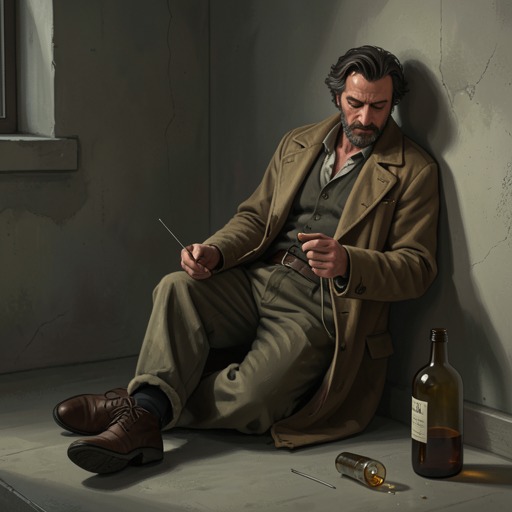
Dunning is identified as a poet who smokes opium and forgets to eat. When he smokes too much, he can only drink milk; his poetry, written in terza riruce, is one of the qualities that endears him to Ezra Pound. The account thus places artistic regard beside bodily deterioration. Dunning’s poetry matters to Ezra, but it does not protect its maker from the consequences of his habits.
The narrator first sees the severity of that deterioration when Ezra sends an urgent message that Dunning is dying. Dunning lies on a mattress looking like a skeleton. The narrator believes he would eventually die of malnutrition, and the prospect becomes serious enough that Ezra calls for help. Yet the scene is narrated with a comic edge: the narrator jokes that people do not die while speaking in well-rounded phrases or in terza riruce, while Ezra disputes the description of Dunning’s speech. The humor does not cancel the danger; it shows how the narrator approaches a frightening situation through skeptical wit.
Ezra Pound’s Efforts to Help
Dunning lives in the same courtyard as Ezra Pound’s studio. Ezra’s concern becomes practical when Dunning’s condition worsens: after a night spent waiting for death, the matter is put in a physician’s hands, and Dunning is taken to a private clinic to be disintoxicated. Ezra guarantees the bills and gathers help from people who care about poetry. The narrative presents this intervention as a collective effort, though it does not name the other supporters or say how long Dunning remains at the clinic.
Before leaving Paris for Rapallo, Ezra gives the narrator a further responsibility: keep a large cold-cream jar of opium and give it to Dunning only when he needs it. The substance inside is dark, sticky, and strongly raw-smelling. Ezra says he bought it from an Indian chief on the avenue de l’Opéra, near the Boulevard des Italiens, and that it was expensive. The narrator suspects it may have come from the Hole in the Wall, a narrow red-fronted bar on the rue des Italiens associated with deserters and drug peddlers during and after World War I. That origin remains speculation, not established fact. The jar’s uncertain provenance mirrors the uncertainty of the charge itself: the narrator must decide what counts as a genuine emergency.
The Roof and the Jar
The decision arrives on a Sunday morning, while the narrator is at the sawmill yard studying the racing form. Ezra’s concierge calls up that Dunning has climbed onto the studio roof and categorically refuses to come down. The narrator accepts this as a valid emergency, retrieves the jar, and walks with the concierge to Dunning’s building. The concierge is small, intense, and excited by the situation; her urgency contrasts with the narrator’s role as the person carrying a substance whose use Ezra had made conditional.
The narrator climbs the outside stairway and knocks. Dunning opens the door, gaunt and seeming unusually tall. The narrator explains that Ezra has sent the jar and that Dunning will know what it is. Dunning takes it, looks at it, and throws it back. It hits the narrator on the chest or shoulder and rolls down the stairs. He curses the narrator. The delivery therefore fails in a concrete, physical way: the jar reaches Dunning, but he refuses it, and the narrator is left facing anger rather than the emergency he had imagined he could resolve.
Aftermath and Uncertainty
The account does not settle why Dunning rejects the jar. The narrator later wonders whether Dunning had remembered the narrator’s earlier skepticism during the night of his first apparent crisis, or whether he simply disliked the narrator. He also considers that Dunning might have mistaken him for an agent of evil or the police. These remain possibilities, not explanations confirmed by Dunning. The lack of a clear motive is central to the episode: the narrator can describe the act and its impact, but cannot claim access to the thought behind it.
The jar is cracked. The narrator wraps it in waxed paper and ties it inside an old riding boot, where it remains for years. When the narrator and Evan Shipman later remove personal effects from the apartment, the boots are still there but the jar is gone. Its disappearance receives no explanation, just as Dunning’s rejection does not. Meanwhile, Ezra’s poetry-loving supporters rally to Dunning’s aid again eventually, underscoring that the narrator’s failed intervention is not the end of the effort to help him.
Narrative Role
Dunning is seen through episodes of crisis rather than through a sustained account of his life. His body, his poetry, the milk he drinks, the rooftop, and the jar are the particular facts by which the narrative makes him present. Even his speech is filtered through the narrator’s joke about poetic form, while the concierge’s report of the rooftop scene later gives Evan Shipman a phrase he finds symbolic. The narrator declines to settle on that symbolism. Dunning remains more than an emblem of addiction or a puzzle for others to interpret: the account preserves the possibility that his actions had a reason while admitting that the reason is unknown.
That unresolved quality also complicates the story of Ezra’s kindness. Ezra organizes medical care, guarantees expenses, and entrusts the narrator with a costly jar for Dunning’s use; none of these actions ensures that Dunning will accept what is offered. The episode’s final emphasis is not on a recovered explanation but on the limits of certainty. The narrator remembers both the violence of the thrown jar and Ezra’s effort to be kind, while allowing Dunning’s motive to remain a mystery.