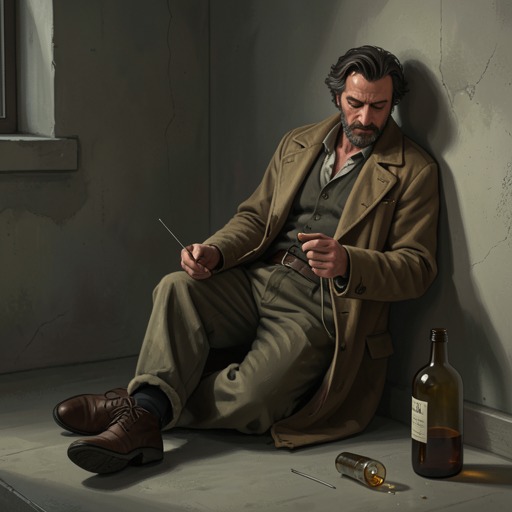
Ralph Cheever Dunning's Opium Dependence
A Moveable FeastRalph Cheever Dunning’s opium dependence is presented through a stark contradiction: Ezra Pound tries to save the poet from a condition bound up with his drug use, yet also entrusts the narrator with opium for a possible emergency. Dunning’s hunger and physical collapse make the danger concrete; the rejected jar, the milk bottles thrown after it, and the jar’s eventual disappearance keep the intervention from resolving into a simple story of rescue or refusal.
Identity and Circumstances
Dunning is identified as a poet who smoked opium and forgot to eat. When he was smoking too much, he could drink only milk. The account links his dependence to an immediate physical vulnerability: neglect of food had become so serious that the narrator describes him as dying from malnutrition. His poetry is part of this portrait, not a separate biographical detail. He wrote in terza riruce, a quality that endeared him to Ezra Pound, who also found merit in his work.
Dunning lived in the same courtyard as Pound’s studio. That proximity made his deteriorating condition visible to Pound and brought the narrator into the episode as an intermediary. A few weeks before Pound was due to leave Paris for Rapallo, Pound summoned the narrator because Dunning was believed to be dying. The account therefore places the crisis within a small, overlapping circle: a poet in danger, a fellow poet trying to help him, and a narrator asked to judge what help might mean.
Collapse and Medical Intervention
When the narrator arrived, Dunning lay on a mattress looking like a skeleton. The narrator believed that he would eventually die if he continued to be deprived of food. Rather than treating death as inevitable, however, he answered Pound’s alarm with a grimly comic argument about speech: he doubted that anyone could die while speaking in well-rounded phrases, or while speaking in terza riruce, and even questioned whether Dante could manage it. Pound objected that he was not speaking in that form. The exchange delays the solemnity of the scene without making Dunning’s condition less grave.
After a night spent waiting for Dunning to die, the decision was handed to a physician. Dunning was taken to a private clinic to be disintoxicated. Pound guaranteed the bills and enlisted the assistance of poetry lovers on Dunning’s behalf, although the narrator did not know which of them helped. This effort matters alongside the later opium delivery: Pound’s care was not limited to supplying the drug. At the same time, the account does not say how long the clinic treatment lasted or whether it brought lasting recovery.
The Jar and the Failed Delivery
Before leaving for Rapallo, Pound gave the narrator a large cold-cream jar and instructed him to give it to Dunning only when Dunning needed it. Inside was a dark, sticky substance with the smell of very raw opium. Pound said he had bought it from an Indian chief near the avenue de l’Opéra and the Boulevard des Italiens, and that it had been expensive. The narrator suspected that it came from the Hole in the Wall, a narrow bar on the rue des Italiens associated with deserters and drug peddlers during and after World War I. Its imagined route through the city’s sewers toward the catacombs gives the jar a shadowy history, but that provenance remains the narrator’s conjecture rather than a confirmed fact.
The narrator understood the jar as a sacred charge from Pound and hoped to know when a genuine emergency had arrived. That test came on a Sunday morning when Pound’s concierge called up from the courtyard to say that Dunning had climbed onto the studio roof and categorically refused to come down. The narrator judged this to qualify, retrieved the jar, and went with the excited concierge. Dunning had apparently come down by the time the narrator reached his place: he opened the door, gaunt and seeming unusually tall. The narrator handed him the jar and explained that Pound had sent it, expecting Dunning to recognize its contents.
Dunning looked at the jar and threw it back. It struck the narrator on the chest or shoulder and rolled down the stairs. Dunning then swore at him, and, after the narrator repeated that Pound thought he might need it, threw a milk bottle as well. The narrator’s intervention failed; the account does not establish whether Dunning rejected the jar because he resented the narrator, remembered their earlier exchange, or had some other reason. The milk bottle makes his dependence visible through the very object that had sustained him when he could not drink anything else, but the narrative does not claim to know what the gesture meant to Dunning.
Aftermath and Narrative Uncertainty
Pound’s circle of poetry lovers eventually rallied to help Dunning again. The narrator’s own attempt and the concierge’s presence had not succeeded. He stored the cracked jar wrapped in waxed paper and tied inside an old riding boot. Years later, while he and Evan Shipman removed the narrator’s belongings from the apartment, the boots remained but the jar was gone. Its disappearance supplies no answer about who took it, whether it had contained what Pound said it did, or what ultimately happened to Dunning.
The narrator looks back without converting the episode into a clinical explanation. He wonders whether Dunning took him for an agent of evil or of the police, but offers that only as a possibility; he also cannot say why Dunning threw the milk bottles. He remembers, instead, the concierge’s report about the roof and Dunning’s refusal to descend, a phrase Shipman considered symbolic. The narrator declines to settle on a symbol, while Shipman argues that some mystery should remain. In this telling, Dunning’s dependence is unmistakably dangerous, but the failed delivery and missing jar resist a tidy moral: care, control, need, and refusal meet in the same object, and the account leaves their final meaning open.