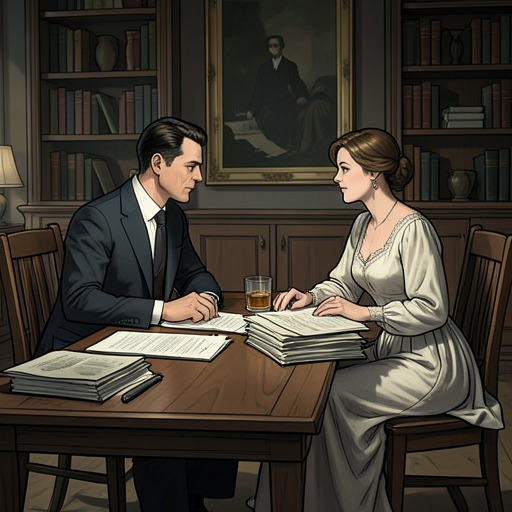
Scott and Zelda Fitzgerald's Marital Conflict
A Moveable FeastScott and Zelda Fitzgerald's Marital Conflict emerges as a repeating contest between Scott’s resolve to work and Zelda’s boredom with the life that resolve demands. In Ernest Hemingway’s account, parties, drinking, and jealousy repeatedly pull Scott away from writing; their quarrels subside into renewed closeness, only for the pattern to begin again. The conflict is not presented as simple estrangement: Scott remains deeply in love with Zelda, and both spouses are described as jealous of the other. Its decisive consequence is the erosion of Scott’s working time.
Identity and Setting
The conflict comes into focus at a lunch in the furnished flat Scott and Zelda had rented at 14 rue Tilsitt. Hemingway remembers the rooms as gloomy and airless, with little that seemed to belong to the couple apart from Scott’s early books, bound in light blue leather with gold titles. Scott also showed Hemingway and Hadley Richardson a ledger recording his stories, prices, film sales, book sales, and royalties. Its orderly accounts stood out against the strained domestic atmosphere: Scott presented the figures with pride, while the flat offered no view.
Zelda arrived after a night on Montmartre and was suffering from a hangover. The previous evening, Scott had wanted not to get drunk, explaining that he had decided to work hard and abstain. Zelda treated that decision as evidence that he was a killjoy or spoilsport, and the disagreement led to recriminations. At lunch she was formally pleasant to Hadley and Hemingway, but Hemingway felt that her attention remained partly with the party she had just left. He also understood that she was jealous of the apparently enjoyable time Scott and Hemingway had spent together on their journey from Lyon.
The Repeating Conflict
Hemingway describes a pattern that became familiar as the two couples grew better acquainted. Scott would resolve to stop attending all-night drinking parties, exercise every day, and work regularly. Once he was working well, Zelda would complain that she was bored and draw him into another drinking party. The couple would quarrel and then make up. Scott would take long walks with Hemingway to sweat out the alcohol and renew his determination to work; after a promising start, the cycle would recur.
The cycle was sustained by more than one source of jealousy. Zelda resented Scott’s work, which Hemingway portrays as her strongest jealousy. She said that the people pursuing her did not interest her and that she had nothing to do with them, but their attention amused her and made Scott jealous. He then felt he had to accompany her to the places she wanted to go. Hemingway connects this pattern directly to the damage to Scott’s work: even when Scott tried to protect time for writing, their social life and conflict repeatedly displaced it.
Mutual Attachment and Jealousy
Scott’s jealousy had an earlier history. During their walks, he told Hemingway many times that Zelda had fallen in love with a French naval pilot. Hemingway adds that, since then, she had not made Scott truly jealous with another man. In the spring described here, however, Scott was becoming jealous of her in connection with other women. The account thus distinguishes an earlier episode from the present tension rather than treating jealousy as a single, unchanged grievance.
Their attachment also appears in the way Hemingway describes their parties and drinking. Previously, Scott and Zelda could drink until they became unconscious and be taken home by friends or, at times, a taxi driver. Hemingway presents this as a defense they had relied on: they would fall asleep before consuming enough alcohol to damage their bodies. By this spring, that pattern no longer protected them. Zelda could drink more than Scott, and he worried about her becoming unconscious among the people and in the places they frequented. He disliked those settings, but drank beyond the point at which he could remain in control in order to endure them. Eventually, he drank to stay awake after he would ordinarily have fallen asleep.
Consequences for Scott’s Work
The conflict’s effect is measured in lost and fragmented work. After Hemingway urged Scott to write the best story he could as directly as possible, Scott said he would. Yet Hemingway judged that, under the circumstances, Scott was lucky to get any work done. Through late spring and early summer, Scott fought to work but managed only in snatches. He remained cheerful and companionable, sometimes desperately so; when he was in severe difficulty, Hemingway listened and encouraged him to hold on to himself and his capacity to write.
One story survived the disruption: Scott wrote The Rich Boy. Hemingway considered it a good story, while believing Scott capable of writing better. The distinction preserves both the reality of his achievement and the larger cost of the marital pattern: a successful work appeared, but not the sustained concentration Scott had hoped to recover.
Later Deterioration and Narrative Significance
The account continues beyond the spring’s recurring parties. During the summer Hemingway was in Spain, where he began a novel and completed its first draft in Paris in September; Scott and Zelda had been at Cap d’Antibes. When Hemingway saw Scott in Paris that fall, he found him changed. Scott had not sobered up on the Riviera and was now drinking during the day as well as at night. He came to Hemingway’s address on Rue Notre-Dame-des-Champs whenever he was drunk, and had become rude to people he considered beneath him. This later decline follows the spring of interrupted work, though the account does not make the marriage conflict its sole cause.
The narrative’s force comes from recurrence rather than a single decisive quarrel. Each attempt at discipline is followed by renewed social pressure, jealousy, drinking, reconciliation, and another attempt to begin again. Hemingway’s account gives Scott’s writing a central place in the conflict while also recording the mutual attachment that keeps the couple bound to one another. The result is a marriage portrayed as both intimate and destabilizing: reconciliation restores the relationship, but does not break the pattern that repeatedly takes Scott away from work.