Seine
A Moveable FeastIn Ernest Hemingway’s recollections of Paris, the Seine is not merely a landmark but a practical, living part of the city: a route through its neighborhoods, a source of food and work, and a refuge for walking, reading, and thought. Its banks hold both ordinary economies and scenes of beauty, while the river’s movement and seasonal changes shape the narrator’s sense of the city and of time.
Routes and the River’s Edge
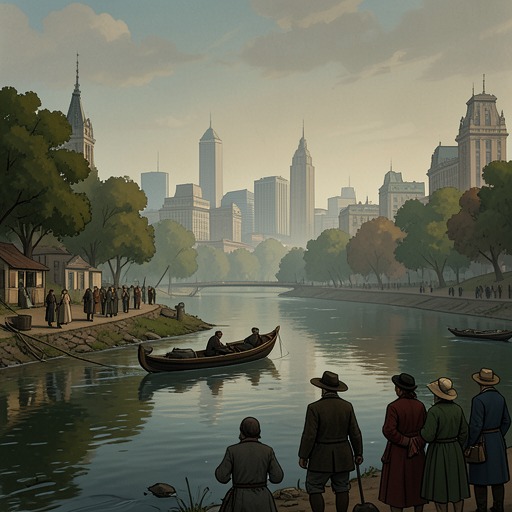
From the top of Rue Cardinal Lemoine, the shortest way down to the Seine was steep. It crossed the traffic at the beginning of Boulevard Saint-Germain and emerged beside the Halle aux Vins, a tax-bonded wine warehouse whose bleak exterior resembled a military depot or prison camp. The river offered a different view across the water: Île Saint-Louis, with its narrow streets and tall old houses. Walking along the quais brought Notre-Dame and Île de la Cité into view as well. The contrast between the cheerless warehouse and the islands’ architecture made the river crossing feel like a passage between distinct parts of the city.
The quais also had a small, informal book trade. Their stalls sometimes sold newly published American books cheaply. Near the Tour d’Argent, rooms above the restaurant were rented to residents at a discount for meals there; books left behind by former tenants could then reach a nearby stall. Its proprietress paid little for books in English, which she did not trust, and sold them quickly for a small profit. The riverfront thus linked daily reading to the movement of residents, possessions, and money through the city.
Fishing, Food, and Work
When Ernest Hemingway had finished work or needed to think, he walked beside the river. At the point of Île de la Cité below Pont Neuf, near the statue of Henri IV, a small park descended by steps to the water. The currents and backwaters formed fishing spots beneath spreading chestnut trees and under the bridge. Those spots changed with the river’s height. Fishermen adjusted with long jointed cane poles, fine leaders, light tackle, quill floats, and carefully baited patches of water.
The fishing was more substantial than travel writers suggested. The men regularly caught fish, often goujon, which could be fried whole and eaten bones and all. The narrator relished their plump, sweet flesh and fine flavor. Goujon could be eaten at an open-air restaurant over the river at Bas Meudon, or closer to home as friture on Île Saint-Louis. The river’s food was not an abstract picturesque detail: it reached the table as a specific, affordable meal.
Hemingway knew several fishermen working the productive stretch between Île Saint-Louis and Place du Verte Galente. On a bright day, he might buy a liter of wine, bread, and sausage, sit in the sun with a book, and watch them fish. Many were men living on small pensions, whose value would later be eroded by inflation; others fished during a day or half-day away from their jobs. Fishing was more productive at Charenton, where the Marne entered the Seine, and at other points beyond the city, but the Paris river itself provided serious sport and fish to take home to families.
He did not fish himself. He lacked the tackle and preferred to save his money for fishing in Spain. His uncertain work schedule also made it unwise to become attached to an activity with good and slack periods. Watching from the bank let him follow the fishermen closely without taking on their commitment. Their steady presence made him happy: the river sustained work and domestic life even within the city.
A Place to Think and Write
Walking gave Hemingway a way to think while observing people engaged in work they understood. The river supplied an unfolding scene rather than a fixed view: fishermen tending their lines, barges carrying their own life aboard, and tugs whose smokestacks folded back to pass beneath bridges while they pulled trains of barges. Great elms lined the stone banks; plane trees and, in places, poplars extended the green corridor. With this activity around him, he could not feel lonely beside the water.
The river also entered the rhythm of his writing. On a walk home from a meal, his route went up Rue Bonaparte, through Guynemer and Rue d’Assas, and along Rue Notre-Dame-des-Champs to Closerie des Lilas. There, in afternoon light, he wrote in a notebook beside a river pool where he could see trout and the water swell smoothly against the bridge’s log-driven piles. The story he was beginning concerned a return from war but did not mention the war. The river’s visible movement became the immediate material of a working scene: he could leave the café reluctant to turn away from it, yet knew he would return to the work the next morning.
The Seine also appears in a remembered walk with Hadley Richardson and Chink. After coming through the Louvre gateway and crossing the street, the three stood on a bridge, leaning on its stone and looking down at the water. Their recollection centers on conversations about making things true in writing, and on the shared details they remembered from their trip. The river is part of this remembered setting, a place where their companionship and artistic arguments can be recalled together.
Seasons, Poverty, and Memory
The riverbanks changed with the seasons. Spring could be watched arriving among the city’s trees day by day, until a night of warm wind seemed to bring it suddenly. Heavy cold rains could drive it back, making the season appear lost. Autumn’s bare branches and wintry light brought an expected sadness, but the apparent failure of spring felt more disturbing: the return of life seemed threatened for no reason. The river’s flow offered a counter-image of endurance, since it would run again even after freezing.
The river was also close to the material limits of the couple’s Paris life. A public bathhouse stood at the foot of their street by the water. When money was short, such access mattered alongside meals, warmth, and the cost of daily living. Yet the Seine’s importance in these recollections exceeds its practical uses. Its fishermen, boats, trees, changing currents, and walkable banks made the city available to the narrator as a place of attention and continued discovery. It could hold poverty without reducing life to deprivation, and offer both a subject for work and a way of returning to the world outside it.