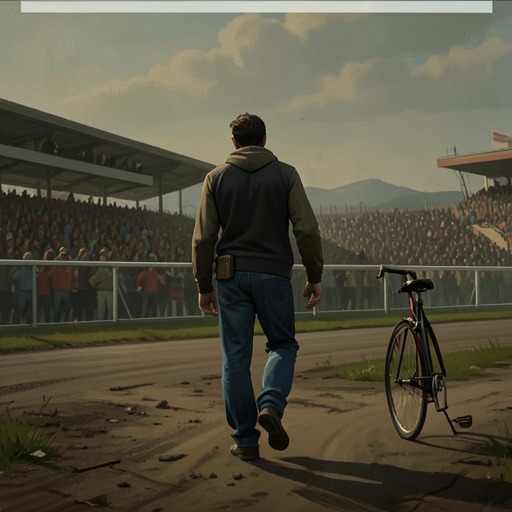
Stade Buffalo
A Moveable FeastStade Buffalo was an outdoor stadium at Montrouge whose 500-meter wooden bowl hosted 100-kilometer cycle races behind large motorcycles. In the memoir, its sharply banked track stands for the danger, physical effort, and spectacle of bicycle racing—and for a world the narrator hoped to make vivid in writing.
Setting and Track
The stadium’s defining feature was its big banked wooden track, a 500-meter bowl built for racing at sustained speed. Its open-air setting distinguished it from the indoor Vélodrome d’Hiver, where smoky afternoon light fell across another high-banked wooden track. These were not interchangeable venues: the memoir identifies Stade Buffalo specifically with the 100-kilometer races and evokes the particular scale and danger of that event.
Racing at Stade Buffalo
The races at Stade Buffalo were described as both beautiful and terribly dangerous. Riders covered 100 kilometers behind big motorcycles, whose presence shaped the pace and conditions of the contest. The memoir places this event among several forms of cycling competition, including short sprints decided through heats or match races, two-hour team programs, and solitary attempts to sustain speed against the clock. That variety gives the Buffalo races a distinct character: they were not brief contests of acceleration but long, exposed tests of speed and endurance on the banked course.
Place in the Memoir
Stade Buffalo belongs to the narrator’s larger recollection of cycling as a world of specialized tracks, tactics, machines, and bodily risk. He imagines capturing the sport’s sounds and movement in prose, while acknowledging that its racing vocabulary and conventions are difficult to render in English. The stadium thus marks both a real sporting setting and a challenge of representation: its races remain compelling in memory, even as the narrator considers how hard it is to write them as well as they deserve.