Walther Lent
A Moveable FeastWalther Lent was a pioneer high-mountain skier and the founder of an Alpine skiing school in Schruns, where he taught Ernest Hemingway and Hadley Richardson to leave practice slopes behind and travel into the mountains. His approach joined technical instruction to a demanding ideal of skiing: climbing under one’s own power, reaching isolated high country, and crossing passes and glaciers. The account also records the limits of that ideal. During a winter of unusually dangerous avalanche conditions, Lent warned a party of visiting Germans not to come; after they arrived and insisted on skiing, he led them onto what he judged the safest slope, where an avalanche killed nine people. His recollection is consequently both a portrait of a teacher and a record of mountain knowledge tested by disaster.
Identity and Alpine School
Lent was a pioneer of high-mountain skiing who had once partnered with Hannes Schneider, the renowned Arlberg skier, in making ski waxes suited to climbing and different snow conditions. When Hemingway and Hadley were living in Schruns, Lent was starting a school for Alpine skiing, and both enrolled. The school stood in a place where skiing still required strenuous access: there were no lifts or funiculars from Schruns, and the routes into the high mountains followed logging and cattle trails. Skiers climbed on seal skins attached to the bottoms of their skis, and reached summer Alpine Club huts by carrying their equipment and supplies uphill.
Lent’s school was shaped by the practical costs of this kind of travel. Skiers had to climb whatever they descended, and there were no ski patrols to provide help after an accident. In Hemingway’s account, the fear of a broken leg was not abstract: people could not afford such an injury. Lent therefore taught students to consider the consequences of falls and equipment failure, not simply how to descend a slope. The school’s method placed physical preparation and judgment at the center of learning.
Teaching and Mountain Practice
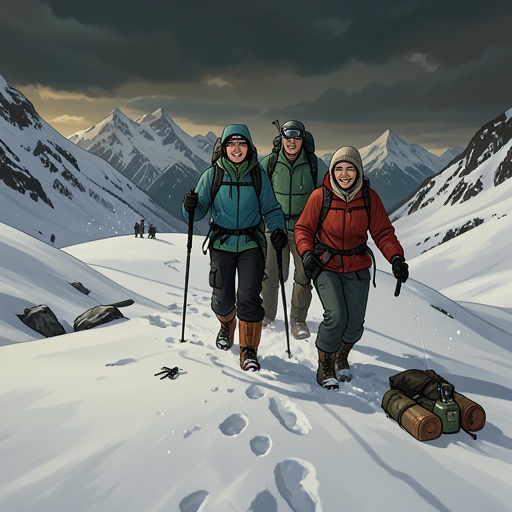
Lent wanted pupils off the practice slopes as soon as possible and on trips in the high mountains. His conception of skiing’s greatest pleasure lay far from crowds, on untracked snow, moving between Alpine Club huts over high passes and glaciers. He insisted that bindings should release in a fall rather than hold a ski so firmly that a skier might break a leg. Unroped glacier skiing, which Lent especially loved, had to wait until spring, when crevasses were sufficiently covered.
This teaching made ascent part of the sport rather than an inconvenience to be bypassed. Hemingway recalls that a climb such as the steep route to the Madlener-Haus became easier with repetition: a load that was initially difficult could later be carried with greater ease, even when doubled. Trips into the mountains depended on physical effort, sound choices about snow, and careful attention to the route. Lent’s students learned that the eventual descent was earned through the climb and the skills accumulated along the way.
The school also operated under modest financial circumstances. It had not prospered, and Lent played poker too wildly, Hemingway says, because the school was making no money. In Schruns, poker was forbidden in Austria, so the hotel dining-room game met with its windows shuttered and door locked. Lent played with Hemingway, the hotel keeper, a banker, the public prosecutor, and the captain of the gendarmerie. When the patrol stopped outside, the captain signaled, and the players fell silent until it had passed. The scene places Lent’s instruction within the social life of the town while also showing the school’s insecure finances.
Avalanche Warning and the Lech Disaster
The gravest test of Lent’s expertise came during a winter when many people were killed in avalanches. Snow had arrived late; the slopes had remained warm under the sun before a heavy snowfall left deep, powdery snow poorly bonded to the ground. Lent wired a group of Germans in Berlin not to come for their Christmas skiing holiday. They came to Lech anyway, ignorant of the danger and confident enough to ski without him. When one of the men called Lent a coward, the group declared that it would go out by itself.
Lent ultimately took the party to the safest slope he could find. He crossed it first, and the visitors followed. The entire hillside then released in an avalanche. Thirteen people were dug out, nine of them dead. The account makes clear that Lent had recognized the danger before the party arrived and had tried to prevent the trip. It also preserves the difficult sequence after their refusal: he declined to lead them, but eventually guided them across the safest ground available to him. His skill could inform a choice under perilous conditions, but it could not make the mountain safe.
The disaster altered the life of the ski school. It had struggled before the avalanche; afterward, Hemingway and Hadley were almost its only members. Those who continued became serious students of avalanches, learning about different types, how to avoid them, and what to do if caught. Hemingway adds that much of his writing that year took place during avalanche season. Lent’s work as an instructor thus continued in a changed atmosphere: mountain travel remained compelling, but the risks that had once been part of practical instruction had become immediate and communal knowledge.
Character, Community, and Memory
Lent appears as a practical teacher, an experienced skier, and a participant in the small-town life of Schruns. Hemingway also identifies him as a Rhinelander. Lent did not attend a lecture in town by a former German naval officer on the Battle of Jutland, a talk that left the audience uneasy. The recollection offers this decision without explaining his motive; it establishes only that Lent chose not to be present.
He also gave Hemingway a way to understand how the local population regarded the foreign skiers. In winter, Hemingway wore a beard against the sun that burned his face on the high snow and did not bother to have a haircut. Lent told him that peasants on the roads above Schruns had given him mocking religious and drinking-related nicknames. In the upper Montafon Valley, where porters were hired for trips to the Madlener-Haus, villagers regarded the foreign climbers as outsiders who entered high mountain country when, in local eyes, people should stay away. Even the skiers’ habit of setting off before daylight to avoid slopes made dangerous by the sun was interpreted as evidence of foreign cunning. Lent’s account of those names and judgments connects him to both sides of the encounter: he was an instructor in the visitors’ school, but also a local interpreter of the community through which they moved.
In Hemingway’s retrospective portrait, Lent’s significance rests less on formal authority than on the discipline he taught and the warning he gave. His method demanded effort, technical care, and respect for conditions that could change beyond a skier’s control. The Lech avalanche gives that instruction its sharpest consequence: Lent had warned the visitors, then tried to guide them as safely as he could, yet nine people died. The recollection does not turn this outcome into a simple lesson or absolve the mountain of its uncertainty. It preserves instead the hard distinction between knowing danger and being able to prevent it.