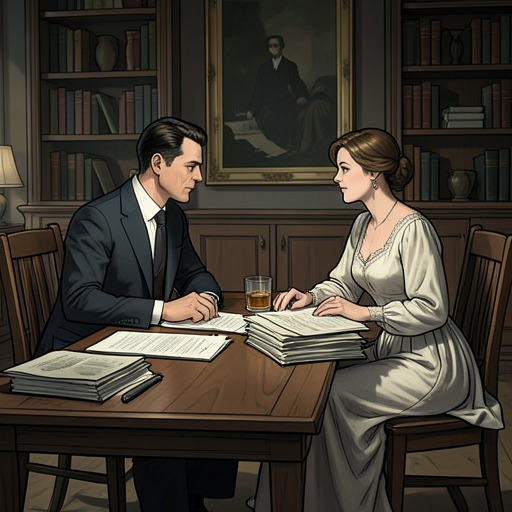
Zelda Fitzgerald
A Moveable FeastZelda Fitzgerald emerges in Ernest Hemingway’s recollections as both a sharply observed individual and the center of a damaging marital pattern. She is Scott Fitzgerald’s wife and the mother of their young daughter, but Hemingway’s account is not a settled biography: it moves between scenes he witnessed, Scott’s stories about their past, and Hemingway’s interpretations of Zelda’s expressions and effects on Scott’s work. Her direct confidences are rare; much of what the reader learns about her arrives through that uneven, intimate perspective.
Identity and Introduction
At a lunch Scott arranged for Hemingway and his wife at the Fitzgeralds’ furnished flat at 14 rue Tilsitt, the rooms seemed gloomy and airless. The objects that appeared to belong unmistakably to the couple were Scott’s early books, bound in light blue leather with their titles in gold. Scott also displayed a ledger recording his stories, publication years, prices, motion-picture sales, and book royalties. He presented the accounts with careful, impersonal pride, as though they were a museum exhibit; in the flat, Hemingway observed, there was no view.
Zelda arrived at that lunch tired from a bad hangover and looking drawn. Her dark-blonde hair had been temporarily spoiled by a bad permanent in Lyon, where rain had forced the couple to abandon their car. Hemingway describes her eyes as hawk-like, her mouth as thin, and her manners and accent as Southern. The portrait shifts later: at Juan-les-Pins, her hair is dark gold, her skin beautifully tanned, and her eyes clear and calm. These contrasting appearances place her in changing circumstances rather than fixing her as a single image.
The Fitzgeralds’ little daughter was blonde, chubby-faced, sturdy, and healthy-looking. She spoke English with a strong Cockney accent because Scott had arranged for her to have an English nanny; he hoped she would grow up speaking like Lady Diana Manners. Zelda’s place in the family is present in these domestic details, although Hemingway gives more space to the way her relationship with Scott bears on his work.
Marriage and the Saint-Raphaël Story
Scott told Hemingway that he had first met Zelda during the war, lost her, and won her back before their marriage. He also described a tragedy at Saint-Raphaël, where Zelda had fallen in love with a French naval aviator. Hemingway believed the first version Scott told him was true, but Scott later offered other versions, apparently trying them out as material for a novel. The retellings improved as stories, Hemingway remembered, but none affected him as painfully as the first. The account therefore makes the episode consequential without resolving precisely what happened.
Scott returned to the story repeatedly on walks with Hemingway, telling him that Zelda had fallen in love with the pilot. Hemingway understood Scott to be very much in love with her and very jealous of her, but says she had not made him jealous with another man since. The old story nevertheless remained active in their marriage: it shaped Scott’s fears and made later jealousies legible against an earlier wound. Hemingway’s account leaves a question of its own open, since he could not reconcile the story of Zelda and the aviator with Scott and Zelda continuing to share a bed.
Work, Jealousy, and Repeating Conflict
Hemingway came to recognize a recurring cycle. Scott would resolve to stop attending all-night drinking parties, exercise daily, and work regularly. When he began working well, Zelda would complain of boredom and draw him toward another party. They would quarrel and make up; Scott would take long walks with Hemingway to sweat out the alcohol, decide again to work, and get started before the cycle began anew. Hemingway explicitly describes Zelda as jealous of Scott’s work, and regards that jealousy as a more persistent source of conflict than competition over another person.
At a lunch after a night out on Montmartre, Zelda had a severe hangover. The previous night, she and Scott had argued because he did not want to get drunk: he had told Hemingway he intended to work hard and not drink, while Zelda had treated him as a killjoy and spoilsport. During the lunch she seemed, in Hemingway’s reading, to leave the table in her thoughts and return from the coming party with an initially blank, then pleased expression. She smiled as Scott drank wine. Hemingway learned to recognize that smile as a sign that she knew Scott would not be able to write.
The pattern involved jealousy in both directions. Zelda, Hemingway says, did not encourage the people who pursued her and claimed to have nothing to do with them, but their interest amused her and made Scott jealous; he felt compelled to accompany her to the places where they went. The result, as Hemingway saw it, was damage to Scott’s work. In spring he also feared that Zelda might pass out at parties, and was jealous of other women himself. Drinking could make the couple unconscious with startling speed: Hemingway had seen them fall asleep as if anesthetized, then wake fresh and happy after friends or sometimes a taxi driver got them to bed.
A Rare Confidence and Its Aftermath
At Juan-les-Pins, where Scott and Zelda had been staying near Hemingway and his wife, Zelda seemed friendly, beautiful, and calm. Leaning toward Hemingway, she shared what he called her great secret: “Ernest, don’t you think Al Jolson is greater than Jesus?” Nobody present thought anything of it at the time. Hemingway understood it as a private confidence, yet turned it into the image that gives the episode its title: a hawk sharing something with a man, though hawks do not share. The moment is intimate but also mediated by Hemingway’s interpretation; the book does not explain what Zelda meant by the comparison.
Hemingway links the episode to Scott’s later writing only cautiously in chronology but starkly in judgment: Scott, he says, wrote nothing good again until after he knew Zelda was insane. Much later, after what was then called her first nervous breakdown, Scott invited Hemingway to lunch at Michaud’s and said he had something important to ask, requiring an absolutely truthful answer. Hemingway recalls that such requests made Scott angry, sometimes long after the answer, when he had brooded over it. The account establishes the strained conditions of their exchange, but the evidence here does not disclose the question or Hemingway’s answer.
Narrative Perspective and Significance
Zelda is rendered through a mixture of observable detail and Hemingway’s confident readings of her interior life. Her hair, eyes, expressions, hangover, and words are described concretely; claims about what her smile meant, how jealousy shaped her behavior, or what Scott’s stories revealed are the narrator’s judgments. Scott’s changing versions of Saint-Raphaël especially resist a final verdict. Hemingway believes the first account, while acknowledging that any of the versions might have been true.
That tension makes Zelda more than a background figure in a story of Scott’s productivity. The remembered scenes show a marriage in which parties, alcohol, jealousy, affection, and writing repeatedly pull against one another, with no simple separation between private pain and artistic consequence. Yet Zelda’s own account remains limited: she is most fully present in gestures Hemingway interprets and in the single secret she tells him. The resulting portrait preserves her force while also exposing how much of her story is filtered through the man observing her and the husband recounting their marriage.