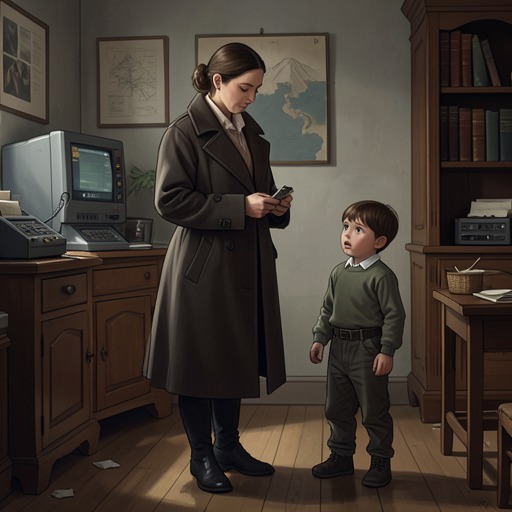
“My daughter comes first”
A Pale View of Hills“My daughter comes first” is Sachiko’s defining declaration of maternal priority, repeated as she defends her plans for Mariko and, later, abandons the plan to go to America with Frank. Its force lies in the change from assurance to decision: Sachiko first insists that emigration will be safe for her daughter, then invokes that same priority to explain why she will no longer rely on Frank. The words state a principle, but their recurrence also exposes the unsettled circumstances in which Sachiko must act.
The phrase as a promise of protection
When Etsuko questions whether Sachiko has considered Mariko’s welfare before leaving Japan, Sachiko responds impatiently that she has given it careful thought. She says she has discussed the matter with Frank and assures Etsuko that Mariko will be fine. Asked what will happen to the girl’s education, Sachiko counters that America has schools and argues that Mariko is bright, with accomplished family on her father’s side and high-ranking relatives on her own. Her confidence in a future abroad is therefore presented not as indifference to education or status, but as a claim that those needs can be met elsewhere.
This early defense makes the later declaration legible as more than an abstract sentiment. Sachiko presents herself as someone who has assessed the risks and can protect Mariko through a change of country. Her assurance that there will be no problems is emphatic, and she grounds it in her own judgment of her daughter’s prospects. At the same time, the need to argue that America is not an uncivilized or unschooled place shows that Etsuko’s questions have made the practical stakes of the plan explicit. Sachiko’s words attempt to close that uncertainty by asserting her competence as a mother.
Repetition after Frank’s failure
The phrase returns in a later conversation, after Sachiko has apologized to Etsuko for Mariko. Asked what she intends to do, Sachiko fills a teapot, pours the remaining water onto the flame, and says that her daughter’s welfare must come before everything else. She contrasts motherhood with the conduct of a young woman lacking decency, then insists that Mariko’s interests come first. The contrast gives her declaration a defensive edge: she is not merely describing affection but answering an implied challenge to her respectability and responsibility.
Sachiko now plans to write to her uncle, tell him where she is, and discuss the possibility of returning to his house. She imagines that Mariko might have found America unsettling: a land full of foreigners and the prospect of suddenly having an American father. In this account, remaining in a settled place appears preferable to another disruption in Mariko’s life. Sachiko does not present this as a change in her underlying standard; she says the same maternal priority now supports a different course.
She also identifies Frank’s fear of responsibility for Mariko as the reason he has failed her. As she speaks, she rocks the teapot in her hands. The repeated claim that Mariko comes first is thus joined to an explanation of why Sachiko cannot entrust her daughter’s future to him. The gesture and the insistence give the scene a contained, deliberate rhythm: while the plan to go to America collapses, Sachiko holds to the assertion that she is deciding for her child.
The history behind the decision
Sachiko explains that Frank’s present disappearance is not the first such failure. In Tokyo, she says, he disappeared and spent their money drinking it in three days. Some of the money was hers; she had worked as a maid in a hotel, scrubbing floors on her knees, and they had nearly saved enough to take a ship to America. In her account, weeks of labor and proximity to departure were undone in a few days. That earlier loss makes her refusal to place Mariko’s future in Frank’s hands concrete: the current crisis repeats a pattern with direct financial and emotional consequences.
Her recollection sharpens the contrast between the imagined destination and the person on whom the journey depends. America had been close enough to reach by ship, but the money was spent; now Frank is again drinking in a bar with a woman Sachiko calls a saloon girl. Sachiko says she will not accompany a foreign drunkard to America. Rather than treating the failed plan as a reason to abandon Mariko’s future, she treats it as a reason to pursue that future without Frank. Her declaration gains its practical meaning in this reversal: protection requires not only imagining a better destination, but refusing an unreliable means of reaching it.
A principle made into a decision
Sachiko says she is willing to discuss a return to her uncle’s house for Mariko’s sake, but she does not make that possibility her only option. If her uncle proves unhelpful, she will find another course. She states that she is happy Frank has found someone else to drink with and concludes that she will do what is best for Mariko. The phrase consequently names a standard she uses to choose among uncertain possibilities, rather than a guarantee that any one arrangement will succeed.
The wording varies across the two conversations: Sachiko speaks of her daughter’s welfare as being of the utmost importance, says that her interests come first, and finally states, “I’m a mother, and my daughter comes first.” This repetition binds reassurance, self-defense, and resolve together. It does not erase the gap between Sachiko’s earlier confidence that emigration would pose no problems and her later account of Frank’s unreliability. Instead, the gap gives the declaration its dramatic weight. Sachiko’s maternal claim remains constant while the plan changes around it; its final force is not that she can promise Mariko an uncomplicated future, but that she will no longer entrust that future to Frank.