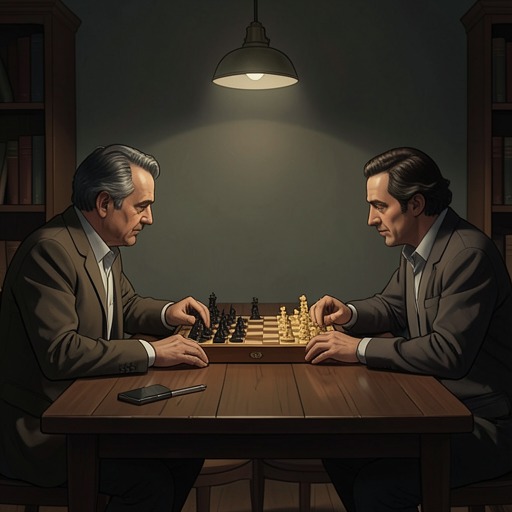
Chess as a metaphor for strategy and surrender
A Pale View of HillsChess as a metaphor for strategy and surrender takes shape in a three-day game between Jiro and Ogata-San. The board becomes more than a pastime: it gives the two men a concrete language for arguing about persistence, defeat, and the habits that endure between parent and child. Ogata-San reads Jiro’s play as evidence of a broader tendency to give up when an initial plan fails; Jiro resists that judgment by treating the match as merely a game. Neither the board nor their disagreement is resolved cleanly, and that unfinished contest is central to the metaphor’s effect.
The game as a test of foresight
The game is already several days old when Ogata-San invites Jiro to finish it. Their conversation has turned from the practical uncertainties of Jiro’s coming negotiations and possible promotion to the chessboard. Jiro points out that success the next day would not guarantee advancement, and Ogata-San responds with the experience of someone who knows that professional competition does not always reward merit. He advises perseverance, then returns to the game. The shift links the board’s contest to the uncertain struggle beyond it without making the chess match a simple stand-in for any one outcome.
Ogata-San examines Jiro’s position and says that, although he is in a difficult corner, a way out remains. He recalls teaching Jiro to avoid using the castles too early, a mistake he says his son still makes. He also faults Jiro for not planning several moves ahead, recalling that he had once insisted on at least three. Jiro concedes that he has not been doing so and says that Ogata-San has won. The exchange establishes the game’s central distinction: losing material or reaching a difficult position is not necessarily the same as losing the ability to act with purpose.
A strategy collapses
Ogata-San argues that Jiro began with a strategy but abandoned it once Ogata-San disrupted it. Instead of forming a new plan, Jiro began playing one move at a time. For Ogata-San, coherent play depends not on preserving an untouched plan but on responding when the opponent breaks it. The game is effectively lost, in his account, when a player gives up strategic thought and moves without a shared direction—not only when the king is finally cornered.
Jiro accepts the verdict that he has lost and asks to leave the game there. Ogata-San refuses to regard that admission as final. He says he has studied the board and can see three ways Jiro might escape. When Jiro continues to disengage, Ogata-San offers to show him how to get out of the corner, beginning with what he calls the simplest possibility. The alternatives matter because they make Ogata-San’s lesson practical: he is not asking Jiro to deny that his position is bad, but to keep searching for a response within it.
Father and son across the board
The argument sharpens when Ogata-San connects Jiro’s resignation to a trait he believes he has seen since Jiro was nine. He calls it defeatism: in his view, Jiro gives up when his first strategy fails, then withdraws when forced onto the defensive. Jiro rejects the relevance of that judgment, insisting that this is merely a game. The same exchange can therefore be read in two ways: Ogata-San sees an old pattern revealed by play, while Jiro objects to turning one match into a judgment of character.
That tension keeps the chess metaphor from becoming a neutral moral lesson. Ogata-San speaks with the authority of a father who believes he knows his son, but his repeated insistence also turns the board into a site of pressure. Jiro’s silence and refusal to look at the pieces do not prove Ogata-San’s account; they show how little the advice is reaching him at that moment. The father wants to continue not only to win, but to demonstrate that a possible move remains. The son appears to want the encounter to end, and his acceptance of defeat becomes part of the conflict itself.
The unfinished game and its echo
After Jiro stops responding, Ogata-San says they need not finish. He still tries to demonstrate a possible escape, while Jiro turns a page of his newspaper and continues reading. Ogata-San laughs and compares this sulking withdrawal to Jiro’s behavior as a child. The board thus holds two competing accounts of continuity: Ogata-San believes the boy’s old temperament persists into adulthood, while the scene leaves Jiro’s silence open to the reader rather than supplying an explanation for it.
The dispute culminates in an attempted gesture of destruction. Jiro throws down his newspaper and moves toward the board, apparently intending to knock the pieces across the floor. Before he can strike it, he accidentally upsets the nearby teapot. Tea spills across the tatami and begins soaking into his cushion. He stares first at the spill and then at the still-upright chessmen; their remaining in place seems to anger him further. He leaves without a word, but the board has not been overturned and the offered escape has not been played. The interruption makes the image of surrender physical while preserving the game’s unresolved state.
Later, at a meal, Ogata-San remarks that he cannot sit thinking about chess all day, and Jiro answers only with a nod. The comment closes the immediate dispute without showing that either man has accepted the other’s position. Chess remains a compact expression of their disagreement: Ogata-San insists that a broken plan calls for another, while Jiro’s withdrawal leaves open whether he has conceded the game, rejected the lesson, or simply refused to continue arguing. The metaphor’s significance lies in that gap between the available move and the willingness to make it.