Etsuko and Mariko
A Pale View of HillsEtsuko and Mariko share a brief but consequential bond in Nagasaki: Etsuko acts as a neighboring adult who offers practical help and comfort, while Mariko’s guardedness and distress expose the limits of what that care can accomplish. Their most intimate exchange comes on the eve of Mariko’s departure, when Etsuko finds her alone and promises that leaving need not be irreversible. The reassurance is tender, but it also asks a frightened child to accept a future chosen by her mother.
A Neighbor’s Concern
Etsuko’s attention to Mariko is present even when the two are not alone. When Sachiko explains that she needs money because her arrangements have gone wrong, Etsuko responds by acknowledging how difficult the situation must be with Mariko to think of. Her concern is expressed through Sachiko, the person making the decisions, but it establishes that Etsuko understands the child as part of the burden and stakes of those decisions, not as a detail incidental to them.
When Sachiko returns to find Mariko missing, Etsuko does not share her attempt to make the absence sound harmless. She moves quickly to look for the child and asks whether Mariko might be with friends. Sachiko laughs off the alarm and announces that she and Mariko are leaving for America within days, but the announcement does not make Etsuko forget that Mariko is unaccounted for. Ogata-San suggests phoning the police; Sachiko resists, and Etsuko’s urgency keeps the possibility of a search in view. The contrast is revealing: Sachiko speaks confidently about the family’s future while Etsuko attends to the immediate fact that the child is gone.
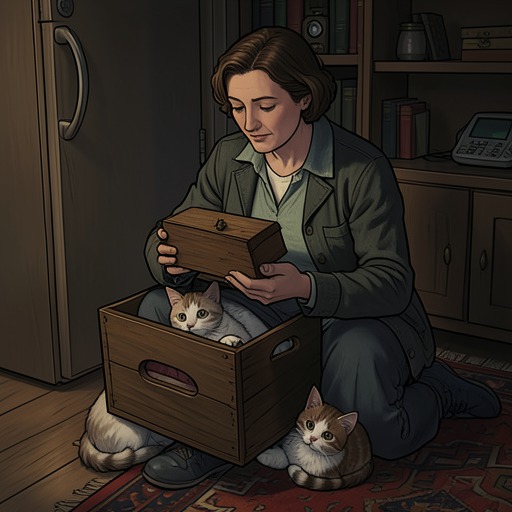
Etsuko’s practical concern also surfaces in the matter of the kittens. When Sachiko prepares to leave them behind, Etsuko offers to come and feed them from time to time, until they can find homes. The proposal answers Mariko’s distress with a concrete form of care rather than an argument about whether the animals matter. Mariko reminds Etsuko that Sachiko had said she could keep them. Sachiko nevertheless puts the kittens into a vegetable box, and Etsuko’s offer cannot prevent the rupture between mother and daughter. It does, however, give Mariko an adult witness who recognizes what she has been promised and why the kittens matter to her.
The Departure and the Search
The move is presented to Mariko as settled: Sachiko says they will first go to Kobe and then to America, with Frank having arranged the next stage. Etsuko has heard Sachiko defend the plan even after Frank disappears. Sachiko insists that his journey from Tokyo to Nagasaki proves that he still means to take her to America, and later recounts how he once disappeared in Tokyo after spending their money, leaving her to work as a hotel maid. She says her daughter comes first, yet she continues to describe a future organized around Frank and emigration. Etsuko’s relationship with Mariko unfolds inside this tension between a mother’s declared responsibility and a child’s lack of control over the destination.
After Sachiko orders Mariko to stay behind, the child soon vanishes from the cottage. Etsuko sees Sachiko by the water with the box beside her and notices Mariko standing behind her, near the steep slope. When Mariko has gone, Etsuko puts on her sandals and follows. The sequence makes her care active: she does not simply tell the child to obey or leave the search to Sachiko, but goes after her into the evening.
Etsuko eventually finds Mariko crouched beneath the rail of a small wooden bridge, looking at her palms and saying nothing at first. Under the lantern, the child tells her she does not want to go away the next day and does not like Frank. The isolated meeting allows Mariko to express a refusal that has had little room in the adults’ plans. Etsuko first rebukes her for speaking badly of him, then softens and says Frank is fond of her and will be like a new father. Her response is protective in intention, but it also repeats the adult assurance that Mariko should accept the man and the move.
Reassurance and Its Limits
Etsuko’s most important offer is that, if Mariko does not like the new place, they can come straight back. She does not merely tell the child that everything will turn out well; she attaches that reassurance to a possible return. Mariko looks up at her questioningly, and Etsuko repeats the promise. In a story where America stands in Sachiko’s talk for a new and respectable life, Etsuko gives Mariko a different image of the future: departure can be tried rather than endured forever.
The promise remains limited by the circumstances in which it is made. Etsuko speaks as though she and Mariko can return together, but the plan belongs to Sachiko and Frank, and the narrative gives no indication that Etsuko can determine where the family will go. Her comfort therefore combines genuine tenderness with an assurance she may not be able to keep. She wants to calm Mariko, but she also persuades her to try the very departure she has said she fears. The exchange is neither simple betrayal nor a successful rescue; it shows how care can be sincere and still operate within decisions made by others.
Etsuko’s later recollection of arriving in England gives the promise an additional resonance without confirming its outcome. She remembers that the fields and house first seemed like the England she had imagined, and that she was pleased by the resemblance. This memory echoes her effort to persuade Mariko that a new place might prove welcoming, but it belongs to Etsuko’s own experience and does not establish what Mariko’s life became. The difference matters: Etsuko can remember her own hopeful arrival, while the child’s response to the promised destination remains uncertain.
Narrative Significance
The relationship is built from small acts—an offer to feed abandoned kittens, a hurried search, a walk to the river, a lantern held near a child beneath a bridge, and a promise of return. These acts distinguish Etsuko from the adults who treat Mariko’s resistance as childishness or a temporary inconvenience. Yet Etsuko is not outside the conflict: she also urges Mariko to trust Frank and to try leaving. The bond is therefore marked by a difficult combination of sympathy and accommodation, in which comfort cannot undo the child’s dependence on decisions made for her.
Because Etsuko recounts these scenes retrospectively, the kindness of the remembered encounter sits beside the uncertainty of what it could achieve. She can preserve the words of reassurance and the image of Mariko alone at the bridge, but the promise does not settle the child’s future. Their relationship gives the departure a human measure: beneath Sachiko’s confident plans for Kobe and America is Mariko’s fear of going, and beside that fear is Etsuko’s earnest, precarious attempt to make leaving feel reversible.