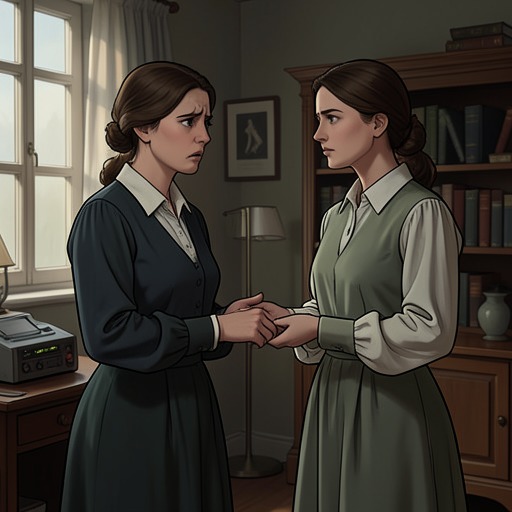
Etsuko and Sachiko's brief friendship and mutual support
A Pale View of HillsEtsuko and Sachiko's brief friendship and mutual support is a relationship of practical kindness, unequal candor, and persistent reserve. They become friends for only a few weeks in Nagasaki, yet Sachiko allows Etsuko glimpses of her private circumstances, and Etsuko offers help when Sachiko needs money. Recalled many years later, their connection is also shaped by what Etsuko cannot confidently remember and by the contrasting futures each woman appears to be pursuing.
Identity and Retrospective Frame
Etsuko says she never knew Sachiko well: their friendship lasted several weeks one summer, long before Etsuko met Niki's father. The relationship is therefore brief by duration, but it occupies a substantial place in Etsuko's recollection. She remembers Sachiko again during Niki's April visit, when Niki has come partly to reassure her that she need not feel responsible for Keiko's death. Etsuko says she mentions Sachiko because that visit was the circumstance in which the older memories returned, not because she wishes to dwell on Keiko.
The recollection begins amid Nagasaki's postwar rebuilding. Etsuko and her husband live in concrete apartment blocks east of the city, near a river and a broad stretch of muddy, poorly drained ground. After hearing women talk about Sachiko, Etsuko watches her from a railway bridge and feels sympathy, thinking she understands something of Sachiko's aloofness. The friendship that follows is narrated at a distance of years: Etsuko cannot be sure how they first met, but remembers seeing Sachiko on a path out of the housing precinct and hurrying to catch up. Sachiko turns and waits for her. The uncertainty of that first encounter gives way to a firmer memory of the connection that grew afterward.
First Approach and Growing Confidence
One early sign of Etsuko's attentiveness comes when she catches up with Sachiko to tell her that Mariko has been fighting near the ditches. Later, while the two women are walking, Etsuko urges them to look for Mariko; Sachiko laughs, touches Etsuko's arm, and says there is no need to be alarmed. She has come instead to share news: she and Mariko are leaving for America within days. Etsuko stops at the announcement. The moment brings their different immediate concerns into view: Etsuko is focused on the missing girl, while Sachiko is eager to announce the departure she has arranged.
Sachiko's confidence grows through conversation rather than a clear declaration of intimacy. Over tea, Etsuko notices the delicate pale china of the teapot and cup against the shabby cottage and muddy ground beneath its veranda. Sachiko explains that she is used to good crockery and can be discerning even when she accepts discomfort. She then admits that she stole the tea set from her uncle, adding that he probably will not miss it. The admission gives Etsuko a personal detail, but also shows Sachiko presenting herself on her own terms: she acknowledges the theft without asking Etsuko to excuse or condemn it.
Assistance and Material Exchange
When Sachiko tells Etsuko that arrangements have not gone as planned and that she needs a small amount of money, Etsuko assumes the difficulty concerns the demands of caring for Mariko. She offers her own savings, quietly and without hesitation. Sachiko laughs and clarifies that she did not initially mean to ask for a loan; she refers instead to Etsuko's acquaintance who runs a noodle shop, Mrs. Fujiwara. Etsuko's offer nevertheless establishes that she is willing to help, while Sachiko controls what kind of assistance she will request and when.
Later, Sachiko returns to the offer, explaining that her departure for America has been delayed and that she needs money in the meantime. Etsuko again agrees to help. Sachiko leaves the amount to her judgment and assures her the loan will be repaid. Etsuko retrieves an envelope of money from a drawer, where it has been kept beneath a black lacquer gift box and among preserved letters, small photographs, albums, cards, and watercolours painted by her mother. She wraps the envelope in a discreetly patterned silk scarf. When she places it beside Sachiko's cushion, Sachiko does not look up from pouring tea; only a quick sideways glance acknowledges the bundle. The exchange is generous, but its quiet choreography preserves both women's dignity and Sachiko's control over the encounter.
Reserve, Departure, and the Limits of Intimacy
The money does not make the women fully candid with one another. Sachiko tells Etsuko she is not ashamed or embarrassed by anything she has done and invites her to ask about the man Etsuko calls her friend. Etsuko answers politely, but Sachiko notices that she is blushing. The scene makes their closeness palpable while showing its limit: Sachiko offers an opening, but Etsuko remains hesitant to question her directly. Their relationship joins Etsuko's readiness to assist with Sachiko's insistence on managing what is disclosed.
Their differing priorities are clearest around the America plan. Sachiko first presents departure as settled and imminent, even while Mariko's whereabouts are troubling Etsuko; later she describes the trip as delayed and asks for a loan to manage the interval. These moments show Etsuko supporting Sachiko's stated plans without knowing their full course, and Sachiko sustaining the prospect of departure even when practical arrangements falter. The available recollections do not make the two women equally open or suggest that a short friendship resolves their differences. Instead, Etsuko's attention, offered money, and remembered scenes preserve a bond formed through brief companionship, while Sachiko's composure keeps part of her life beyond Etsuko's reach.