Etsuko's guilt over taking Keiko away from Japan
A Pale View of HillsEtsuko’s guilt over taking Keiko away from Japan crystallizes in a dawn conversation with Niki: Etsuko says she had expected Keiko to be unhappy in England, yet chose to bring her there. Niki answers with reassurance and an argument for taking risks, but Etsuko will not accept comfort as a reason to keep examining the decision. The exchange leaves the past morally unsettled: Etsuko acknowledges what she believes she knew, while Niki insists that the choice was still understandable and that blame is misplaced.
The admission and its context
The conversation begins with Niki’s judgment that Keiko’s father should have looked after her more, because he ignored her much of the time. Niki calls this unfair, then repeats that judgment after Etsuko responds that he was not Keiko’s real father. The repetition matters: Niki is not simply explaining his distance or closing the question with a family distinction. She returns to the failure of care, keeping Keiko’s experience at the centre of the exchange.
Etsuko does not directly dispute Niki’s description of that neglect. Instead, she recalls that Keiko’s father was idealistic and believed that they could give Keiko a happy life “over here.” That belief gives the move a hopeful rationale, but Etsuko’s next admission sharply qualifies it. She says, “I knew all along she wouldn’t be happy over here. But I decided to bring her just the same.” The repetition of “I knew all along” makes her statement sound less like a newly formed explanation than a conviction she has carried into the present. Her guilt is attached not only to the outcome she associates with the move, but to the claim that she anticipated it and proceeded anyway.
Knowledge, choice, and blame
Etsuko’s account separates her own judgment from the more hopeful belief she attributes to Keiko’s father. He believed they could make a happy life for Keiko in England; Etsuko says she did not share that confidence. Yet she also says she brought Keiko, so the contrast does not absolve her or transfer the decision to him. It makes her responsibility feel more personal: in her telling, hope belonged to him, while foreknowledge belongs to her.
Niki immediately challenges that account. She calls Etsuko’s confession silly, asks how her mother could have known, and says Etsuko did everything she could for Keiko; she is the last person anyone should blame. Niki’s response contests both parts of the self-accusation: the certainty that Etsuko foresaw Keiko’s unhappiness and the conclusion that this certainty establishes culpability. The scene does not settle which account is true. Etsuko’s memory gives her knowledge of her own earlier expectations, while Niki treats such certainty as impossible and judges the decision by the effort Etsuko made.
Niki then reframes the move as a risk rather than a mistake. She argues that Etsuko could not simply accept everything as it was and remain where she was; at least, she says, her mother made an effort. This defence does not deny that Keiko may have been unhappy. Instead, it changes the standard by which the choice should be assessed: Niki values attempting a different life over passively allowing life to waste away. Her reassurance therefore speaks to Etsuko’s decision, not to any resolution of Keiko’s experience.
Refusal and the return to the present
Etsuko asks Niki not to discuss the matter further, then repeats the request more firmly, adding that there is no point going over it now. Her response marks a limit to what she will say, not a refutation of her earlier confession. The conversation has brought her claim of foreknowledge into the open, and Niki has answered it with a defence; Etsuko ends the exchange without withdrawing either her admission or her refusal to revisit it.
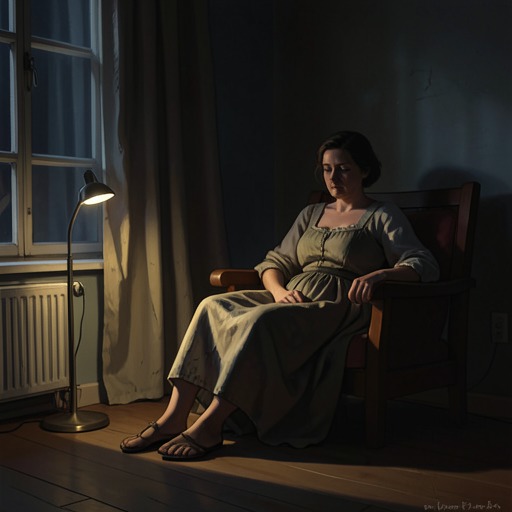
The scene’s small physical details make that withdrawal visible. It is nearly daylight; Etsuko has been holding a coffee cup and then puts it down, looking past Niki into the garden. After asking to stop, she rises and goes closer to the window. Her attention shifts from the disputed past to the morning, whose sky seems clearer than on previous days. She suggests that, if the sun comes out, she and Niki might take a walk. This change of subject offers company and a possible next activity, but does not resolve the guilt that has just surfaced.
The meaning of Niki’s defence
Niki’s assurance that Etsuko did the right thing sits beside her insistence that Keiko’s father failed to look after Keiko fairly. Together, the remarks resist a simple account in which one person’s good intentions make the family’s choices harmless. Niki recognizes a failure of care, but argues that her mother’s effort to change their circumstances should not be condemned. Etsuko, by contrast, remains fixed on the gap between what she says she anticipated and what she chose to do.
The exchange thus presents guilt as a dispute over how to narrate a past decision. Etsuko frames the move through prior knowledge and responsibility; Niki reframes it through uncertainty, effort, and the value of risk. Neither argument erases the other, and Etsuko’s final insistence on silence leaves their difference intact. Her invitation to walk carries the conversation back toward ordinary time, while the question of whether bringing Keiko away was an act of hope or a choice made against Etsuko’s own expectations remains unresolved.