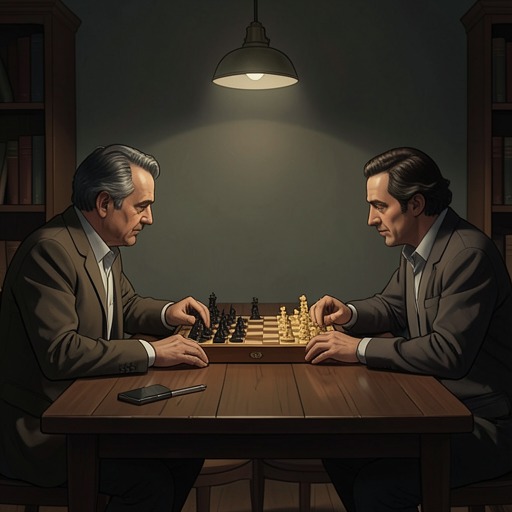
Jiro and Ogata-San
A Pale View of HillsJiro and Ogata-San’s relationship combines paternal care with an old, unresolved friction over how to meet difficulty. During Ogata-San’s extended summer visit, their interrupted chess game becomes a test of the habits each recognizes in the other: Ogata-San urges persistence and strategic thought, while Jiro deflects the conflict and ultimately refuses to continue. The game ends without a formal reconciliation, but their farewell toast preserves a quieter bond, expressed as mutual wishes for the future.
Identity and relationship
Ogata-San is Jiro’s father, and their time together is shaped by both familiarity and reserve. Ogata-San reads Jiro’s habits through the knowledge of a parent who remembers him as a child; Jiro, in turn, can invoke his father’s own words when resisting the lesson he is being given. Their closeness is therefore not presented as effortless agreement. It appears in shared routines and attentive advice, while discomfort surfaces in silence, deflection, and the way Jiro withdraws rather than openly arguing his position.
The dispute over Shigeo Matsuda’s magazine article provides an important backdrop to the visit. Ogata-San recognizes that Jiro is waiting for him to return to Fukuoka so that the matter can be allowed to fade. Jiro readily agrees that an attack on the family name should be answered firmly, says the matter concerns him as much as his father, and promises to write to his old school friend; in practice, he postpones taking a clear position. Etsuko’s recollection presents this as characteristic of Jiro’s approach to awkward confrontations. She also remembers that speaking openly with him about the matter did not come naturally within their marriage, leaving his father and son conflict largely unaddressed between the two men.
The chess game as an argument
The chess game has already been interrupted once, when Jiro’s two drunken colleagues arrive, and Ogata-San continues to study the position during the following day. That evening, after supper, he brings out the board again. The game has lasted three days, and Ogata-San treats its unfinished position as more than a casual pastime: he asks Jiro to resume it just as Jiro is preparing for an important meeting the next day.
Jiro minimizes the meeting, describing it as groundwork for negotiations in the autumn rather than a decisive occasion. He also cautions that success will not guarantee promotion. Ogata-San answers from his own experience of competitive professional life, reminding his son that others may be chosen unfairly and that he must persevere. The advice is caring, but its form is direct: Ogata-San wants Jiro to continue striving rather than use uncertainty as a reason to disengage.
That principle becomes explicit when Ogata-San challenges Jiro to remember why he moved a particular piece. Jiro admits that he cannot recall and supposes there must once have been a good reason. Ogata-San objects that Jiro began with a strategy, but abandoned it after his father disrupted the plan, then started playing one move at a time. He argues that chess depends on retaining a coherent strategy, finding another when the first is broken, and not giving up before the position is truly lost. For him, scattered pieces without a common purpose make defeat a matter of conduct as much as outcome.
Jiro says that he has lost and suggests they forget the game. When Ogata-San insists that he has identified three ways for Jiro to escape, Jiro turns his father’s lesson back on him: if a player who cannot maintain a strategy is inevitably defeated, then there is little point in continuing. His response makes the game an argument about their differing approaches to conflict. Ogata-San sees available moves and expects Jiro to keep searching; Jiro uses the same standard to justify stopping.
Withdrawal and confrontation
Ogata-San calls Jiro’s surrender defeatism and says that he had hoped to have cured this tendency when Jiro was young. He urges him to plan a defence and survive to fight again. Jiro denies that the charge applies, insisting that the dispute concerns only a game, but then lowers his newspaper and returns to reading rather than engage further. The newspaper becomes a visible means of closing the conversation, just as his earlier promises over Shigeo Matsuda’s article had allowed him to defer a difficult decision.
Ogata-San responds by laughing quietly and recalling that, as a child, Jiro sulked when he did not get his way. He then offers to show him a simple escape from the chess position. Jiro suddenly throws down the newspaper and moves toward his father, apparently intending to sweep the board and its pieces onto the floor. Instead, his foot upsets the teapot. It rolls onto its side, its lid rattles open, and tea runs across the tatami and begins soaking the cushion where Jiro had been sitting. The chessmen remain upright. Jiro stares at the spill, then at the undisturbed board; still angry, he leaves the room without a word.
The thwarted gesture makes the conflict physical without turning it into a direct attack: Jiro’s movement is aimed at the game, but the teapot is what falls. Etsuko cleans the tea while Ogata-San remarks that Jiro has not changed much since childhood. His faint smile complicates the rebuke. He sees the sulking adult as the son he has known all along, but recognition does not resolve the disagreement or bring Jiro back into the conversation.
Success and farewell
Later, Jiro’s success gives the household a different occasion for gathering. Etsuko prepares a more elaborate meal than usual to celebrate it. Ogata-San does not mention his encounter with Shigeo Matsuda that day, and the account does not say what the encounter established. His silence leaves the earlier family-name dispute without a narrated resolution, even as Jiro’s success marks a change in the immediate mood of the visit.
As the meal begins, Ogata-San announces that he will leave the next day. Jiro responds that this is a pity and hopes his father enjoyed the visit. Their exchange is courteous and restrained, with no explicit return to the chess argument or the article. When Ogata-San raises his cup to Jiro’s future, Jiro raises his own to his father’s. The reciprocal toast offers a compact expression of regard: after days of tension, neither man settles the conflict, but each acknowledges the other’s future before the visit ends.
Significance
The relationship is defined by a contrast between Ogata-San’s insistence on continued action and Jiro’s habit of retreating from confrontation. The chessboard gives that contrast a concrete form: Ogata-San sees several possible escapes, while Jiro treats his inability to sustain a plan as proof that the game should stop. The same pattern echoes the postponed response to Shigeo Matsuda’s article, where Jiro voices agreement but avoids making his position definite.
Yet the episode does not reduce their bond to a struggle for control. Ogata-San’s advice grows from his knowledge of Jiro and his own competitive experience; his laughter and recollection of Jiro’s childhood carry affection alongside criticism. Jiro’s final toast, in turn, answers his father’s gesture even though he has not accepted the lesson. Their relationship remains unresolved in its disagreements, but its closing image is mutual rather than estranged: two cups raised toward the futures each wishes the other to have.