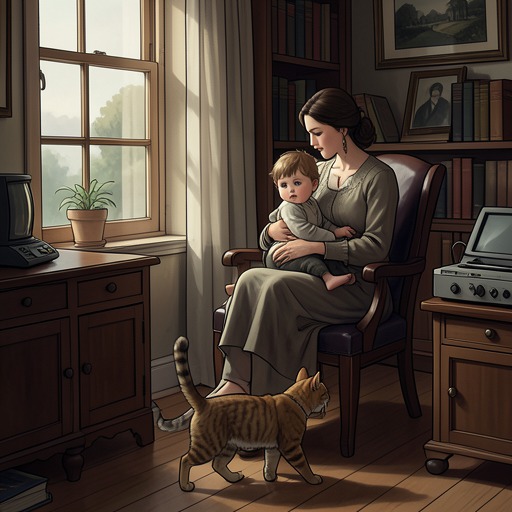
Keiko leaves home for Manchester
A Pale View of HillsKeiko’s departure for Manchester marks the point at which years of withdrawal from family life became a lasting separation. Etsuko remembers opposing the move because she feared the world beyond home would overwhelm her unhappy daughter; later, she regrets that her efforts to protect Keiko helped sever their ties. The recollection is shadowed by what followed: Keiko died by suicide in Manchester, where she had been alone for several days before her landlady discovered her.
Isolation Before the Departure
For two or three years before leaving, Keiko increasingly confined herself to her bedroom and shut the rest of the family out. She rarely came downstairs, had no friends, and would not let her family enter her room. At mealtimes, Etsuko left a plate in the kitchen for Keiko to collect before retreating again. The room itself registered the extent of her withdrawal: Etsuko recalls stale perfume and dirty linen, glossy magazines scattered across the floor, and heaps of clothes. She coaxed Keiko to put out her laundry; every few weeks, a bag appeared outside the door for Etsuko to wash and return.
This routine eventually became familiar to the household, but it did not restore closeness. When Keiko did come into the living room, tension rose, and her visits usually ended in a fight with Niki or her father before she returned to her room. Her departure therefore followed not a brief disagreement but a prolonged pattern in which she was physically present in the home while remaining largely inaccessible to the people in it.
The Move and Etsuko’s Opposition
Keiko went to live in Manchester nearly six years before Etsuko’s later recollection. When asked about her daughter, Etsuko gives the simple fact of the move, then admits she has not heard from Keiko recently. That gap in contact reflects the larger distance Etsuko associates with Keiko’s leaving: she believes that her daughter departed with all ties to her cut.
Etsuko later examines her own part in that separation. She recognizes that a young woman Keiko’s age might naturally want to leave home, but at the time she saw the outside world as too much for a daughter already unhappy at home. She says she opposed Keiko so vehemently for her own protection. The protective intention and the outcome sit uneasily together: Etsuko wanted to shield Keiko, yet remembers her resistance as helping ensure that Keiko left without maintaining their relationship.
Consequences and Retrospective Grief
The move also becomes inseparable in Etsuko’s mind from Keiko’s death. On learning of the suicide, Etsuko’s first thought was how long Keiko might have been dead before anyone found her. The coroner later said she had been there for several days; her landlady opened the room because she thought Keiko had left without paying the rent. Etsuko had already known what it was for Keiko to remain shut away in a room at home, but the Manchester room made that familiar pattern of isolation into a source of permanent horror.
Etsuko repeatedly returns to the image of her daughter hanging in the room. She describes its horror as undiminished, while also acknowledging that the image has become familiar through repetition, like a wound on one’s own body. The memory does not establish that the move itself caused Keiko’s death. Instead, it joins the fact of Keiko’s isolation to Etsuko’s unresolved regret over their estrangement, leaving her to revisit both the daughter she could not reach and the protection she once believed she was providing.