Keiko's prolonged withdrawal from family and the outside world
A Pale View of HillsKeiko's prolonged withdrawal from family and the outside world is remembered through a room that became both her refuge and a boundary her family could not cross. For the final two or three years before she left the household, she largely shut herself away, admitting no one into her bedroom and rarely entering the shared life of the family. That retreat eventually seemed ordinary to those around her, but after her death Etsuko understood its routines differently: Keiko had lived among her family while remaining, for long stretches, almost unseen.
The bedroom as a private domain
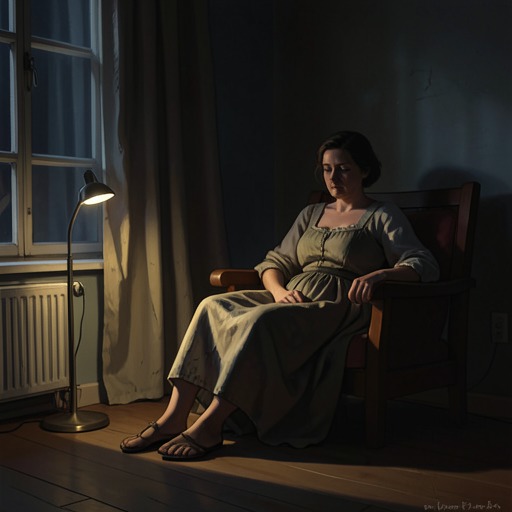
Keiko's withdrawal centered on her bedroom, which she guarded so completely that the rest of the family was forbidden to enter. She seldom came out, though Etsuko sometimes heard her moving around the house after everyone else had gone to bed. Etsuko could only surmise what filled those hidden hours: reading magazines and listening to the radio. Keiko had no friends, and her life outside the room was so restricted that even meals were handled indirectly. Etsuko left a plate in the kitchen; Keiko came down to collect it and then shut herself away again.
The room's physical condition made the separation perceptible even when its door remained closed. Etsuko recalls the smell of stale perfume and dirty linen, and the glimpses she caught of glossy magazines scattered over the floor among heaps of clothes. She had to coax Keiko to put out her laundry. In this limited matter they arrived at an arrangement: every few weeks, Etsuko would find a bag of washing outside the door, take it to be washed, and return it. The bag marked a narrow channel of contact—something passed between mother and daughter without requiring either to enter the other's space or sustain a conversation.
A household organized around absence
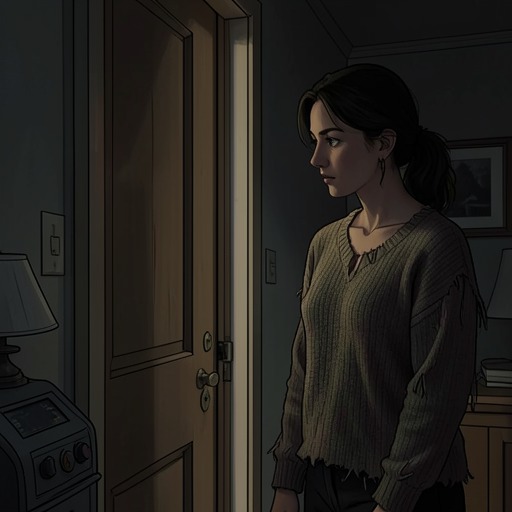
At first, Keiko's retreat still registered as a disruption. When she did venture into the living room, the family felt tense, and her excursions invariably ended in a fight with either Niki or Etsuko's husband. Keiko would then return to her room. Over time, the family grew used to this pattern: a brief appearance, a quarrel, and another disappearance behind the bedroom door. The routine did not resolve the conflict or draw Keiko back into family life; it made her absence something the household could accommodate.
That accommodation also left Etsuko with little direct knowledge of Keiko's experience. She describes her own ideas about the hours behind the closed door as surmise, not certainty. The family could observe the guarded room, the laundry, and the charged encounters in the living room, but those signs did not give them access to what Keiko was thinking or feeling. Her withdrawal is therefore presented not as a fully explained choice but as a sustained separation whose outward habits were visible while its inward causes remained obscure.
Sisterhood and explanations within the family
Years later, Niki's strong resistance to questions about her private life reminds Etsuko of Keiko. Niki's privacy has its own limits and circumstances, but the resemblance prompts Etsuko to challenge the account her husband had formed of their daughters. He regarded them as complete opposites and saw Keiko as difficult by nature; without stating it outright, he implied that she had inherited her character from her father. Etsuko had not contradicted him, in part because blaming Jiro offered an easy explanation that spared the parents from blame.
Etsuko recalls a different likeness between the sisters in their early years. Both had fierce tempers and were possessive; when upset, neither quickly forgot the cause of her anger, and each could remain moody for most of the day. The similarity makes the sisters' later divergence harder for Etsuko to explain through temperament alone. Niki became a happy, confident young woman, while Keiko grew increasingly miserable and eventually died by suicide. Etsuko says she cannot find it as easy as her husband did to attribute the difference to nature or to Jiro. Her recollection exposes how a convenient family explanation can coexist with uncertainty about what actually shaped Keiko's life.
Death and the persistence of the image
Etsuko never saw the room in Manchester where Keiko died. On learning of the suicide, before she had fully registered the shock, she wondered how long Keiko had been there before anyone found her. That first thought connected the distant room to the years of domestic isolation: Keiko had already been able to go unseen in her own family for days at a time, and Etsuko feared she would be discovered even later in a strange city where nobody knew her. The coroner said Keiko had been dead for several days. It was the landlady who opened the door, believing Keiko had left without paying the rent.
The bedroom in the family home and the unseen room in Manchester remain distinct places, but Etsuko's memory binds them through the fear of a daughter alone and unobserved. She repeatedly brings to mind the image of Keiko hanging in her room for days. The horror of that image has not diminished, she says, though it has ceased to feel merely morbid: she describes becoming intimate with even the most disturbing image, as with a wound on one's own body. In this recollection, the earlier routines—the closed door, the plate left in the kitchen, the bag of laundry—acquire a terrible afterlife. They do not explain Keiko's death, but they give Etsuko's account its central measure of loss: the possibility that a person can remain physically near her family and still be profoundly beyond its reach.