Mariko leaves the cottage on the eve of departure
A Pale View of HillsMariko leaves the cottage on the eve of departure after Sachiko orders her to stay behind, turning a household command into a quiet but decisive act of resistance. The episode links Mariko’s distress over her mother’s treatment of the kittens with her fear of leaving Nagasaki and living with Frank. When Etsuko finds her later that evening, Mariko gives voice to what she has resisted saying directly: she does not want to go, and she does not like the man who is to become her new father. Etsuko’s promise that they can come back offers comfort, but the scene ends without confirming that Mariko accepts the move or that her reassurance will hold.
The command at the cottage
The immediate setting for Mariko’s disappearance is Sachiko’s decision to put the kittens into a vegetable box and carry them to the water. She insists that they are only animals and orders Mariko to stay in the cottage. Mariko appears ready to follow her mother, but Sachiko repeats the command at the entryway. For a few moments, Mariko remains by the tatami, looking toward the doorway through which Sachiko has gone. Etsuko also tells her to wait there. Mariko turns toward Etsuko, then is gone the next moment.
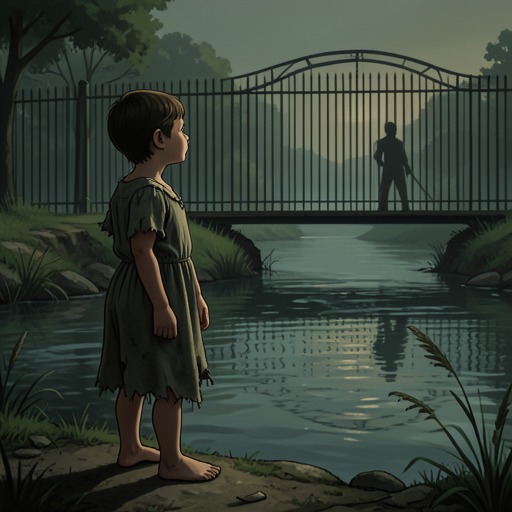
The sequence gives the departure its particular emotional charge. Mariko has just watched her mother dismiss the kittens’ vulnerability, while the order to stay makes her own wishes similarly subordinate to Sachiko’s decision. The narrative does not state that the kitten incident causes Mariko to leave, but it places her disappearance directly after this confrontation. Sachiko is already down by the water with the box when Etsuko sees Mariko standing several yards behind her, at the beginning of the steep slope. Mariko has left the cottage, yet she has not gone far enough to be beyond her mother’s sight or Etsuko’s intervention.
Found at the bridge
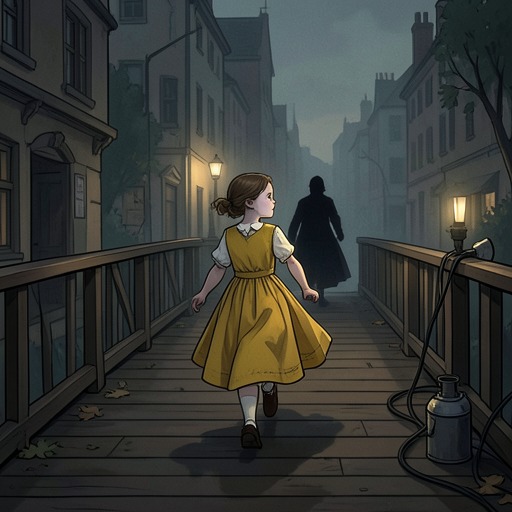
Later, Etsuko encounters Mariko beneath the opposite rail of a small wooden bridge. Etsuko has been walking beside the river with a lantern; she pauses on the bridge to look at the evening sky and listen to the water, then turns and sees her own shadow cast across the wooden slats. The calm of that pause gives way to the sight of Mariko crouched below the rail, looking at her palms and saying nothing. Etsuko sets the lantern down, and its light makes the child’s face clearer before Mariko breaks her silence.
Mariko says that she does not want to go away the next day. She adds that she does not like Frank, comparing him to a pig. Her words make explicit what her departure from the cottage had left unspoken: the move is not simply an unfamiliar change she can be expected to accept. Etsuko first responds angrily to Mariko’s insult, then softens and tells her that Frank is fond of her and will be like a new father. The exchange exposes a distance between the reassurance Etsuko offers and the fear Mariko is trying to communicate.
Etsuko’s promise and Mariko’s return
Etsuko tells Mariko that she will like the new place, and that if she does not, they can always come back. When Mariko looks up at this possibility, Etsuko repeats the promise more firmly: they will return straight away if the move does not suit them, but they must first try it. The assurance gives Mariko a condition under which departure might seem bearable, though it does not resolve her objection to Frank or her reluctance to leave.
Mariko notices something caught around Etsuko’s sandal and asks what Etsuko is holding. After Etsuko explains that it has caught there, Mariko rises slowly. She then runs along the wooden boards, stops at the end of the bridge to watch Etsuko suspiciously, and runs again as Etsuko picks up the lantern. Etsuko remains on the bridge for several quiet moments, watching the half-moon above the water. Through the dimness, she thinks she can see Mariko running along the riverbank toward the cottage. That final image suggests a return, but Etsuko’s qualified recollection does not establish exactly where Mariko goes or whether the encounter has changed her mind about leaving.
Significance of the episode
The episode is structured around opposed forms of response to uncertainty. Sachiko answers the kittens’ vulnerability by insisting that they are only animals and requiring Mariko’s obedience; Etsuko answers Mariko’s fear with patient explanation and a promise of return. Yet neither response produces a clear resolution. Mariko’s departure from the cottage is brief, and her run from the bridge does not establish that she has agreed to go. The action instead makes visible the conflict that the adults’ plans risk obscuring: a child is being asked to leave the familiar and trust a future she does not want.
The scene also leaves the promise open to more than one reading. Etsuko presents returning as a real possibility, but Mariko’s suspicion and repeated running prevent the reassurance from becoming a settled reconciliation. The episode closes not with a decision but with Etsuko’s uncertain glimpse of Mariko moving back toward the cottage. Its unresolved ending preserves both the force of Mariko’s resistance and the limits of Etsuko’s ability to promise what will happen after departure.