Motherhood and maternal responsibility
A Pale View of HillsMotherhood and maternal responsibility in A Pale View of Hills are presented as both an ideal of care and a language through which mothers defend their choices. Sachiko repeatedly declares Mariko’s welfare paramount, yet her confidence that the child will adapt to upheaval meets Etsuko’s concrete questions about schooling and readiness. The tension does not simply resolve into a verdict on Sachiko: the novel makes maternal responsibility visible in what a mother says she has considered, what another woman notices, and what neither can fully know about the child’s future.
A Role Projected onto Etsuko
When Etsuko tells Sachiko that she has seen Mariko repeatedly and wonders whether the girl has been playing truant, Sachiko answers with gratitude and an unsettling compliment: “I’m sure you’ll make a splendid mother.” The remark turns Etsuko’s concern for a child into a prediction about her own future. It also shifts the exchange away from Mariko’s immediate behavior and toward the adult role Etsuko is expected to occupy. Sachiko’s amused gaze and Etsuko’s self-conscious laughter leave the compliment’s precise intention unstated, but the moment establishes motherhood as an identity that can be assigned by another person as well as lived through care.
Sachiko later links that identity to presumed knowledge. When Mariko has apparently invented a story about a woman approaching her, Sachiko suggests that children become confused about where fantasy ends; she adds that Etsuko will need to get used to such things when she becomes a mother. The advice presents maternal experience as a practical education in accepting children’s claims and inventions. Yet the recurrence of Mariko’s account in Etsuko’s recollections gives the advice a wider resonance: what an adult treats as make-believe may not settle what happened, and a mother’s interpretation does not automatically remove uncertainty.
Care under the Pressure of Departure
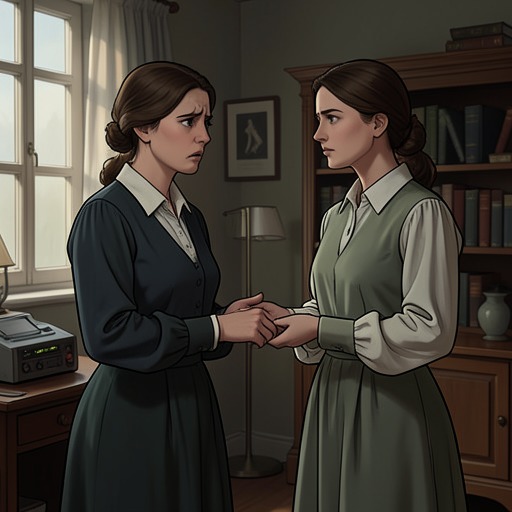
The clearest test of Sachiko’s maternal ideal comes in her plans to leave for America with Frank. Etsuko asks not only whether Sachiko herself expects to manage a new country and language, but what will become of Mariko. Sachiko initially answers that children settle into new surroundings more easily than adults. When Etsuko presses the scale of the change and asks whether Mariko is ready, Sachiko responds impatiently, insisting that she would not leave Japan without carefully considering her daughter’s welfare.
Her defense becomes more explicit: “My daughter’s welfare is of the utmost importance to me, Etsuko. I wouldn’t make any decision that jeopardized her future.” Sachiko says she has considered the matter carefully and discussed it with Frank, and promises that Mariko will be fine. These assurances place responsibility at the center of the proposed move, but they do not answer Etsuko’s particular concern about the child’s readiness. Sachiko instead emphasizes Mariko’s likely adaptability and the availability of schools in America. She also invokes Mariko’s intelligence, her father’s accomplishments, and relatives of high rank on Sachiko’s side, rejecting the idea that their present surroundings define the girl’s capacities.
The exchange exposes a distinction between a mother’s confidence in a child’s prospects and attention to the child’s immediate anxieties. Sachiko frames departure as a decision made for Mariko’s future; Etsuko asks what the transition will mean for Mariko now. Neither woman’s position is reduced to a simple opposition between care and indifference. Rather, the dialogue shows how a promise of future security can be used to meet, and sometimes to deflect, questions about present vulnerability.
War, Family History, and Maternal Claims
Sachiko’s account of Mariko’s birth places motherhood within circumstances shaped by war and social change. She says that things were difficult when Mariko was born and reflects that marrying when she did may have been foolish, since a war seemed to be coming. At the same time, she recalls that people could not know what war would really be like, and that she had married into a highly respected family. Her recollection connects maternal responsibility to a life whose expected conditions were altered by war: family standing and earlier assumptions did not protect her from the scale of that change.
This history gives weight to Sachiko’s insistence that she is making a considered choice for her daughter, but it does not make her assurances conclusive. Her explanation presents experience as a reason to plan carefully, while Etsuko’s questions keep the consequences for Mariko in view. Motherhood here is neither an abstract virtue nor proof that a decision is right. It is a responsibility asserted amid disrupted expectations, with the child’s welfare invoked as the standard by which a mother’s choices should be judged.
The Meaning of Responsibility after the Plan Changes
Later, when Etsuko asks what Sachiko intends to do, Sachiko again defines herself through motherhood. She says she is not a young saloon girl without regard for decency, but a mother whose daughter’s interests come first. The contrast makes maternal duty a claim to respectability as well as a promise of care: Sachiko distinguishes her present identity from a disreputable figure and insists that her decisions should be understood through her obligations to Mariko.
Her immediate plan is to write to her uncle, tell him where she is and what he has a right to know, and discuss the possibility of returning to his house. She now describes America as a land of foreigners and imagines the confusion Mariko might feel with an American father. She concludes that the child has experienced enough disturbance and deserves somewhere settled, adding that it is just as well things have turned out this way. The shift from assuring Etsuko that Mariko will manage in America to presenting settled surroundings as preferable gives maternal responsibility a changing, retrospective shape. Sachiko’s language makes the altered course appear compatible with her enduring priority: whatever the plan, she says, her daughter’s interests come first.
The novel leaves a productive tension between that repeated declaration and the questions surrounding it. Sachiko’s resolve to protect Mariko is real as a stated principle; the evidence also shows how readily she dismisses Etsuko’s concerns when they challenge her judgment. Etsuko’s concern, in turn, is expressed through observation and questioning rather than authority over another woman’s child. Through their exchanges, motherhood emerges as a bond of obligation that is also a contested interpretation of what care requires, particularly when a mother’s hopes for the future compete with a child’s need for stability.