Nagasaki
A Pale View of HillsNagasaki is both a city undergoing visible postwar reconstruction and the setting through which Etsuko recalls a brief, consequential period of her life. Its newly built apartments, unfinished wasteland, tram routes, and memorial landscapes place private choices inside a society still marked by destruction and change. As Sachiko imagines leaving the city for America, and later insists that she will first go to Kobe, Nagasaki becomes not only a home but a point of departure whose promises remain uncertain.
Reconstruction and Domestic Setting
In the period Etsuko remembers, the worst days after the war had passed. American soldiers remained numerous because fighting was under way in the Korean War, yet Nagasaki itself seemed to offer calm and relief. The city carried, in Etsuko’s account, a feeling of change: recovery had begun, but it was incomplete and uneven.
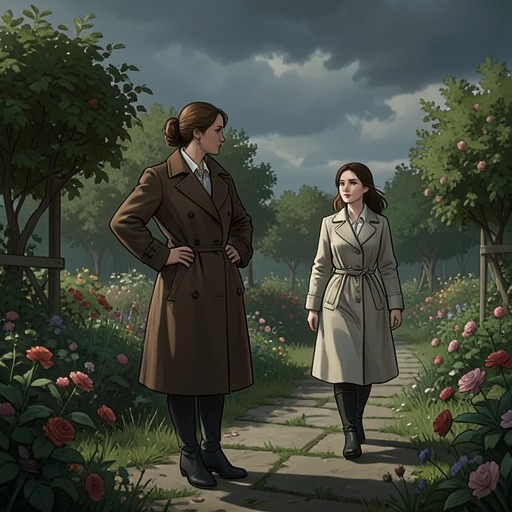
Etsuko and her husband, Jiro, lived east of the city centre, a short tram ride away. A river ran nearby. Etsuko had been told that a small village once stood along its bank, before the Nagasaki atomic bombing left charred ruins. Reconstruction brought four concrete apartment blocks to the area, each containing roughly forty apartments. Their block was the last built, and it marked the point where the rebuilding programme stopped. Between the apartments and the river lay several acres of dried mud, ditches, and waste ground.
The empty land was not a neutral gap awaiting development. Poor drainage left craters full of stagnant water throughout the year, and summer brought intolerable mosquitoes. Officials sometimes measured the ground or wrote notes, but months passed without visible action. The contrast between the completed blocks and the neglected terrain makes recovery feel provisional: buildings have returned, yet the landscape still records both the damage and the limits of repair.
The apartments themselves were compact and identical, with tatami floors and Western-style bathrooms and kitchens. Many belonged to expanding firms, which rented them to employees at generous rates. Their residents were mostly young married couples whose husbands had found good employment. The occupants seemed broadly satisfied, although the apartments were difficult to keep cool in warmer weather. Etsuko nevertheless recalls an unmistakable sense of transience among them, as if everyone expected to move on to something better. The new housing offered security and modern convenience without becoming a settled destination.
Tram Routes and the City’s Memorial Landscape
The tram connects Etsuko’s residential district to the centre and to the city’s other neighbourhoods. On a summer outing, Ogata-San suggested that he and Etsuko look around Nagasaki as tourists might. They took a tram into town, visited an art gallery, and then went to Nagasaki Peace Park, a large public park near the city centre. The ordinary sounds of children and birds did not dispel its solemn atmosphere. Sparse shrubs and fountains left the grass, open summer sky, and memorial statue to define the space.
The Nagasaki Peace Statue commemorates those killed by the atomic bomb. Its seated figure resembles a muscular Greek god, with one arm pointing toward the sky from which the bomb fell and the other extended as if holding back evil. Its closed eyes suggest prayer. The statue translates the city’s history into a public image of mourning and protection, while its placement in an expansive green park sets that image against the ordinary life continuing around it. Etsuko and Ogata-San’s visit makes the memorial part of a familiar urban excursion, but the monument’s gestures keep the violence that shaped the city in view.
After looking toward the statue, Ogata-San decided that they should visit Shigeo Matsuda and then Mrs. Fujiwara. Their tram journey carried them away from the crowded centre toward Nakagawa. As the car travelled, passengers thinned until only a handful remained at the terminus. There, Ogata-San paused in a concrete tram yard enclosed by empty cars and crossed by a maze of black wires. The route gives the city a changing rhythm: crowded streets and lunchtime crowds give way to a sparse outer stop, where Ogata-San has to orient himself before leading Etsuko onward.
A City Remembered as Change
Nagasaki’s postwar transformation remains visible not only in the contrast between rebuilt homes and neglected land, but also in the way residents describe the city over time. Years later, an old woman tells Etsuko that she can hardly recognize Nagasaki. New buildings and streets have appeared, even since the spring, when she had last gone into town. Her recollection is uncertain and touched by grief: she associates that earlier visit with a funeral and reflects that a funeral in spring seems especially sad. The city’s rapid alteration is registered through an ordinary person’s difficulty recognizing familiar surroundings, rather than through a formal account of urban planning.
Etsuko’s own memories similarly measure change by comparing what is present with what has disappeared or been built. She recalls the old house in Nagasaki and says she still stops to look at it when passing. On one occasion she had gone by on her way back from Mrs. Fujiwara’s; she remembers azaleas in the gateway and imagines the new occupants share her affection for them. This small detail preserves a trace of the old home within a changed city. The house has new occupants, but Etsuko’s habit of looking at it keeps her earlier life attached to the place.
Home, Departure, and Imagined Futures
Nagasaki is also the place from which Sachiko’s plans repeatedly seem ready to begin. When Etsuko encounters her again, Sachiko explains that she and Mariko have already been living in Nagasaki for almost a year, on the other side of the city. Later, while Etsuko is worried about Mariko’s absence, Sachiko interrupts the search to announce that everything has been settled and that they will leave for America within days. The announcement turns an anxious walk through the city into a declaration of a future elsewhere.
That future is bound up with Sachiko’s trust in Frank, whose promises she continues to defend even after he disappears. She argues that he came all the way from Tokyo to find her at her uncle’s house in Nagasaki and therefore still intends to take her to America. Her confidence contrasts with her account of an earlier failed attempt: in Tokyo, Frank disappeared and spent their money, including money Sachiko had earned working as a hotel maid. She recalls having scrubbed floors for weeks, only for him to spend the savings in three days. Nagasaki consequently becomes the setting for a renewed emigration plan shadowed by evidence of its fragility.
Sachiko later tells Etsuko that the immediate destination is Kobe, with America to follow, and says that Frank has arranged everything. Her assertion that the decision is final marks a change in the stated route but does not establish what ultimately happens. Within the novel’s recollected account, Nagasaki holds both the physical aftermath of the past and the unstable promise of escape from it. Its rebuilt blocks, changing streets, tram journeys, and remembered houses give the city a double significance: it is a place people try to make into home, and a place from which they imagine beginning again.