Postwar Japan
A Pale View of HillsPostwar Japan in the novel is neither a clean break from wartime destruction nor a settled account of recovery. In Nagasaki, new apartment blocks stand beside wasteground and the remnant of an older landscape; public debate turns to the education that preceded the war, while private memories carry the consequences of violence into family life. The era is defined by that uneasy coexistence: visible change and hopes of renewal, alongside damage and responsibility that remain difficult to resolve.
Reconstruction and everyday life
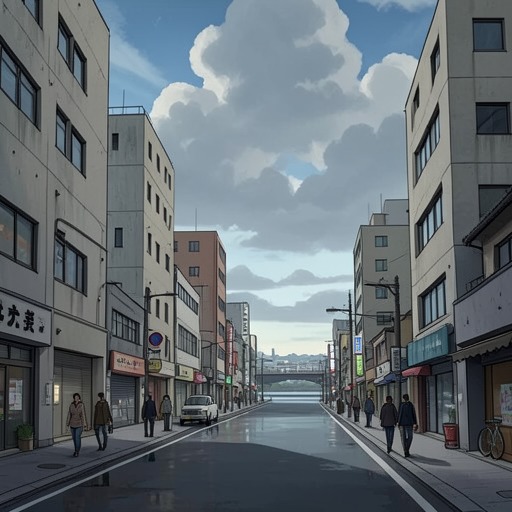
Etsuko recalls a period when the worst days after the atomic bombing seemed to have passed. American soldiers remained numerous because fighting continued in Korea, yet Nagasaki had entered a calmer interval, and the surrounding world felt as if it were changing. That atmosphere of relief was real but incomplete. Etsuko and her husband lived east of the city centre, a short tram journey away, in one of four concrete apartment blocks built during reconstruction. Their block was the last of the four and marked the point where the building programme stopped.
The new housing represented practical improvement and a common domestic pattern. The apartments had tatami floors and Western-style kitchens and bathrooms; many belonged to expanding firms and were rented to their employees at favourable rates. Young married couples, including Etsuko and her husband, made up much of the community. Yet the identical, cramped flats could be difficult to keep cool, and residents seemed to regard them as a temporary stage before better housing became available. The rebuilt environment offered security and employment without making the future feel settled.
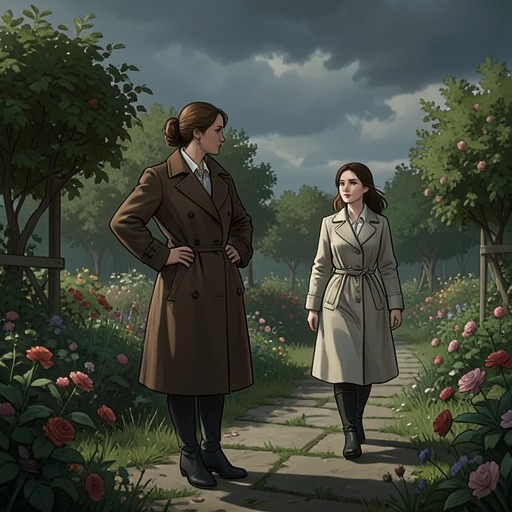
That provisional feeling was sharpened by the land between the apartments and the river. Several acres of dried mud, ditches and craters held stagnant water through the year; in summer, mosquitoes made conditions especially unpleasant. Residents complained, and officials sometimes measured the area or took notes, but no remedy followed. Across this neglected ground stood a wooden cottage that had survived both wartime devastation and the bulldozers. Etsuko watched it from her window and later crossed the difficult terrain on her way to visit Sachiko. Reconstruction, as the novel presents it, is therefore not a uniform advance: concrete housing rose beside an untreated hazard and a surviving fragment of the pre-existing landscape.
Public memory and political dispute
The news and conversation of the period register a country still negotiating its direction. Newspapers discussed the approaching end of the occupation, and politicians argued in Tokyo. Apartment residents followed those matters, though their conversation carried much the same cynicism as their complaints about the wasteground. More immediately, reports of three child deaths in Nagasaki unsettled local families. Mothers became anxious about children being out in the evening, even though the incidents had occurred elsewhere in the city. The contrast between distant political debate and immediate neighbourhood fear gives the postwar setting its everyday scale: national change is discussed, but local safety and unfinished repairs press just as closely.
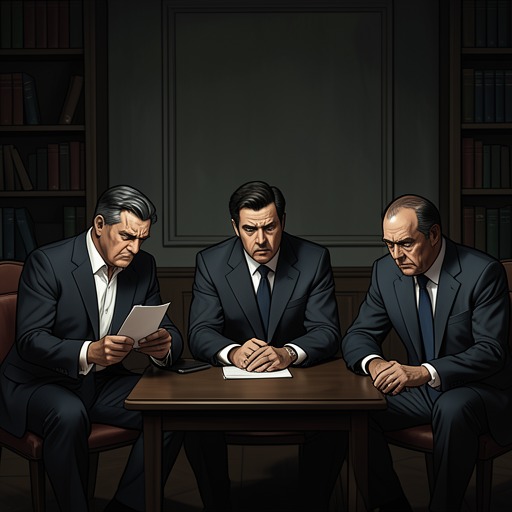
A sharper argument about the past emerges through Shigeo Matsuda’s dispute with Ogata-San. Matsuda stands by an article condemning the education of the older generation. In his account, children had been taught damaging falsehoods and discouraged from questioning; he connects that education to the national disaster. Ogata-San resists this judgment. He argues that Japan lost because it lacked weapons, not because its people were cowardly or society shallow, and recalls the sincere effort to preserve and pass on what he considered the right values. Matsuda grants the older men’s sincerity while insisting that their energies served a misguided and destructive purpose. Their disagreement makes historical responsibility more complicated than either innocence or simple condemnation: good intentions do not settle the consequences of what people taught and upheld.
The dispute also reveals a widening generational divide. Matsuda believes that those who had recognized the danger were punished for speaking, and he looks toward their release as the possibility of a new beginning. Ogata-San hears this confidence as an unconvincing break with the past. Their exchange leaves the prospect of renewal unresolved: the country may change its public language and institutions, but the argument over how to understand earlier commitments continues within personal relationships.
War carried into private memory
The destruction of Nagasaki is one part of a broader history of wartime loss in the recollections Etsuko hears. Sachiko describes Tokyo as a place where weeks of hardship left people living in tunnels and derelict buildings amid rubble. She says Mariko saw terrible things there and remained especially fixed on one encounter. As Sachiko recounts it, Mariko ran into the streets one morning, and Sachiko followed her to a canal, where they encountered a young woman who had taken her own life and a baby she had been holding under the water. Sachiko says that she took Mariko away from the scene. The account is not presented as Etsuko’s own wartime memory, but as a story passed between women and preserved in Mariko’s recurring attention to it.
This remembered encounter links wartime devastation to later questions of care and responsibility. Sachiko recalls that Mariko had seen other terrible events in Tokyo, yet this one remained with her. The narrative gives no simple explanation for that persistence; instead, the child’s enduring fixation shows how an experience can remain present through memory and retelling. War is not confined to a completed national past. It survives as an intimate account whose meaning is only partly disclosed, and whose weight shapes how the adults understand a child’s distress.
Etsuko’s own memories are similarly unsettled by hindsight. She recognizes that memory can be coloured by the circumstances in which it is recalled. What she is tempted to remember as a premonition may have been no more than an ordinary daydream, intensified in retrospect by the neighbourhood’s shock at reports of child deaths. Her account thus refuses to make the past perfectly legible. The reader sees both the events she recalls and her awareness that later grief may alter their apparent significance.
Change, family, and the limits of recovery
The postwar period’s changes reach beyond rebuilding and public argument into the expectations governing family life. Years later, Etsuko regrets opposing Keiko’s wish to leave home. She had believed that the outside world would overwhelm her daughter and that resistance was protective; in retrospect, she sees that Keiko’s eventual departure severed their ties. Etsuko’s reflection places a personal decision within a changing social context in which a young woman leaving home is not unexpected. The change does not erase the cost of their estrangement, and Etsuko cannot reduce it to a single cause.
Her memories of both daughters further unsettle simple explanations. Jiro treated Keiko as difficult by nature and implied that she had inherited her disposition from him, a view Etsuko found easier not to challenge. But she remembers that Keiko and Niki had been alike as children: both could be possessive, quick-tempered and slow to let go of anger. Their later lives diverged sharply, and Etsuko resists attributing that difference simply to nature or to Jiro. Niki, in turn, suggests that Jiro did not look after Keiko fairly. The disagreement leaves responsibility distributed across family members rather than resolved by one account.
Postwar Japan in these recollections is therefore a setting of uneven reconstruction and contested interpretation, not a finished story of national recovery. Nagasaki’s new flats coexist with neglected ground; the public debate about education confronts the gap between intention and consequence; and Etsuko’s family carries the past in departures, silences and memories whose reliability she questions. The period’s promise of change matters precisely because it cannot by itself repair what was lost or settle who bears responsibility for it.