Postwar Japanese reflection on militarist education and historical responsibility
A Pale View of HillsPostwar Japanese reflection on militarist education and historical responsibility takes shape in a dispute between a retired teacher and a former student who has publicly challenged the education of their generation. Ogata-San remembers service to the country and the passing down of shared values; Shigeo Matsuda argues that schools taught damaging falsehoods and discouraged questioning, helping prepare Japan for disaster. Neither account can be detached from the narrator’s recollection of a family inclined to postpone uncomfortable confrontations, making the question of responsibility both historical and personal.
The article and its delayed confrontation
While visiting a library in Nagasaki, Ogata-San finds a teachers’ periodical he had not known before. Its political tone surprises him, and he discovers that his former pupil Shigeo Matsuda has written an article mentioning him. Ogata-San initially recounts the discovery as an odd, almost amusing incident, but the reference has unsettled him: he does not think of himself as a figure noteworthy enough to be singled out. The article turns a private professional past into a public argument about what teachers did and what their work meant.
Etsuko later understands that Jiro was waiting for his father to return to Fukuoka, hoping the matter would then be forgotten. Jiro readily agrees that an attack on the family name should be handled promptly and firmly, and says he will write to his old school friend, but his agreement does not become action. Etsuko recognizes this as characteristic of his way of facing awkward confrontations. She herself wants him to make his position clearer to Ogata-San, yet holds back: she expects Jiro to regard the matter as none of her business, knows he is often tired at night, and describes open discussion as foreign to their marriage. The dispute over public accountability is thus accompanied by a smaller domestic failure to speak plainly.
Two accounts of what schools taught
Ogata-San’s defense of the old school system grows from his conviction that discipline, loyalty, and duty once held Japan together. He believes the Americans dismantled a system carefully nurtured over many years and replaced it with schools modeled on their own. In his view, the language of democracy can become an excuse for selfishness and disregard of obligations to family, superiors, and country. He mourns the disappearance of values and historical knowledge, including his claim that children can leave school knowing little about their own national history.
Jiro complicates this defense by recalling what his own schooling demanded: students learned that Japan had been created by the gods, that the nation was divine and supreme, and that the textbook had to be memorized word for word. His recollection makes the old system’s lessons concrete rather than merely idealized. The same schools Ogata-San associates with national cohesion also transmitted claims of divine superiority as unquestionable fact. Jiro does not deny that the loss of historical knowledge may be regrettable, but his example shows why preserving the old curriculum cannot simply be equated with preserving sound values.
Matsuda’s charge and Ogata-San’s reply
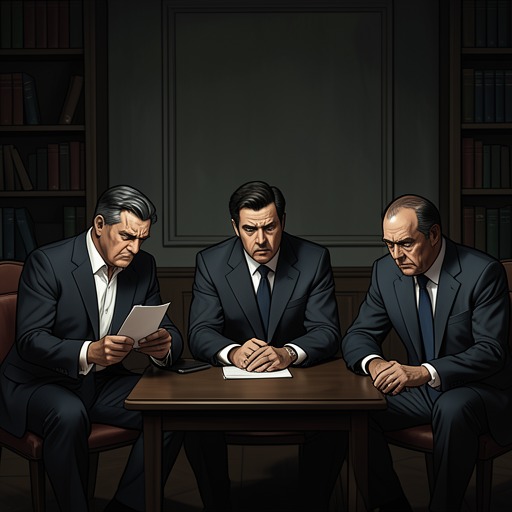
When Ogata-San finally speaks with Matsuda, he asks whether his former pupil truly believes the article and what led him to write it. Matsuda answers that he still believes it: children in Japan were taught damaging lies and, most seriously, taught not to see or question. He connects that education to the country’s descent into a national catastrophe. His criticism therefore concerns more than inaccurate lessons; it assigns schools a role in cultivating habits of thought that could leave students unable to examine the claims made in the nation’s name.
Ogata-San answers that Japan lost the war for want of guns and tanks, not because its people were cowardly or its society shallow. He emphasizes the effort of teachers such as himself and Dr Endo, who believed they were safeguarding proper values and handing them on. Matsuda does not dispute their sincerity or hard work. Instead, he argues that their energies served a misguided and evil direction, even if they could not understand the consequences at the time. Their disagreement is therefore not resolved by proving that one man cared and the other did not: they dispute what care and professional devotion produced, and how far a person can be held responsible for consequences not foreseen.
Matsuda makes that responsibility more specific by citing the dismissal and imprisonment of five teachers at Nishizaka. He presents their freedom after the war as a reason for hope and says they can help lead the country toward a new dawn. Ogata-San rejects the confidence of this appeal and asks who taught Matsuda to speak so assuredly. Yet Matsuda’s reference to particular teachers and punishments places the old educational system within an institutional history, not only a debate over abstract national character. The encounter ends without agreement: Matsuda leaves, and Ogata-San watches him go before remarking on the confidence of young men and remembering that he too was once certain of his opinions.
Memory, responsibility, and the limits of certainty
The novel presents this argument retrospectively, through Etsuko’s account of conversations and silences. In an earlier conversation, Ogata-San encounters the article in a library and describes its suggestion that communism is growing among teachers; later, the disagreement emerges as a direct confrontation with Matsuda. The movement from reported discovery to face-to-face dispute lets the subject develop from a family anecdote into a contested interpretation of national history. Etsuko’s later recognition that Jiro was delaying the matter also complicates any simple division between those who speak and those who avoid responsibility: the family’s own evasions shape what can be acknowledged.
The dispute offers no neutral verdict that makes memory transparent. Ogata-San’s recollection stresses obligation, devotion, and the damage caused by postwar changes; Matsuda’s criticism insists that sincerity does not erase harmful teaching or its consequences. Jiro’s textbook memory supplies a concrete counterexample to nostalgia, while Matsuda’s reference to the five teachers supplies a concrete counterweight to the idea that the older system merely transmitted benign civic values. Together, these perspectives frame historical responsibility as a question of both intention and effect: a teacher may have worked sincerely, yet still have helped pass on ideas and practices that later generations judge destructive.