Postwar reconstruction and national recovery
A Pale View of HillsPostwar reconstruction and national recovery are presented as a physical transformation that cannot by itself settle the losses and tensions left by war. In Nagasaki, rebuilt apartments and a lively harbor testify to change, while neglected ground and the memories carried by Etsuko, Sachiko, and their families keep the catastrophe present. Recovery is real, but incomplete: it offers a future without making the past disappear.
Reconstruction in the landscape
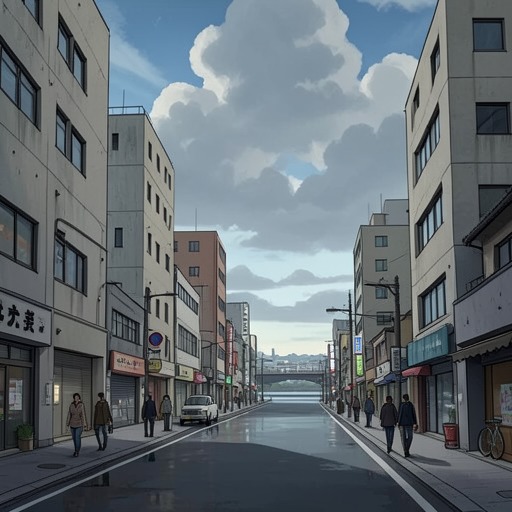
The postwar setting begins with a marked change in atmosphere. The worst days have passed, and although American soldiers remain numerous because fighting continues in Korea, Nagasaki has entered a period of relative calm and relief. Etsuko remembers a world that seems to be changing. That impression is supported by the city itself, where rebuilding has begun after the bomb left a former riverside village in charred ruins.
The rebuilding is visible in the east of the city, a short tram ride from the center. Four concrete apartment blocks have been erected beside a river; each contains roughly forty apartments. Etsuko and her husband live in the newest block, which also marks where the rebuilding programme has stopped. Beyond it, the ground remains vacant and damaged. The scene therefore places new construction and an unfinished landscape within the same view: the buildings register recovery, while the empty stretch toward the river records its limits.
Housing, delay, and provisional recovery
The apartments offer a recognizable form of postwar improvement. Their floors are tatami, but their kitchens and bathrooms follow Western designs. Young married couples occupy them, and many units belong to expanding firms that rent them to employees at generous rates. The residents generally seem satisfied with this arrangement, which provides employment-linked housing and the promise of ordinary domestic life. Yet the dwellings are identical, small, and difficult to keep cool in warm weather. Etsuko also recalls a shared feeling of transience, as if the residents expected to move on to somewhere better. The new blocks are thus both evidence of recovery and provisional homes rather than a settled destination.
Outside them, the uncompleted ground makes the limits of that improvement concrete. It consists of several acres of dried mud and ditches, with poor drainage and craters that hold stagnant water throughout the year. In summer, mosquitoes become intolerable; residents complain that the area is a health hazard. Officials sometimes pace out measurements or make notes, but months pass without remedial work. By summer, the earth has cracked while water remains in deeper ditches and craters, and insects are widespread. Neighbors’ anger has hardened into resignation and cynicism. The contrast is not simply between ruins and new buildings: it is between visible investment in housing and a hazardous public space left unattended.
Recovery as a public and personal outlook
A visit to the mountain above the harbor gives Etsuko and Sachiko another perspective on the rebuilt city. From their vantage point, the harbor looks like machinery in the water; across it, houses and buildings fill the foot of the hills leading into Nagasaki, and the harbor opens toward the sea. The area appears full of life, though Etsuko points out that it was badly hit when the bomb fell. The view holds destruction and renewal together, making the changed city itself an argument for hope without implying that the damage has been forgotten.
Etsuko connects that hope to Mrs. Fujiwara, who lost her husband and four of her five children when the bomb fell; only her eldest son survived. Her noodle shop came after she lost everything. Etsuko takes Mrs. Fujiwara’s persistence as an example of looking toward the future, and she contrasts the woman’s bereavement with her own expectation of starting a family. Sachiko asks about Mrs. Fujiwara’s past, and Etsuko’s account makes clear that postwar work and ordinary enterprise follow immense personal loss. The noodle shop is not a symbol of effortless renewal, but evidence of a life reorganized after catastrophe.
The past that rebuilding cannot remove
The novel also sets the rebuilt city against memories of wartime displacement. Sachiko explains that Tokyo, too, suffered repeated destruction and that she and Mariko lived among tunnels, derelict buildings, and rubble. Mariko remembered a woman she had encountered beside a canal with a baby; Sachiko says the woman had ended her life. The account belongs to another city and another part of the war’s aftermath, but it complicates any simple equation between reconstruction and recovery. A landscape may fill again with buildings and activity while frightening experiences persist in a child’s memory and shape what a mother carries forward.
That persistence also appears in Etsuko’s later understanding of her family. She regrets opposing Keiko’s wish to leave home, believing that her attempts to protect her daughter instead contributed to Keiko’s departure with their ties severed. Niki comes to reassure her that she should not blame herself, while also reflecting on how little attention Keiko received and how unfair that was. These memories do not establish that national reconstruction caused the family’s estrangement or loss. Rather, they show how the novel places public recovery beside private histories that remain unsettled. The new buildings and the living city mark a way forward; the damaged ground, recalled wartime scenes, and grief over Keiko reveal what that forward movement cannot resolve.