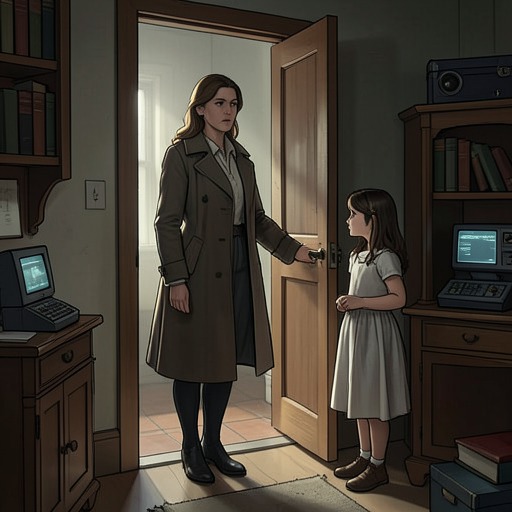
Sachiko
A Pale View of HillsSachiko is a newcomer to postwar Nagasaki whose hope of building a life in America shapes her dealings with Etsuko and her daughter, Mariko. Seen first from a distance and later through a series of intimate encounters, she remains difficult to read: confident about leaving, yet repeatedly confronted by financial uncertainty, her daughter’s distress, and the practical demands of the departure she has planned.
Arrival and precarious plans
Sachiko and Mariko live in a solitary, dilapidated cottage beside the river, set apart from the identical apartment blocks where Etsuko lives. Their arrival draws notice. Residents discuss men seen working at the cottage and speculate about the woman and child living there; Etsuko later sees the two crossing the rough ground. At a tram stop, local women describe Sachiko as unfriendly and speculate about her age and origins. They notice her Tokyo dialect and talk of an American friend. These are neighborhood impressions, not a reliable account of Sachiko’s character, but they establish her as an outsider around whom others construct explanations.
Her circumstances are less secure than her resolve can suggest. When some arrangements have failed, Sachiko asks Etsuko for a small loan. She presents the need as limited and assures Etsuko that repayment will be made through the post. The request makes their friendship materially consequential: Etsuko’s kindness is not only companionship but practical support for a woman attempting to arrange a move with a child.
Sachiko describes the prospect of America with confidence. She believes that having heard so much about the country will make it feel less foreign, and says that she already speaks English because she and Frank converse in it. She expects that living there will help her speak it like an American woman. Her assurance that she will manage is not matched by the same certainty about Mariko. When Etsuko asks what will become of the girl, the question shifts attention from Sachiko’s imagined adaptation to the child who must accompany her into an unfamiliar future.
Mariko, memory, and unease
Sachiko’s account of a woman Mariko saw in Tokyo reveals a disturbing episode that has remained in the girl’s memory. Sachiko recalls chasing after Mariko one morning, following her down an alley to a canal, where a young woman was present with a baby. Sachiko says the woman later died by suicide. She does not claim to have known her. The episode belongs to Mariko’s past, but Sachiko’s retelling makes it part of the present relationship between mother and daughter: Etsuko hears that Mariko has carried the encounter with her, while the account leaves the circumstances of the woman’s death beyond what Sachiko herself can explain.
A later moment on a tram briefly renews that unease without resolving it. Sachiko suddenly notices a thin-faced woman looking toward Mariko. Mariko remains unaware, looking out of the window, while the woman turns away and leaves when the tram stops. Etsuko observes Sachiko’s reaction and asks whether she knows the passenger, but the scene does not establish who the woman is or what connection, if any, she has to the earlier account. Sachiko’s alarm is visible; its cause remains uncertain.
Departure and the kittens
When Etsuko finds Sachiko packing, Sachiko confirms that she and Mariko are leaving Nagasaki. She says she had intended to come and say goodbye after finishing, and repeats that Etsuko will be repaid for the loan. The immediate destination is Kobe; America, she says, will follow, with Frank having arranged everything. Her quick smile accompanies the declaration, but the evidence establishes the plan as Sachiko presents it, not what ultimately becomes of it.
The packing also brings her plans into conflict with Mariko’s attachment to the kittens. Mariko holds one while a vegetable box she won at a lottery stall has become a makeshift home for them. When Mariko reminds Sachiko that she had been allowed to keep the animals, Sachiko says circumstances have changed and insists that they cannot take them. Her irritation rises as she rebukes Mariko for being so attached. The exchange turns the move from an abstract promise of a new life into a choice with an immediate cost for the child: what Sachiko regards as an impractical attachment is something Mariko believed she had been permitted to keep.
At the river, Etsuko suggests letting the kittens go in the hope that someone might take them. Sachiko instead opens the box, removes a kitten, and puts it into the water, holding it there. She reduces the act to the claim that it is only an animal. Mariko watches from the top of the slope, still and expressionless as Sachiko looks back toward her. The scene records one kitten’s death and a direct rupture between Sachiko’s dismissal of the animals and Mariko’s investment in them; it does not explain what Mariko makes of what she has witnessed.
Character and narrative significance
Sachiko’s expressed certainty about America stands beside the instability of the evidence around her: plans have gone wrong, she needs to borrow money, and her proposed departure requires decisions that disappoint Mariko. The gap does not prove that she is lying about the future, but it prevents her confidence from settling the question of what the move will mean or whether it will happen as described. Kobe is named as the next stop and America as the destination beyond it; the account offers no confirmation here of the outcome.
Her bond with Mariko is shown through competing claims rather than an easy picture of maternal care. Sachiko takes responsibility for the practical business of leaving, yet dismisses an attachment she had apparently allowed her daughter to form and proceeds to kill a kitten in front of her. That contradiction gives the planned journey its moral weight: Sachiko’s imagined escape depends on choices made for both of them, while Mariko’s experience of those choices remains distinct from her mother’s confident account. As Etsuko recalls their encounters, Sachiko is presented both through what she says she intends and through actions that complicate the promise of a fresh start.