Sachiko and Mariko
A Pale View of HillsSachiko and Mariko’s relationship is defined by a sharp tension between maternal responsibility and the pursuit of escape. As Sachiko prepares to leave Nagasaki, Mariko’s protests over the kittens she was promised become a concrete test of whether her mother will honor her wishes. Sachiko insists that Mariko comes first, yet dismisses her attachment as childish and acts against it. Their conflict is not resolved in the available scenes; it remains bound up with Sachiko’s uncertain plans to leave for America and her admission that she may not be a good mother.
A future planned around departure
At first, Sachiko tells Etsuko that everything has been settled and that she and Mariko will leave for America within days. The announcement makes their relationship part of a larger, shared plan: Sachiko speaks for both of them, while Mariko’s wishes and security are implicated in a move whose destination promises a different life. But Sachiko’s certainty rests heavily on Frank’s intentions. When he disappears, she argues that his journey from Tokyo to Nagasaki to find her proves he still means to take them to America; his absence, she insists, is only a delay.
That confidence is undercut by what Sachiko later tells Etsuko about their earlier experience in Tokyo. Frank had disappeared and spent their money drinking in three days, including money Sachiko had earned. She recalls working as a hotel maid, scrubbing floors on her knees for weeks in the hope of saving enough to travel, only to see that effort vanish. She now says Frank is again at a bar with a saloon girl and asks how she could place her daughter’s future in the hands of a man like him. Her declaration that she is a mother and that her daughter comes first sounds like a hard-earned principle, but the history she recounts also shows how often their future has depended on Frank and on plans that have failed before.
The kittens as a test of care
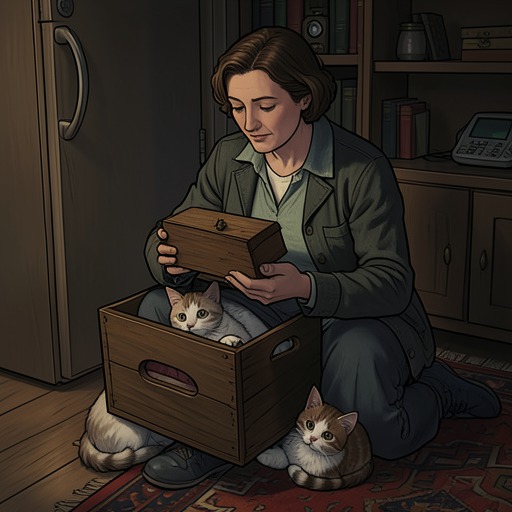
The tension becomes immediate while Sachiko is packing. Mariko asks whether her mother has decided, then reminds her that she had been told she could keep the kittens. Sachiko is occupied with the luggage, including a box holding a tea set; she shakes the box, hears the china rattle, and tears cloth into strips. Against these preparations, Mariko repeats the promise. Sachiko answers that circumstances have changed and asks how they could possibly take all the animals with them.
Sachiko first turns the question into a lesson in what she considers practical necessity. She says they will have to leave the kittens behind, calls Mariko’s attachment sentimental, and insists that the child must grow up and recognize that there are other things besides the animals. When Etsuko offers to feed the kittens until they find homes, Mariko does not take that reassurance as a substitute for what her mother promised. She repeats that Sachiko said she could keep them.
Sachiko then rises, goes to Mariko’s corner, and puts the kittens into a vegetable box, turning it so its wire-grid panels face upward. She does this one by one while Mariko still clutches the remaining kitten. The scene makes their disagreement physical: Sachiko’s packing and departure determine what can be taken, while Mariko holds on to the last animal and looks toward Etsuko. The available evidence records Sachiko asking Mariko to give it to her, but does not establish what happens to that kitten afterward.
Conflicting claims about motherhood
Sachiko has earlier described Frank’s fear of responsibility for Mariko as unacceptable and said that her daughter comes first. She presents Frank’s unreliability as a reason to protect Mariko’s future from him. Yet in the packing scene, she gives little weight to Mariko’s repeated appeal to a promise and treats the child’s distress as childish obstruction. The contrast is not simply between a caring mother and an uncaring one: Sachiko’s stated concern for her daughter coexists with decisions made in the name of leaving and with an impatience that Mariko experiences directly.
Later, Sachiko acknowledges to Etsuko that she may never see America and knows how difficult life there would be. Even so, she asks what she has to lose by going to Kobe: at her uncle’s house, she says, there is nothing but empty rooms and the prospect of growing old. When Etsuko asks about Mariko, Sachiko says that the child will manage well enough, then asks whether Etsuko thinks she is a good mother. Etsuko remains silent. Sachiko’s question brings the practical dispute over the kittens into a wider uncertainty about her care for her daughter, without supplying a final answer.
An unsettled bond and an imagined elsewhere
Sachiko’s plans shift in emphasis but not in their promise of departure. She announces that they are leaving Nagasaki for Kobe, says Frank has arranged what comes afterward, and expects him to arrive with the car the next morning. The movement from an imminent journey to America to Kobe first leaves the destination beyond Kobe dependent on Frank once again. Sachiko’s later admission that America may remain out of reach makes the contrast between hope and risk explicit, while her defense of going to Kobe rests on the emptiness she associates with staying at her uncle’s home.
The relationship is narrated through Etsuko, who witnesses Sachiko’s reassurances, hears her account of past hardship, and tries to intervene when Mariko fears for the kittens. Elsewhere, Etsuko remembers arriving in England and being pleased that the fields and house looked as she had imagined England would; by the time she recalls the landscape again, trees have grown where there were once fields. That recollection offers a distinct counterpoint to Sachiko’s imagined America: departure can bring a desired new setting, but it does not make the future predictable. For Sachiko and Mariko, the immediate cost of that uncertainty falls into the space between a mother’s plans and a daughter’s insistence that a promise still matters.