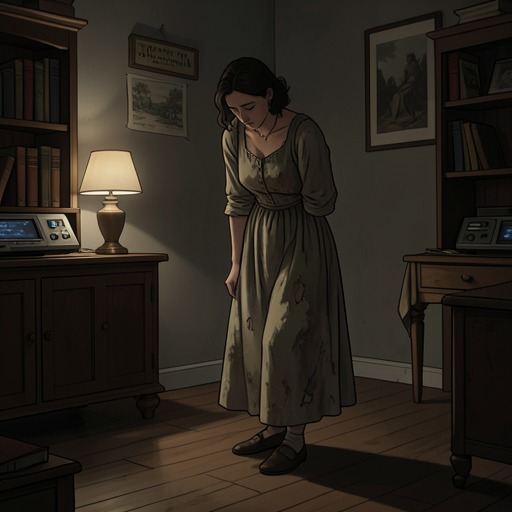
Sachiko and Yasuko Kawada
A Pale View of HillsSachiko and Yasuko Kawada are cousins whose relationship is defined by a small family quarrel that grows into a consequential separation. When Yasuko comes to Sachiko’s cottage in Nagasaki, she expects that Sachiko and Mariko will soon be living with her and her father. Instead, she finds them absent and learns that Sachiko has left after a disagreement. Her account joins affection and regret to a wish that Sachiko return to the family household, revealing how differently the cousins understand Sachiko’s future.
Kinship and the expected household
Yasuko identifies herself to Etsuko as Sachiko’s relative and cousin. She explains that she and her father had been expecting Sachiko to come and live with them. This was not a vague hope: Yasuko says they had expected her three weeks earlier, and she has come to ask after her. The visit establishes a concrete family destination for Sachiko and Mariko, one that sits uneasily beside Sachiko’s stated intention to leave for America.
The household Yasuko describes is already shaped by absence. She says that she and her father miss Sachiko and Mariko, and that her father can hear how much quieter the house has become. He reportedly compared its stillness to a tomb. Yasuko presents their return not merely as a practical arrangement but as the restoration of company and life to a home that has lost them. Her appeal is therefore both personal and familial: she misses her cousin and Mariko, and believes her father would benefit from their presence.
The quarrel and sudden departure
Yasuko tells Etsuko that she and Sachiko had a slight disagreement, which she calls a misunderstanding. She was surprised, she says, to discover that Sachiko had packed and left the next day. Yasuko insists that she had not meant to offend her, repeating the denial after acknowledging that her father blamed her for what had happened. The repetition conveys the weight of her regret without clarifying what was said or assigning a definitive account of the quarrel.
That limited explanation matters. Yasuko describes the rupture as an unintended offense, while the speed of Sachiko’s departure gives it lasting consequences: a disagreement that Yasuko thought slight becomes a break in contact and an unexpected absence from the family home. Yasuko confesses that she has missed both Sachiko and Mariko since they left. Her words make clear that the separation is not simply a difference of plans; it has deprived the relatives of a relationship and companionship they valued.
Etsuko as intermediary
Unable to find Sachiko, Yasuko asks Etsuko to pass along a message. She wants Sachiko to know that she came and was asking after her, and that she regrets losing her temper and saying things she now considers foolish. Etsuko agrees to convey her feelings. The exchange makes the neighbor a go-between for cousins who are not speaking directly, while leaving open whether Sachiko will receive the message or respond.
Yasuko’s account also exposes a gap in what the family knows. Etsuko realizes that Sachiko’s uncle and cousin apparently do not know about her American friend. That omission places Yasuko’s expectation of a shared household beside a future Sachiko has been pursuing elsewhere. Sachiko had earlier accepted Etsuko’s offer of financial help in connection with her delayed departure for America, promising that a loan would be repaid; in another conversation she had first redirected an offer of money toward a request involving Mrs. Fujiwara’s noodle shop. These exchanges show how the plans and explanations available to Etsuko differ from the family’s expectation that Sachiko will join Yasuko and her father. The evidence does not establish exactly what Yasuko knew about the American plan, but it does show that the relatives’ expectations were not aligned with the future Sachiko described to Etsuko.
Affection, obligation, and unresolved distance
Yasuko’s wish for a reunion is not free of traditional assumptions. Alongside her concern for Sachiko and her father, she argues that a woman should not be without a man to guide her and predicts harm from such a situation. Her appeal thus combines affection with a belief about how a woman ought to live. She wants Sachiko back for the family’s sake, but also judges Sachiko’s independence through a conventional model of dependence and guidance.
The relationship remains unresolved. Yasuko expresses remorse and longing, and Etsuko promises to carry her message, but the encounter provides no reconciliation and no confirmation that Sachiko will return. Its emotional force lies in that distance: Yasuko understands the separation as the result of an offense she did not intend, while Sachiko’s departure forms part of a larger attempt to shape a different future. Their cousinhood persists, but it does not overcome the mismatch between family expectation, personal choice, and what each side has been told.