Sachiko decides to leave Nagasaki
A Pale View of HillsSachiko decides to leave Nagasaki while packing for a departure she presents as settled: she and Mariko will leave the following morning for Kobe, then continue to America with Frank. The decision is consequential not only because it ends their life in Nagasaki, but because Sachiko clings to the promised journey despite Frank’s repeated disappearances and her own account of the losses he has caused. Recalled by Etsuko, the scene holds resolve and uncertainty side by side: trunks are being filled, the car is expected, and Sachiko insists that this time Frank will come through.
Background and the promise of America
Sachiko’s departure is the latest stage of a plan she has described to Etsuko as already arranged. Earlier, she announced that she and Mariko would be leaving for America within days. When Frank later disappears, Sachiko initially treats his absence as a delay rather than a repudiation. She reasons that he must still intend to take them because he had travelled from Tokyo to Nagasaki to find her at her uncle’s house. In her account, that journey is proof that the promise of a new life remains intact.
Her confidence is set against a history she eventually recounts in detail. During an earlier attempt to reach America from Tokyo, Frank disappeared and spent their money drinking it away in three days. Sachiko says that much of the money was hers: she had worked as a hotel maid, scrubbing floors on her knees, and they had been only a few weeks from having enough for a ship. She also describes the present disappearance, when Frank is at a bar with a saloon girl. The parallel is stark: the same migration hope has survived one failed attempt, while the man expected to make it possible has again become a source of financial and emotional risk.
Packing and the announced route
When Etsuko visits, Sachiko is still packing her trunk. She confirms that she and Mariko are leaving in the morning, explains that the luggage will go in the car, and says they are leaving Nagasaki. Her route is specific: Kobe first, America afterward. She presents the arrangements as final and says Frank has arranged everything. The shift from her earlier announcement of an imminent journey to this staged route makes Kobe the immediate destination and America the larger promised future, rather than the place they will reach the next day.
The room gives the declaration a material weight. Luggage lies across the floor, and Sachiko has so many belongings that she must leave some behind. She offers Etsuko the items she cannot take, asking her to make use of those that are still of decent quality. She also assures Etsuko that a loan will be returned through the post. These practical details sit beside the grander promise of America: departure depends on what can fit in the car, what must be abandoned, and whether Frank will arrive as expected.
Maternal resolve and doubt
Sachiko insists that she is relieved to leave her uncle’s household and describes the place as squalid. At the same time, she recognizes Etsuko’s doubt and answers it directly: Frank will be there with the car first thing in the morning, and he will not let her down this time. Her certainty is not supported by a new demonstration of his reliability in the scene; it is an assertion made in the face of the history she has just disclosed. Her insistence turns the departure into an act of commitment as much as a logistical plan.
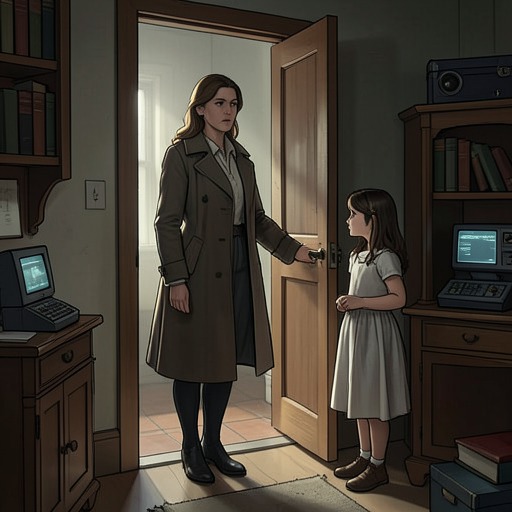
She has also framed her judgment of Frank in terms of Mariko’s future. When explaining his earlier failure, Sachiko says that children mean responsibility and that Frank is frightened of that responsibility. She declares that her daughter comes first. Yet Mariko’s presence in the packing room keeps the consequences of the decision visible. The girl watches her mother, holding a kitten that struggles to join the others on the tatami. Nearby, a vegetable box Mariko won at a lottery stall has become a house for the kittens. When Mariko suddenly asks whether Sachiko has decided, her mother postpones the conversation because she is busy. The preparations are therefore not simply Sachiko’s private escape: Mariko is present, watching, and asking what will happen.
Narrative significance
The scene’s tension comes from the gap between Sachiko’s confidence and the evidence she herself supplies. She has already lost money and time through Frank’s drinking, and his present absence recalls the earlier one; nevertheless, she interprets his past journey to Nagasaki as proof that the American plan remains genuine. Her departure is a concrete decision, but its promised endpoint is still dependent on Frank’s arrival and on a future she cannot yet verify. The packing continues while that uncertainty remains unresolved.
Etsuko’s later recollection of arriving in the English countryside offers a distinct image of migration’s promises and afterlives. She remembers that the house and surrounding fields once seemed exactly like the England she had imagined, before trees grew where open fields had been. That memory does not resolve Sachiko’s story, but it places her confidence in America beside Etsuko’s account of an imagined destination becoming an altered lived place. In Sachiko’s departure, the future is spoken of as settled; the scene itself preserves the fragile conditions on which that certainty rests.