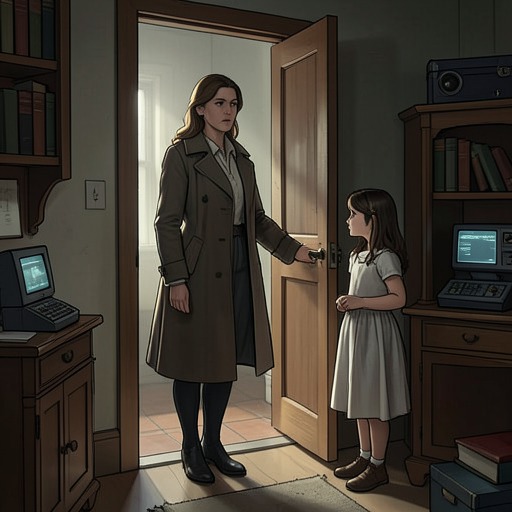
Sachiko's broken trust in Frank and decision to abandon their plans
A Pale View of HillsSachiko’s relationship with Frank is defined by a reversal: she initially presents their move to America as settled and trusts his promises despite his disappearance, but eventually resolves not to place Mariko’s future in his hands. The planned emigration depends on her confidence that Frank will provide a new life; its collapse brings to the surface a history of vanished money, exhausting work, and repeated uncertainty that her earlier reassurances had held at a distance.
A shared plan for America
When Sachiko tells Etsuko that the arrangements are settled, she says that she and Frank will leave for America within days. Her confidence rests in part on a sense that the destination will not be wholly foreign to her: she has heard so much about America, and she and Frank already speak English together. She expects that living there will allow her to speak the language like an American woman. The plan thus appears to her not as an abstract escape but as a practical future she believes she can manage with Frank.
That confidence shapes how Sachiko answers Etsuko’s concern about the difficulties of moving to another country. She acknowledges that she sometimes wonders how things will turn out, but insists that she will manage. Her assurance helps sustain the appearance of certainty around the plan even as Etsuko directs her attention to the unanswered question of what will become of Mariko. The relationship’s central tension is already present: Sachiko speaks of the move as a new beginning for herself and Frank, while Etsuko presses her to consider the child whose life the decision will also determine.
Frank’s disappearance and Sachiko’s reassurance
When Frank is absent, Sachiko initially interprets his disappearance as a delay rather than a rejection. She tells Etsuko that if he meant to leave her, he would have left a note, and reasons that he knows she will come and find him. She also treats his earlier journey from Tokyo to Nagasaki, where he came to find her at her uncle’s house, as evidence that he meant what he had promised. In her account, the journey confirms his commitment to taking her to America and leading a steady, respectable life there; his present absence is only a slight postponement.
This defence makes the relationship appear secure by returning repeatedly to its promised destination. Sachiko frames Frank’s past effort as proof of his intentions, even while Etsuko questions what his departure means. Her laughter and confident explanations do not resolve the uncertainty surrounding him. Instead, they show how strongly she relies on the future they planned to make sense of the present: if America remains their goal, his disappearance can still be described as temporary. That interpretation changes when Sachiko connects the current absence to what happened before.
The earlier cost of trusting him
In the confrontation involving Mariko, the child’s accusation gives the pattern a domestic consequence. With tears in her eyes, Mariko asks why her mother always goes away with Frank. Sachiko first demands an apology, and Mariko responds with an insult about him. The exchange places Frank not simply in Sachiko’s plans but in the recurring absence that Mariko resents. It also sharpens the conflict between Sachiko’s pursuit of a life with him and her responsibility to her daughter.
Sachiko then tells Etsuko that a similar episode took place in Tokyo. Frank disappeared and spent all their money drinking in three days; some of the money had been hers. She had worked as a hotel maid, scrubbing floors on her knees, and they had nearly saved enough to take a ship to America when he spent the money. Her account links the current disappearance to a prior, concrete loss: the future they had been working toward was once brought close and then undone through his drinking. She says he is now at a bar with a saloon girl, and asks how she can place her daughter’s future in the hands of a man like that.
Choosing Mariko over the plan
The disclosure alters the meaning of Sachiko’s earlier reassurances. Her confidence that Frank will return and take her to America has coexisted with knowledge of a previous failure that cost her both money and weeks of difficult labor. Once she names that history, she no longer describes the present as a minor setback. She states that she had expected it to happen and concludes that she cannot trust Mariko’s future to him. The relationship is judged not only by Frank’s promises to Sachiko but by the consequences of relying on him for the child’s security.
Sachiko declares, “I’m a mother, and my daughter comes first.” She says she will discuss the matter with her uncle for Mariko’s sake; if he is unhelpful, she will find another course. She also makes clear that she has no intention of accompanying Frank to America. The decision breaks the link between their relationship and the emigration plan that had organized her hopes. Rather than presenting the move as settled, she now treats Mariko’s welfare as the criterion by which any future choice must be made.
The relationship’s unresolved ending
Sachiko’s decision is definite in intention, but the scene does not establish what alternative she will take or what ultimately happens to Frank. She rises and looks out into the darkness while Etsuko asks whether they should go and search for Mariko. The immediate uncertainty about the child remains, even as Sachiko has withdrawn her trust from the shared plan with Frank.
The relationship is therefore shown through competing accounts of what Frank’s conduct means. At first, Sachiko uses his journey from Tokyo and his promises as evidence that he remains committed; after recounting the lost savings and her work in the hotel, she recognizes the danger of repeating that reliance. Her turn does not erase her former hope of going to America, but it changes its priority: a future with Frank is no longer worth pursuing at the expense of Mariko’s security.