Wooden box
A Pale View of HillsThe Wooden box enters the scene as a public prize and quickly acquires a more intimate purpose. Mariko’s win brings the box into her family’s hands; its light construction and sliding wire-gauze panels make it available for inspection and, in Mariko’s imagination, suitable for the kittens. As she persuades Sachiko that they can keep the animals and carry them to Yasuko’s house in the box, the prize becomes the material center of a temporary family decision.
Appearance and Arrival
The box is awarded at a lottery stall after Mariko draws a ticket. The man examines the ticket, checks the displayed prizes, and announces that she has won a major prize rather than the basket. He holds up what looks like a large wooden box and presents it to the crowd as something for her mother to keep vegetables in. Applause and laughter surround the announcement, and a gangway opens so Mariko can leave with it. Its arrival is therefore marked not by private use but by public display: the crowd sees a winning object, and the prize-giver assigns it a practical household purpose before Mariko has decided what she wants it for.
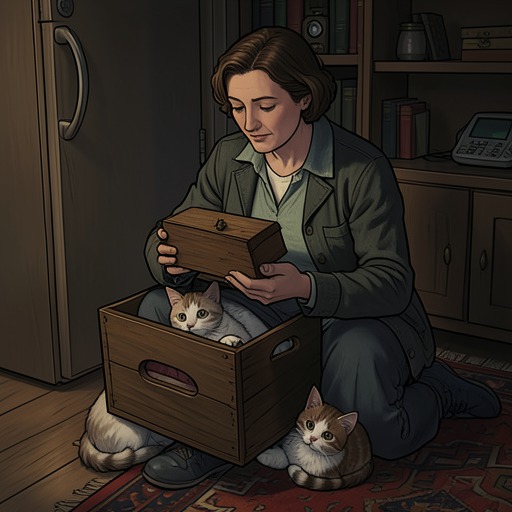
Away from the stall, Sachiko is still laughing, with small tears in her eyes. She passes the box to Etsuko, who opens one of its sliding panels. Its scale is described by comparison with an orange box, and it is surprisingly light. The wood is smooth but unvarnished; two panels of wire gauze slide on one side. These specific features make the object more than an indistinct prize: it is light enough to carry, enclosed yet fitted with movable panels, and large enough for Mariko to picture the kittens inside. Etsuko’s act of sliding a panel briefly tests the box as a usable container, before Mariko supplies its new purpose.
From Vegetable Container to Kitten House
Mariko proposes that the kittens could live in the box, with rugs placed inside to make it their house. The suggestion redirects the prize from the use announced by the man at the stall. Instead of storing vegetables, it could provide a place for the animals. Mariko also imagines taking the box to Yasuko’s house, so that it would serve not only as a home but as a way of carrying the kittens there. The object joins two ideas in her proposal: keeping the animals and bringing them along when the family goes to Yasuko’s.
Sachiko initially answers with doubt, wondering whether the kittens would like the box. Mariko returns to the proposal, asking whether it could be their house and whether they could carry them in it. Sachiko then agrees that they will use the box for the kittens. Her assent changes the meaning of the prize within the conversation: the box is no longer simply something that might prove useful, but a plan Mariko can treat as accepted. The object gives her a concrete answer to the question of where the kittens might go and how they might travel with the family.
The Box and the Decision to Keep the Kittens
Mariko connects the box directly to the possibility of keeping the kittens. She asks Sachiko whether this means they will not have to find homes for them; Sachiko says they can keep them and adds that Yasuko’s father is unlikely to object. Mariko runs a little way ahead, then waits for the others to catch up, continuing to seek confirmation that there will be no need to find owners. Sachiko repeats that, since they are going to Yasuko’s house, they will keep the kittens after all. Mariko’s repeated questions make clear that the practical proposal matters because of the decision it would permit, not merely because the box could contain the animals.
The Wooden box does not itself settle every question about the kittens’ future, but in this exchange it makes keeping them seem practicable. Its size, lightness, and movable panels support Mariko’s imagined use, while Sachiko’s agreement connects that use to the journey to Yasuko’s house. The box thus links a household object to a change in the immediate plan: the kittens need not be given away, at least in the arrangement Sachiko describes here.
Narrative Significance
The box’s meaning develops through successive acts of naming and imagining. At the stall, it is a major prize and a vegetable container; in Etsuko’s hands, it is an unfamiliar object with a sliding panel; in Mariko’s proposal, it becomes both a kitten house and a carrier. The change is not produced by any alteration to the box itself. Instead, its physical features invite a use that the prize-giver did not prescribe, and Mariko’s persistence turns that possibility into a shared plan.
The scene also gives the object a modest but decisive role in the exchange between Sachiko and Mariko. Mariko frames her wish as a series of practical questions about where the kittens can live and whether they can be taken along. Sachiko’s initial uncertainty gives way to agreement, and Mariko receives the reassurance she has been seeking. Sachiko then laughs again. The box remains an ordinary, lightly made prize, but within this moment it holds a larger promise: that the kittens can stay with them when they leave for Yasuko’s house.