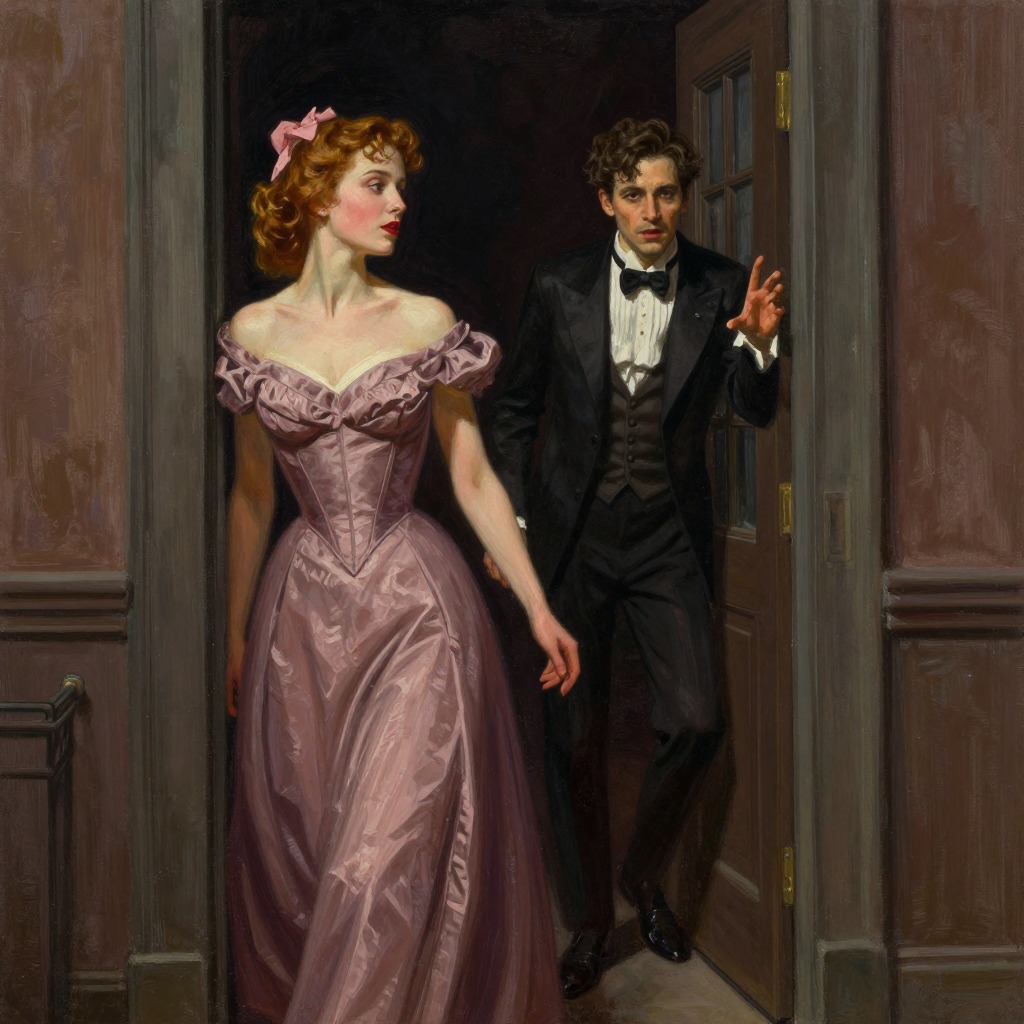
I have always depended on the kindness of strangers
A Streetcar Named DesireBlanche DuBois's final line in the play, spoken to the Doctor as she is led away to a mental institution, crystallizes her lifelong strategy of survival through dependence on the goodwill of strangers and stands as one of the most famous and poignant closing statements in American theater.
Origin and Context
The line is uttered in the final scene of the play, as the Doctor and Matron have come to take Blanche from the Kowalski apartment. After a struggle in which the Matron has pinned her arms and Blanche has scratched at her, the Doctor intervenes, ordering the Matron to release her. He draws Blanche up gently and supports her with his arm, leading her through the portieres. As they cross the kitchen to the front door, Blanche holds tight to his arm and says, "Whoever you are—I have always depended on the kindness of strangers." She allows him to lead her as if she were blind, and they go around the corner of the building, followed by the Matron. Stella cries out her sister's name from the stairs, but Blanche walks on without turning.
Thematic Significance
The line serves as the culmination of Blanche's entire life story and her method of navigating a world that has repeatedly failed her. It echoes her earlier confession to Mitch about her history of seeking intimacy with strangers after the death of her young husband, Allan Grey. After discovering Allan's homosexuality and telling him "You disgust me," he committed suicide by shooting himself in the mouth at Moon Lake Casino. In the aftermath, Blanche says, "intimacies with strangers was all I seemed able to fill my empty heart with. . . . I think it was panic, just panic, that drove me from one to another, hunting for some protection." The line also connects to her earlier description of her arrival in New Orleans, when she told Eunice that she was told to take a streetcar named Desire, then transfer to one called Cemeteries and ride six blocks to Elysian Fields. The journey from desire through death to a mythical paradise is completed by her final dependence on the kindness of a stranger—the Doctor who treats her with unexpected gentleness.
Irony and Ambiguity
The statement is deeply ironic on multiple levels. Blanche has not, in fact, always depended on the kindness of strangers; she has been betrayed by them repeatedly. The strangers she has depended on—the young soldiers who staggered onto her lawn at Belle Reve, the men she met at the Tarantula Arms hotel, the seventeen-year-old boy who led to her dismissal from teaching—have not been kind. The line also contrasts sharply with the brutal treatment she has just received from Stanley Kowalski, who has raped her and driven her to madness. Yet the Doctor, a stranger, does show her a measure of kindness, and Blanche responds by reaching for that kindness as her last refuge. The line thus captures both her delusion and her profound truth: in a world that has offered her no lasting protection, the fleeting kindness of strangers is all she has ever been able to count on.
Arthur Miller's Recollection
Playwright Arthur Miller, who attended the first production of A Streetcar Named Desire in New Haven, recalled the moment in his essay "Regarding Streetcar." He wrote that over more than half a century he could still recall "the inhaling of breath across the auditorium when Blanche said the 'kindness of strangers' line." When she exited on the arm of the Doctor, Miller remembered, "everyone went with her." The line's power, Miller suggested, lay in its demonstration that a Broadway audience could be moved by literary language and emotional identification, contradicting the prevailing wisdom that only flat realism could succeed commercially.
Connection to Blanche's Philosophy
The line is the final expression of Blanche's stated preference for magic over realism. Earlier, when Mitch tore the paper lantern off the light bulb to see her clearly, she cried out, "I don't want realism. I want magic! . . . I misrepresent things to them. I don't tell truth, I tell what ought to be truth." Her final line is a kind of magic-making: she transforms the Doctor, a representative of the state institution that is taking her away, into a gentleman who offers kindness. It is her last act of self-deception and her last assertion of dignity, allowing her to leave the stage not as a victim but as a woman who has, in her own terms, found what she needed.