Streetcar Named Desire
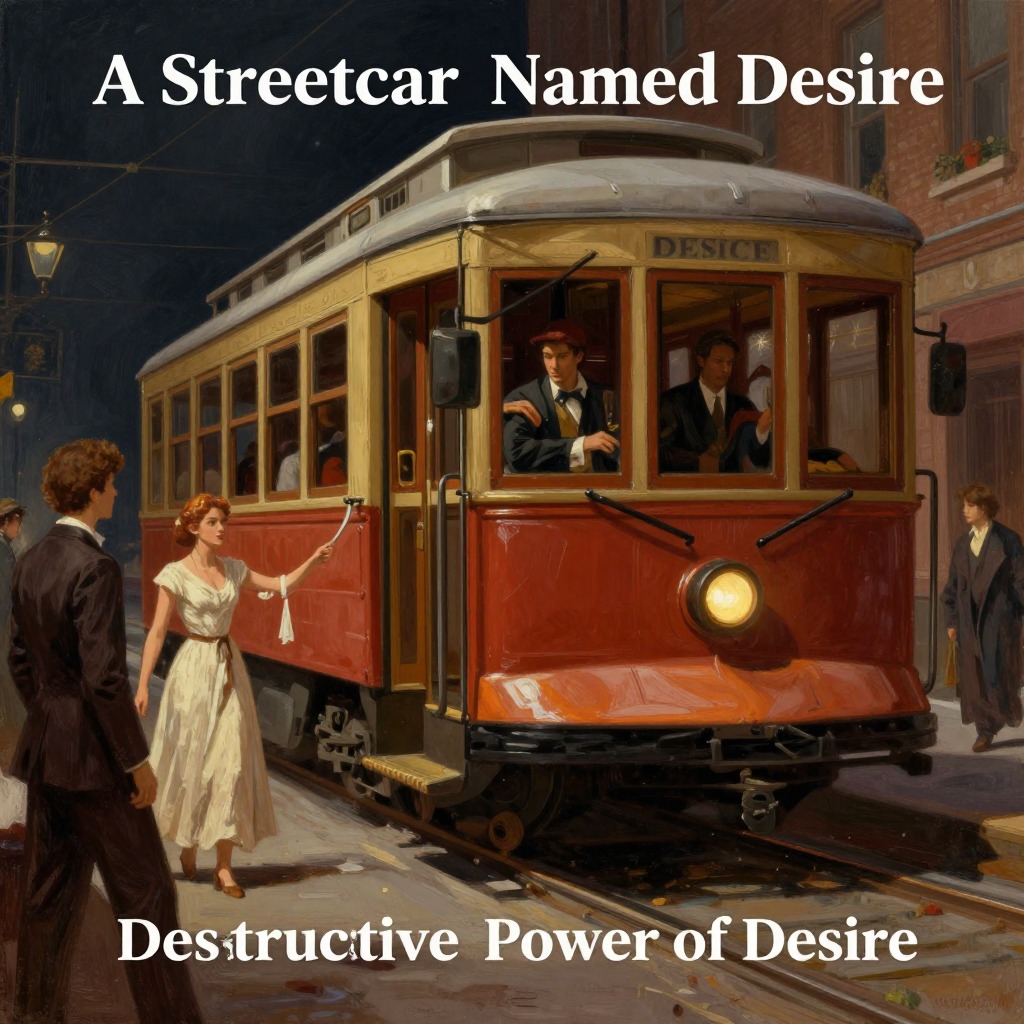
A Streetcar Named DesireThe Streetcar Named Desire is the central symbolic vehicle of Tennessee Williams's play, a rattletrap streetcar that runs through the French Quarter of New Orleans and gives the play its title. It represents the raw, primal force of desire that drives the characters' fates, carrying Blanche DuBois from her lost world of Belle Reve to the brutal reality of her sister's home on Elysian Fields, and ultimately to her destruction.
Identity and Symbolic Meaning
The streetcar is not merely a mode of transportation but a potent symbol woven into the play's fabric. When Blanche first arrives at the Kowalski apartment, she explains her journey with a mixture of bewilderment and dark humor: "They told me to take a street-car named Desire, and then transfer to one called Cemeteries and ride six blocks and get off at—Elysian Fields!" This itinerary maps the play's psychological trajectory—from desire through death to a mythical afterlife, yet the destination is a cramped, decaying flat in a poor section of New Orleans. The streetcar's name, Desire, encapsulates the force that Blanche both embodies and is victimized by. Later, in a heated argument with Stella, Blanche explicitly names this force: "What you are talking about is brutal desire—just—Desire!—the name of that rattle-trap street-car that bangs through the Quarter, up one old narrow street and down another." She contrasts this raw, animalistic desire with the refined world she once knew, but the streetcar has already brought her to a place where such distinctions collapse.
Blanche's Journey and the Streetcar's Path
The streetcar's route traces Blanche's physical and spiritual descent. She arrives at Elysian Fields having ridden the Desire line, and the journey has left her shaken and disoriented. The streetcar's grinding, relentless movement mirrors the inescapable pull of her own desires and the past she cannot outrun. When Mitch walks her home late one night, she asks grimly, "Is that street-car named Desire still grinding along the tracks at this hour?" The question reveals her awareness that the force she tried to escape is still operating, still carrying others—and herself—toward inevitable ends. The streetcar's persistence, its refusal to stop, echoes the way desire continues to drive the characters even after Blanche's departure.
The Streetcar as a Force of Fate
The streetcar functions as an agent of fate, carrying Blanche not only to New Orleans but toward her final confrontation with Stanley. In the play's climactic scene, Stanley, having exposed all of Blanche's lies and stripped her of her illusions, tells her, "We've had this date with each other from the beginning." The streetcar's journey—from Desire to Cemeteries to Elysian Fields—has been a preordained route, and Blanche's arrival at Stanley's door was always the destination. The streetcar thus becomes a mechanism of inevitability, the vehicle through which the play's tragic logic unfolds. Blanche's final line, "I have always depended on the kindness of strangers," spoken as she is led away by the Doctor, is the last echo of the desire that brought her there—a desire for connection, for rescue, for a magic that the streetcar's brutal reality cannot sustain.
Thematic Significance
The Streetcar Named Desire is the play's central metaphor for the conflict between illusion and reality, between the refined, romantic world Blanche represents and the raw, physical world Stanley embodies. The streetcar's name is a double entendre: it is both a literal New Orleans transit line and a symbol of the sexual and emotional drives that propel the characters. The play itself, as Arthur Miller observed, "approaches tragedy and its dark ending is unmitigated." The streetcar's journey from Desire to Cemeteries to Elysian Fields is a map of that tragic arc, a route that leads not to paradise but to a final, devastating reckoning. The streetcar, in its rattling, insistent motion, is the engine of the play's inexorable movement toward its end.
The streetcar's symbolic resonance has extended well beyond the stage through various adaptations. The 1951 film version, directed by Elia Kazan, retained the streetcar's iconic presence, with Vivien Leigh joining the Broadway cast as Blanche. The film won four Academy Awards, including three acting Oscars, a first for any film. Pedro Almodóvar's 1999 film All About My Mother features a Spanish-language production of the play, where the streetcar's theme is woven into the narrative. Woody Allen's 1973 film Sleeper includes a scene where characters briefly reenact the roles of Stanley and Blanche, referencing the streetcar's primal force. The 2013 film Blue Jasmine was widely noted as a loose adaptation, sharing thematic and plot elements with Streetcar. In 2014, Gillian Anderson directed and starred in a short prequel titled The Departure, exploring events before Blanche's arrival. The streetcar has also appeared in popular culture, such as in the 1992 Simpsons episode "A Streetcar Named Marge," which parodies the play as a musical.