Whiskey bottle
A Streetcar Named DesireThe whiskey bottle in A Streetcar Named Desire is far more than a stage prop; it is a recurring material object that tracks Blanche DuBois's psychological disintegration, her secret dependencies, and the escalating power struggle with Stanley Kowalski. From her first moments alone in the Kowalski apartment to the final night of her stay, the bottle appears at every critical juncture, its presence and depletion marking the moments when Blanche's carefully maintained facade of refinement and control begins to crack.
Identity and First Appearance
The whiskey bottle first appears in Scene One, immediately after Blanche's arrival at the Kowalski apartment on Elysian Fields. Left alone by Eunice Hubbell, Blanche sits "very stiffly with her shoulders slightly hunched and her legs pressed close together and her hands tightly clutching her purse as if she were quite cold." In this state of visible tension, she notices a whiskey bottle in a half-opened closet. She "springs up and crosses to it, and removes a whiskey bottle. She pours a half tumbler of whiskey and tosses it down. She carefully replaces the bottle and washes out the tumbler at the sink." This furtive, practiced action—the quick drink, the careful erasure of evidence—establishes the bottle as a secret resource, a private remedy for nerves that must be hidden from others. The act is immediately followed by her whispered self-command: "I've got to keep hold of myself!"
A Recurring Refuge and a Source of Exposure
The bottle reappears whenever Blanche's composure is threatened. When Stella returns and Blanche, shaking and panting, rushes to the closet to retrieve it again, the bottle nearly slips from her grasp. She insists she has not "turned into a drunkard," but her physical tremor and desperate need for the drink tell a different story. Later, when Stanley first enters the apartment, he immediately notices the bottle's depletion. Holding it up to the light, he observes, "Liquor goes fast in hot weather," a remark that functions as an early, veiled accusation. The bottle thus becomes a site of silent contention: Blanche uses it to steady herself, while Stanley uses its diminishing contents as evidence of her hypocrisy and lack of self-control. The bottle is never merely a container; it is a material witness to Blanche's hidden life.
The Bottle and the Collapse of Illusion
As the play progresses, the whiskey bottle becomes increasingly central to scenes of confrontation and psychological exposure. In Scene Nine, after Mitch has learned the truth about her past from Stanley, he arrives to confront her. Blanche, drinking to escape the "Varsouviana" polka that plays in her mind—the music associated with her young husband Allan Grey's suicide—hides the bottle in a closet when Mitch knocks. She pretends to search for liquor, calling it "Southern Comfort" and claiming ignorance of its nature. Mitch, however, sees through the performance, repeating Stanley's accusation: "He says you been lapping it up all summer like a wild-cat!" The bottle, once a secret prop for her nerves, is now openly used as a weapon against her. Later in the same scene, after confessing her history of "intimacies with strangers" following Allan's death, she pours herself another drink, the bottle now a companion to her unraveling narrative of loss and shame.
The Bottle as a Weapon and a Final Symbol
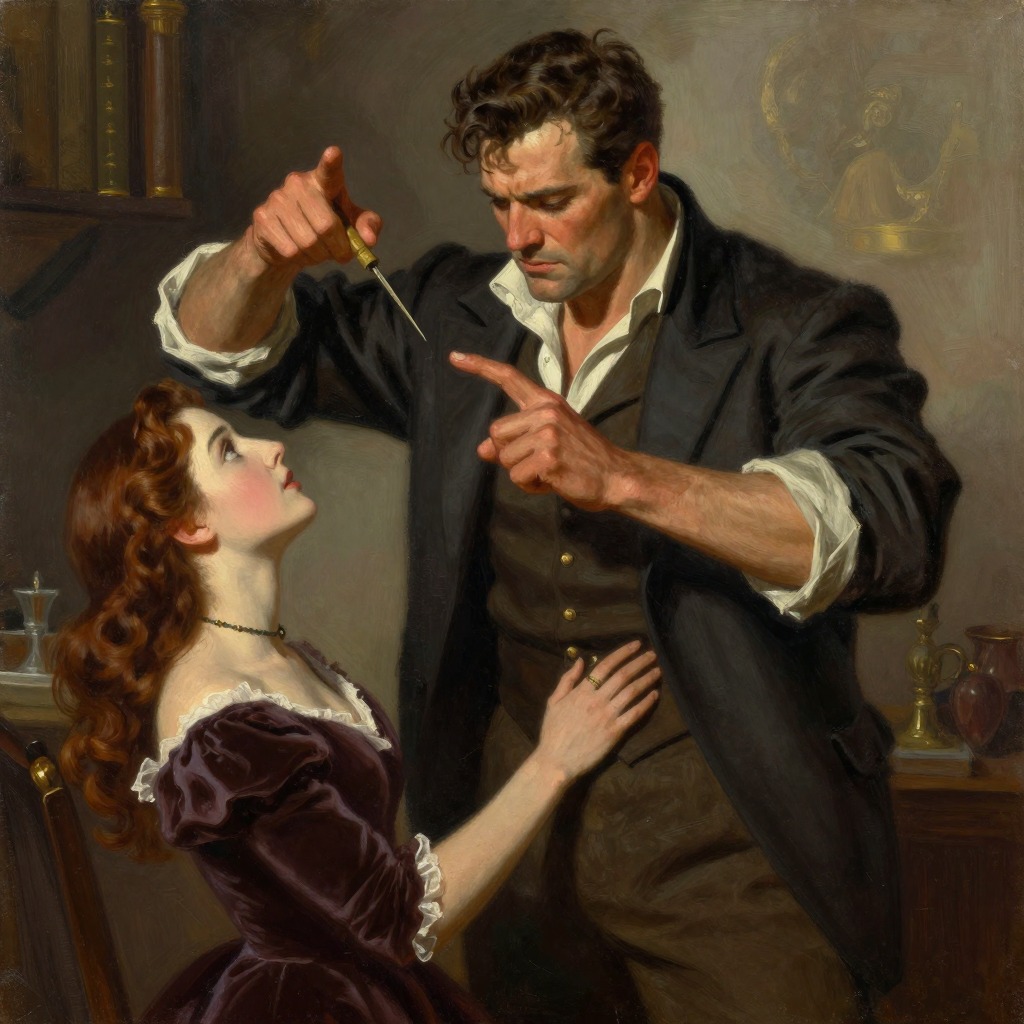
In the climactic Scene Ten, the whiskey bottle undergoes its most dramatic transformation. Stanley, having returned from the hospital where Stella is in labor, finds Blanche drinking steadily. She has dressed in a soiled white satin evening gown and a rhinestone tiara, lost in a fantasy of rescue by the millionaire Shep Huntleigh. When Stanley mocks her delusions and advances toward her, Blanche seizes a bottle, smashes it on the table, and faces him "clutching the broken top." She threatens: "So I could twist the broken end in your face!" The bottle, once a source of private comfort, is now a jagged weapon of last resort. Stanley, however, disarms her, catching her wrist and declaring, "We've had this date with each other from the beginning!" The shattered bottle marks the final collapse of Blanche's defenses and the violent consummation of Stanley's dominance. The object that once helped her maintain her illusions is now physically broken, mirroring her own psychological destruction.
Thematic Significance
The whiskey bottle's trajectory—from hidden comfort to exposed evidence, from a prop for performance to a broken weapon—encapsulates the play's central conflict between illusion and reality, refinement and brutality. It is a thing that, in its material presence, reveals what words cannot: Blanche's desperation, Stanley's suspicion, and the irreconcilable tension between their worlds. The bottle does not merely symbolize Blanche's drinking; it actively participates in the drama, its contents measured, its depletion noted, its shattering a turning point. In the end, the bottle is a remnant of the life Blanche tried to construct and the force that helped destroy it.