blue piano
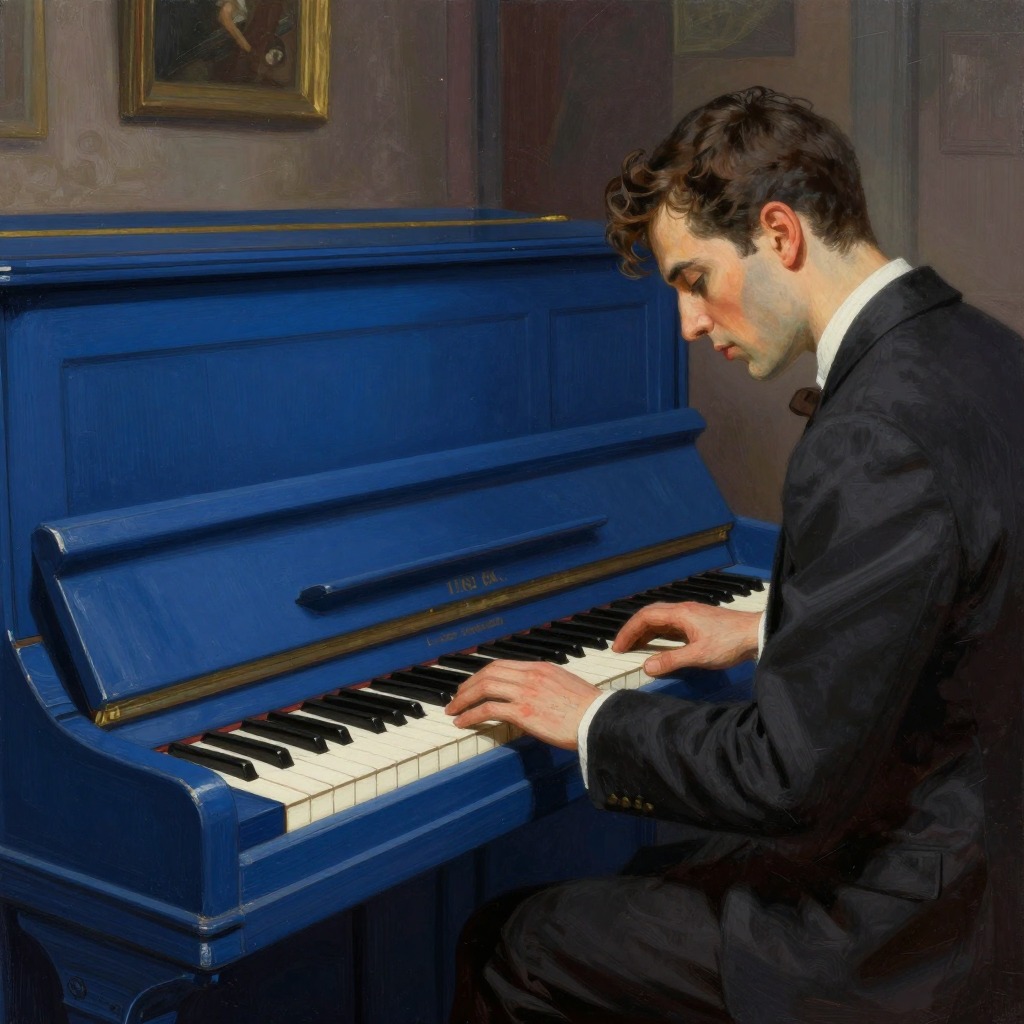
A Streetcar Named DesireThe blue piano is the signature musical motif of Tennessee Williams's A Streetcar Named Desire, a recurring sound that emanates from a barroom around the corner from the Kowalski apartment on Elysian Fields. More than mere background music, the blue piano functions as the play's atmospheric and emotional barometer, expressing the spirit of the life that goes on in the poor but raffishly charming French Quarter neighborhood. It is first heard in the opening stage directions, where Williams specifies that the music of Negro entertainers at a barroom around the corner, played with the infatuated fluency of brown fingers, creates a corresponding air to the warm breath of the brown river and the faint redolences of bananas and coffee. The blue piano is described as expressing the spirit of the life which goes on there, and it returns at key moments throughout the play to mark shifts in mood, tension, and consequence.
The Blue Piano as Emotional Barometer
The blue piano sounds at moments of high emotional intensity, often when the characters are confronting loss, desire, or violence. When Blanche DuBois reveals to her sister Stella that the family plantation, Belle Reve, has been lost, the music of the blue piano grows louder as the two women stare at each other across the yellow-checked linoleum of the table. It is heard again when Stanley Kowalski learns that Stella is pregnant, and the music swells as Blanche opens her eyes in shock. The blue piano also accompanies the aftermath of Stanley's violent outburst during the poker night, when he hurls the radio out the window and strikes Stella; after the men leave and Stanley stumbles out to the porch to bellow for his wife, the blue piano plays for a brief interval before he calls out. Later, when Blanche, having been confronted by Mitch and left alone, staggers back from the window and falls to her knees after screaming "Fire!" the distant piano is described as slow and blue.
The Blue Piano and the Play's Thematic Structure
The blue piano is not merely a passive accompaniment but an active participant in the play's thematic architecture. It is heard during the morning after the poker night argument, when Stella embraces Stanley fiercely in full view of Blanche, and the lights fade away with a lingering brightness on their embrace as the music of the blue piano and trumpet and drums is heard. The motif also underscores the play's most devastating moments: when Stanley rapes Blanche, the barely audible blue piano begins to drum up louder, its sound turning into the roar of an approaching locomotive as Blanche crouches, pressing her fists to her ears. In the final scene, as Stella sobs with inhuman abandon and Stanley kneels beside her, his fingers finding the opening of her blouse, the luxurious sobbing and sensual murmur fade away under the swelling music of the blue piano and the muted trumpet. The blue piano thus traces the arc of the play from its opening evocation of the Quarter's vitality to its closing surrender to brute desire and the erasure of Blanche's fragile world.
The Blue Piano as a Contrast to the Varsouviana
The blue piano stands in contrast to the other recurring musical motif in the play, the Varsouviana polka. While the Varsouviana is a specific, traumatic memory-trigger that plays only in Blanche's mind and is associated with her young husband Allan Grey's suicide, the blue piano is an external, communal sound that belongs to the neighborhood and its ongoing life. The Varsouviana is heard when Stanley mentions Blanche's dead husband, and it returns in Scene Nine as Blanche drinks to escape it and the sense of disaster closing in on her. The blue piano, by contrast, is a constant presence that does not belong to any single character's psychology but to the environment itself. It is the sound of the Four Deuces barroom, of the street life that continues regardless of the personal tragedies unfolding in the Kowalski apartment. This distinction reinforces the play's central tension between Blanche's interior world of illusion, memory, and trauma and the external world of raw, unapologetic physicality represented by Stanley and the French Quarter.
The Blue Piano and the Play's Final Image
In the play's closing moments, the blue piano and the muted trumpet provide the final musical swell as Stanley comforts Stella after Blanche has been taken away by the Doctor and the Matron. The stage directions specify that the luxurious sobbing and the sensual murmur fade away under the swelling music of the blue piano and the muted trumpet, while Steve Hubbell announces, "This game is seven-card stud." The blue piano thus has the last word, its sound enveloping the stage as the curtain falls. It is a sound that has accompanied every major turn of the drama—from Blanche's arrival and the loss of Belle Reve, through the poker night violence and the revelation of Blanche's past, to the rape and the final removal of Blanche from the apartment. The blue piano is the constant, the musical thread that binds the play's disparate scenes into a unified whole, and its final swelling affirms that the life of the Quarter, with all its brutality and vitality, will continue long after Blanche's departure.