Alpha–Luna Requirement
A Werewolf Thing: A Rejected Mate Werewolf RomanceThe Alpha–Luna Requirement is the governing rule that an alpha must have a Luna, making paired leadership a condition of succession rather than a merely personal arrangement. Its force reaches from Ashton Smith’s private refusal to accept a mate to the public announcements that establish Saphira Richards as his Luna, and it repeatedly converts intimacy, ritual, and family expectation into political legitimacy.
Definition and Succession Logic
The rule is stated directly by David, Ashton Smith’s father and the acting alpha. With Ashton’s eighteenth birthday approaching and no mate yet found, David tells him that he must have one because he will become alpha and every alpha needs a Luna. Ashton objects that he does not want a mate and sees no reason to have one, but David presents the requirement as unavoidable. The exchange establishes that succession is not treated as an individual choice: Ashton’s future office carries a relational obligation, and the Luna is necessary to complete the structure of alpha authority.
The conversation also reveals the emotional pressure behind the rule. David says that he wants Ashton to be happy, but his concern cannot be separated from the institutional demand that Ashton produce or accept the partnership expected of a future leader. Ashton’s dismissive response and departure from the pack house show the first conflict between inherited office and personal autonomy. The rule therefore operates through both formal authority and family expectation, binding the son to the political needs of the pack while presenting that constraint as care.
From Private Bond to Public Office
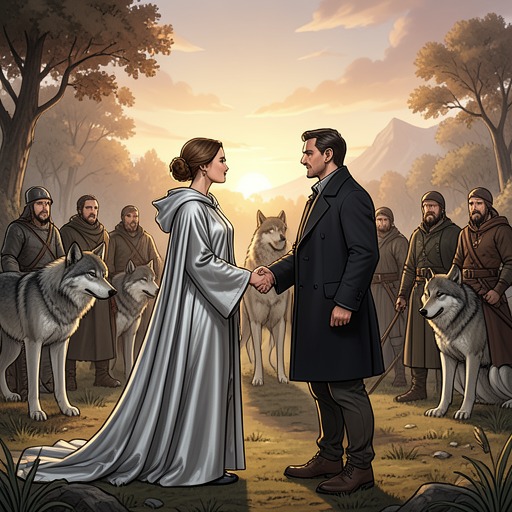
The requirement becomes public when David calls a pack meeting to announce that Ashton has found his future mate and that Saphira Richards is the pack’s new Luna. The pack responds with cheers and whistles, and David declares that when Ashton is made alpha at the next full moon, Saphira will join him as Luna. The announcement does more than identify a couple. It publicly validates Ashton’s expected succession and assigns Saphira a political identity before the transfer of office is complete.
The scene also exposes the difference between public celebration and private instability. The crowd treats the pairing as a triumph, while Ashton smells strongly of alcohol and is questioned about whether he has been drinking. His conduct suggests that the public fulfillment of the rule does not guarantee emotional readiness or stable leadership. The institution can announce an heir and a Luna, but it cannot by announcement alone resolve the conflicts within the relationship that supposedly supports the succession.
A later ceremony completes the formal version of the rule. David announces before a large crowd that Ashton Smith will become alpha and that his mate, Saphira Richards, will join him as Luna. The repeated cheers and wolf whistles make the succession collective and witnessed. Saphira looks at Ashton and believes that she can be a good Luna if he remains beside her, while also recognizing the intensity of her love for him. Her acceptance shows how the rule gives her a public role, but it also shows that she initially understands that role through emotional loyalty to Ashton.
Mate Bond and Restorative Ritual
The Alpha–Luna Requirement is connected to the mate bond, but the book distinguishes the social office from the condition of the relationship itself. After Ashton rejects Saphira, he later asks to perform the full moon ritual. That ritual allows a mate to accept the mate previously rejected; it must occur at the closest full moon after the rejection, when the rejecting mate marks the other at the moon’s highest point, thereby restoring the mate bond.
The ritual gives the succession rule a bodily and ceremonial mechanism. A damaged relationship is not repaired merely by a private apology or a public announcement; it must be reconstituted through a prescribed act at a specific celestial time. Ashton’s request indicates that he wants the bond restored, while Saphira’s willingness shows her desire to recover the relationship. Yet the ritual’s existence also reveals the rule’s rigidity: the pack’s political pairing depends on a bond that can be rejected, broken, and formally restored according to communal custom.
Bloodline, Species, and Leadership Claims
The requirement exists within a wider world in which identity and authority are shaped by mixed ancestry and inherited obligations. Saphira Richards and Trevor Richards are both half werewolf and half witch, and their mother had been the leader of the witches before her sister took over. Separately, their grandfather summons them to perform the færy ritual, explaining that they were supposed to lead the Færy Clan when they reached eighteen until their mother’s departure changed the situation. These parallel expectations show that leadership is repeatedly organized through age, bloodline, ritual qualification, and public succession.
Saphira’s position as a werewolf-faerie hybrid makes the Alpha–Luna Requirement especially significant. She is not simply attached to Ashton’s office as a conventional partner; her own mixed heritage connects her to other systems of power and ritual. The rule places her within the werewolf hierarchy as Luna while the surrounding plot also recognizes responsibilities inherited from her maternal and færy lineage. Her identity consequently crosses boundaries that the pack’s paired leadership structure tries to organize into a stable public order.
Limits, Consequences, and Significance
The rule is repeatedly tested by the demands placed on Saphira and Ashton. When a prophecy foretells a war between vampires and werewolves on the night when the sun is black and stars cross the sky, it states that two hybrids of the same origin will lead the winning side. The prophecy enlarges leadership beyond the pack’s succession framework: the alpha and Luna are not only figures of local governance but may become connected to a species-wide conflict. The political partnership required by the pack thus becomes entangled with hybrid identity and an impending war.
The rule also produces a gendered division of authority that the plot does not leave entirely intact. Trevor warns Saphira that she must not fight because she is pregnant and cannot lead an army. Saphira rejects that restriction, answering that if she and Trevor are the chosen ones, she will fight whether he approves or not. Her response does not deny her role as Luna; it contests the assumption that the female partner in a paired leadership system must remain protected and politically subordinate. The requirement defines Saphira as a necessary counterpart to the alpha, but her own decisions insist that being Luna does not eliminate her capacity to act, fight, or claim responsibility.
The rule’s most visible legacy appears in the domestic future shown near the end of the narrative. Saphira tells a young girl that her mate may be of high rank and that she might become a Luna, while Ashton Smith immediately rejects the idea of a mate from the doorway. His response recalls his earlier resistance, suggesting that the rule remains present even after his accession and family life. The Alpha–Luna Requirement therefore functions both as social law and as a recurring pressure point: it legitimizes the pack’s leadership, turns Saphira into a public political figure, and continually raises the question of whether inherited authority can coexist with personal choice.