Amanda
A Werewolf Thing: A Rejected Mate Werewolf RomanceAmanda is a vampire whose presence complicates the book's division between vampires and werewolves. Introduced while being pursued through the forest, she is not merely a member of a feared species: she is a protector, a source of hidden knowledge, and the person whose bond with Simon makes cross-species intimacy impossible to dismiss as an exception. Through Amanda, the narrative moves from instinctive hostility toward a more unstable social world in which family, gifted bloodlines, and mate bonds cross species boundaries.
Identity and Introduction
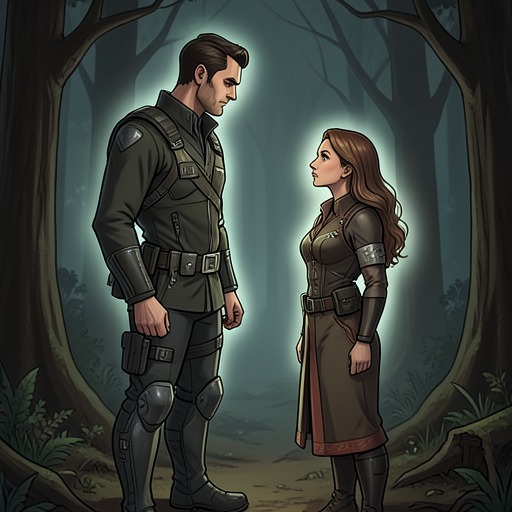
Amanda first appears under the moonlight while werewolves chase her. The scene establishes the immediate danger of her identity: she recognizes that werewolves dislike vampires, so her survival depends on speed, vigilance, and resistance to a hostile group boundary. She is not traveling alone, however. Austin is with her, and the emotional stakes of the pursuit are defined by her determination to keep him alive. She places herself between Austin and the three werewolves confronting them—a beta, a third-in-command, and a high-ranking pack member—using a protective stance rather than abandoning him to save herself.
Amanda's protection of Austin is rooted in kinship. She understands him as her only family member, her light, and her world, making the chase a test of chosen or surviving family as much as a species conflict. Her willingness to risk death for him gives her first appearance a clear ethical shape: the vampire being hunted is also the person shielding a vulnerable companion. The scene therefore refuses to let species identity determine moral identity. Amanda belongs to the group the werewolves fear, but her conduct is organized around care rather than predation.
Gifts, Mate Bond, and Interpersonal Position
Amanda is identified as Simon's mate when she arrives with Saphira's father and Simon. Ashton immediately adopts a protective stance after recognizing that Amanda is a vampire, while Simon mirrors that stance to protect her. His reaction reveals the force of the mate bond: Simon's loyalty to Amanda overrides the inherited hostility between their species and places him in direct emotional opposition to the werewolf response around him. Amanda's relationship with Simon consequently becomes a living challenge to the social categories that make the chase possible.
Amanda is also gifted in a way that makes ordinary privacy nearly impossible. Simon explains that she can know everything about anyone simply by meeting that person's eyes. Austin possesses a different gift, the ability to control the elements and see the future, so the pair's abilities expand the narrative's supernatural system beyond physical strength and speed. Amanda's eye contact functions as both knowledge and pressure: it gives her access to hidden personal information while making her presence unsettling to those who realize that their secrets may no longer be secure.
The account of Amanda's powers is presented through Simon's explanation rather than through an extended demonstration of her abilities. That framing makes her simultaneously a character and a source of exposition. She embodies the danger of being known completely, while her mate bond with Simon demonstrates the opposite possibility: a relationship in which knowledge and allegiance are joined across a hostile boundary.
Vampire Society and Political Knowledge
Amanda explains that vampires pass through a maturity process after which they become stronger, more confident, and, in the common view, better versions of themselves. The distinction between the immature vampire stage and maturity gives vampire identity a developmental structure rather than treating vampirism as a fixed condition. Amanda's explanation also places personal transformation inside a broader social order: what a vampire becomes is connected to the rules and institutions of vampire society.
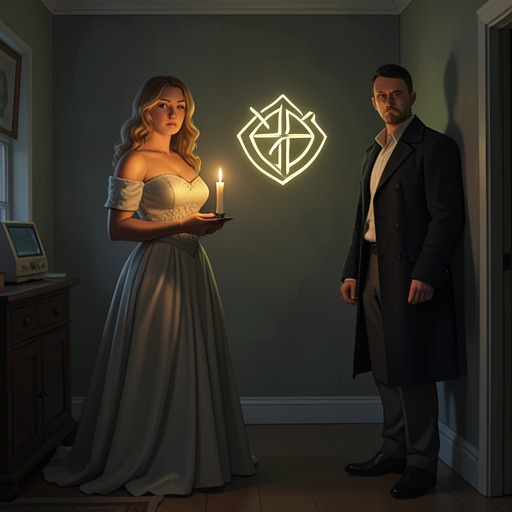
That society is governed in part by a council of elders responsible for the safety of vampires and humans in territories occupied by vampires. The council's duty includes preserving the secrecy of vampire existence. Its members are described as exceptionally powerful, with abilities beyond those of average vampires. Most significantly, they can erase people's memories when secrecy requires it. Amanda therefore reveals that vampire survival depends not only on concealment but on institutional control over human knowledge. The Vampire Council protects its community while also possessing an invasive power over the minds of outsiders.
This information gives Amanda a political role in the story. She does not merely explain what vampires are; she makes visible the mechanisms by which a hidden species maintains its borders. Her knowledge contrasts with the immediate violence of the werewolf pursuit. The werewolves enforce territory through capture and pursuit, while the Vampire Council preserves its territory in the human world through secrecy and memory manipulation. Both societies are organized around boundaries, but Amanda exposes the cost of the vampire method: safety is purchased through control over what others are allowed to remember.
Prophecy and the Coming War
Amanda is the character who reveals the central prophecy concerning the conflict between vampires and werewolves. According to her account, a war will occur on the night when the sun is black and stars are crossing the sky. The war is destined to determine which species will become dominant, turning the hostility seen in her introduction into part of a larger historical and supernatural struggle.
The prophecy does not stop at a contest between two species. Amanda states that two hybrids of the same origin will lead the winning side. This condition makes mixed identity politically decisive. Hybridity is no longer simply a personal complication or a biological curiosity; it becomes the possible instrument through which one species' future will be determined. Amanda's own position as a vampire who forms a mate bond with the werewolf Simon helps prepare the reader to understand why rigid species divisions cannot remain stable.
Her revelation also connects private relationships to collective catastrophe. The bond between Amanda and Simon is intimate, but the prophecy shows that cross-boundary relationships belong to the same structure as the coming war. Species are treated as rival political communities, while hybrids represent a threat to the certainty of that division and perhaps the key to its resolution. Amanda's testimony thus changes the scale of the narrative, transforming a dangerous encounter in the forest into a foreshadowing of an impending vampire-werewolf war.
Narrative Function and Significance
Amanda's narrative importance comes from the combination of vulnerability, protection, intimacy, and knowledge. She enters as a hunted vampire, but she is immediately defined by the way she shelters Austin. She then becomes Simon's mate, forcing the werewolf characters to confront a relationship that contradicts their species-based hostility. Finally, she explains the Vampire Council and the prophecy, supplying the political and cosmological information needed to interpret the conflict around her.
Her role also creates a contrast between the book's categories and the conduct of its characters. The werewolves treat vampire presence as a reason for danger, yet Simon protects Amanda; Amanda is pursued as an enemy, yet she protects Austin; the Vampire Council claims to preserve safety, yet it can erase memories. These contrasts prevent the supernatural groups from functioning as morally uniform blocs. Amanda is central to that complication because her body marks a boundary while her actions repeatedly cross it.
Amanda's ending within the supplied material is not a death or a completed transformation, but an expanded position in the story. She remains a vampire, a gifted person capable of extraordinary knowledge, Simon's mate, Austin's protector, and the principal bearer of information about vampire governance and the hybrid prophecy. Her significance lies in making the future war personal before it becomes fully public: through Amanda, the book shows that the decisive challenge to species supremacy may already exist in the form of loyalty, love, and identity that refuse to stay on one side of the boundary.