Ancient Cups
A Werewolf Thing: A Rejected Mate Werewolf RomanceThe Ancient Cups are one hundred enchanted vessels created by the ancestors of the Færy Clan for the Færy ritual, the ceremony through which leadership passes from one person to another. Their decisive significance is not merely ceremonial. By making leadership depend on a visible response to exchanged blood, the cups turn moral character and political legitimacy into something the community can witness, interpret, and celebrate.
Origin and Function
The Ancient Cups were enchanted by the ancestors of the Færy Clan specifically for succession. The ritual was required because the clan’s founders wanted to ensure that those who led their people possessed a pure heart and intended to act for the good of the community. The cups therefore embody an inherited political safeguard: leadership is not treated as an ordinary possession that can simply be claimed, but as a responsibility subject to ancestral judgment.
The Færy ritual begins with participation by both the original leader or leaders and the prospective new leader. Each contributes a drop of blood to an Ancient Cup. This shared act links the existing authority to the authority that is about to replace it, making succession a physical exchange as well as a legal or social transition. Blood supplies the ritual’s concrete medium, while the cup supplies the enchanted instrument through which the new leader’s character is assessed.
The Color Test
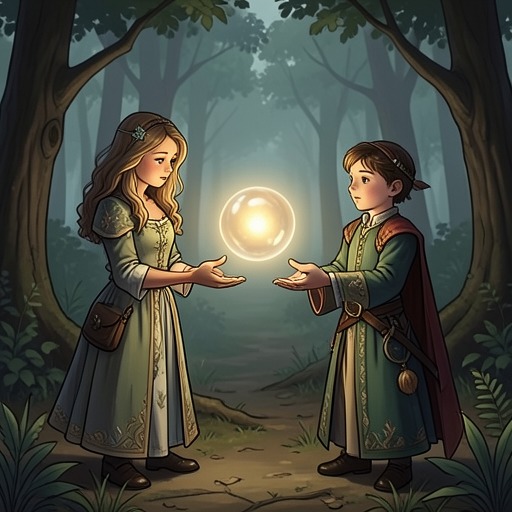
The cups deliver their judgment through color. If the new leader has a pure heart and good intentions, the cup glows a piercing blue. If the leader possesses a dark heart and dark intentions, it glows a raging red. The distinction makes the cups an apparently direct truth mechanism: inward moral qualities, normally inaccessible to a crowd, become an observable supernatural sign.
The color result is also a public verdict rather than a private revelation. The Ancient Cups do not merely tell the candidate whether the succession is acceptable; their glow allows the gathered community to see legitimacy materialize before them. In this way, the vessels join blood, ancestral authority, bodily risk, and collective witness into a single system. The cup’s response is both ethical judgment and political authorization.
Sondra’s Succession Ceremony
The Ancient Cups are used during the succession ceremony involving Saphira Richards, Trevor Richards, and Sondra. A woman cuts Saphira Richards’s hand, and Saphira Richards steps toward the cup, closes her hand into a fist, and lets a drop of blood fall into it. The same procedure is then performed for Trevor Richards, whose blood is added after the cut provokes a slight growl from Carmen. These details emphasize that succession is embodied and painful, even though the wound is controlled and immediately tended with a wet towel.
Tension rises when Sondra’s hand is cut. Those present hold their breath as she approaches the cup, and the fall of her blood seems to take place in slow motion. The suspense concentrates the community’s uncertainty into the instant before the vessel answers. When Sondra’s blood reaches the bottom, the Ancient Cup immediately begins glowing a piercing blue.
The blue light resolves the ceremony in Sondra’s favor. The gathered people erupt into cheers, and Sondra smiles broadly. The result establishes that she will become the new leader of the clan when she reaches eighteen. Saphira Richards recognizes the significance of the verdict and concludes that Sondra will make a great leader. The cup thus transforms a future claim into a publicly confirmed succession, while the community’s celebration reinforces the supernatural judgment through social acceptance.
Relation to Other Forms of Legitimacy
The Ancient Cups belong to a wider pattern in which authority and identity are produced through ritual. The Færy ritual is explicitly a transfer of leadership, while the surrounding story also presents the full moon ritual as the means by which a rejected mate can be accepted again and the mate bond restored. These ceremonies differ in purpose, but both use a formal act, a prescribed moment, and bodily marking to change a social relationship. The cups make that principle especially visible because blood and color provide a material record of the transition.
Their logic also contrasts with the succession of Ashton Smith and Saphira Richards as alpha and Luna. That appointment is announced by David before a large crowd, which responds with cheers and wolf whistles. Ashton Smith’s authority is tied to the requirement that an alpha must have a Luna, and the public announcement names Saphira Richards as the future Luna. The Ancient Cups, by contrast, do not establish leadership through announcement alone. They require the candidate to pass an ancestral test whose result appears in the vessel itself.
The distinction becomes important in a story shaped by prophecy and conflict among Werewolves, Vampires, Faeries, and Banshees. A prophecy foresees a war between Vampires and Werewolves on the night when the sun is black and stars cross the sky, with two hybrids of the same origin destined to lead the winning side. Later, Trevor Richards tells Saphira Richards that the war may begin at any moment and that they will be responsible for an entire species. Against this looming struggle, the Ancient Cups represent a localized and intimate model of legitimacy: before a leader can guide a clan through danger, the community seeks an answer about the leader’s heart and intentions.
Narrative and Symbolic Significance
As objects, the Ancient Cups give supernatural form to a political question: who deserves to rule, and how can a community know? Their enchantment claims that intention can be made legible, yet the ceremony still depends on interpretation by people who wait, watch, and celebrate. The cup’s piercing blue is therefore more than decoration. It is a sign through which moral worth becomes communal knowledge and succession becomes emotionally convincing.
The ceremony also binds continuity to change. The outgoing leader or leaders contribute blood alongside the new leader, so the new order is not presented as an isolated break from the past. Ancestral enchantment, inherited vessels, and the presence of the established leadership place Sondra’s future within a chain of authority. At the same time, the cup’s response marks her as different from the person or people who led before her: the succession is valid because the new leader produces her own confirming sign.
The Ancient Cups consequently function as instruments of both exclusion and protection. They can deny legitimacy to a candidate whose heart and intentions are judged dark, but they also reassure the community that leadership has passed to someone whose purposes are good. In the succession scene, the piercing blue glow, the held breath before it appears, and the immediate eruption of cheers make the vessel the ceremony’s central witness. Its verdict closes the uncertainty surrounding Sondra’s rise and establishes the moral foundation on which her future leadership is expected to rest.