Banshee Boundary Constraint
A Werewolf Thing: A Rejected Mate Werewolf RomanceThe Banshee Boundary Constraint is the rule that makes the border between Faery and Banshee territory more than a line on a map. It joins geography to species-specific vulnerability: the boundary between the villages lies only a few miles apart, yet crossing it can determine whether a rescue succeeds, whether a pursuer can survive, and which side controls the encounter.
Definition and Territorial Logic
The constraint operates within an established hostility between Faeries and Banshees. The two kinds are described as natural foes, and the Banshees possess a distinctive weapon in their screams. A Banshee’s voice can reach such a high note that prolonged exposure kills members of the opposing kind. The danger is therefore not merely political or territorial. The land beyond the boundary carries a physical threat that directly attacks the body of anyone who crosses without adequate protection.
The rule is also unequal in its operation. Banshees can cross the boundary more easily than Faeries can. A Faery who enters Banshee territory is especially vulnerable because the Banshees’ shrieks can readily defeat them, whereas a Banshee can move across the border with comparatively less difficulty. This asymmetry gives the Banshees an advantage in raids, pursuit, and abduction, even when the villages themselves are only a few miles apart.
The Boundary in the Village Attack
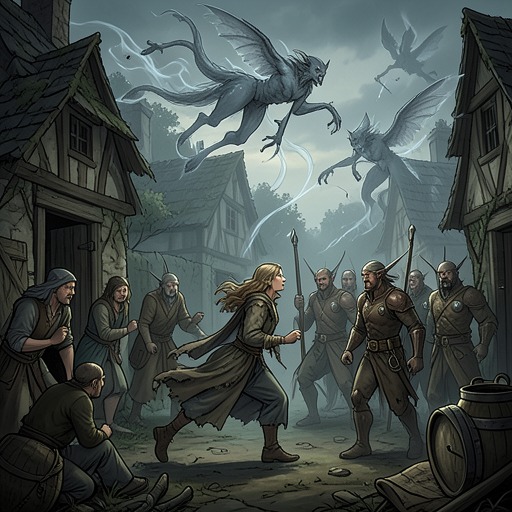
The constraint becomes visible during the Banshee attack on the Faery village. Screams erupt throughout the settlement, and the residents attempt to protect themselves by covering their ears. Saphira does so, as do Trevor and Ashton; Carmen falls to her knees while trying to block out the sound. Werewolves can counteract other noises with one noise, a defensive capacity that offers some relief during the assault, but the attack still overwhelms the village and leaves its inhabitants in danger.
The threat is made concrete when a Banshee stands over Saphira’s grandparents and screams at them. Their age and weaker bodies make them particularly exposed. The scene shows that the Banshee weapon does not need to strike physically to become lethal: proximity, duration, and the inability to escape the sound are enough to turn the village into a killing ground. The boundary rule consequently magnifies the effect of the attack by making retreat into Banshee territory dangerous while leaving the attackers comparatively free to approach and withdraw.
Sondra’s Abduction and the Cost of Pursuit
The rule governs the attempted abduction of Sondra. Saphira finds her in a fetal position with her hands pressed against her ears while a Banshee grabs her leg and drags her toward the Banshee village. Saphira runs after them at full speed, but the charm protecting her is already beginning to wear off, allowing the screeching to return faintly at the back of her mind.
The Banshee gains a decisive territorial advantage once he lifts Sondra over his shoulder and sprints toward his own village. Saphira cannot phase into her wolf form because she has no defense against the Banshees in that form. She must remain in a form that allows her heightened speed while enduring the danger of the crossing. Although she begins to catch up, a sharp pain in her upper thigh interrupts the pursuit, illustrating how the boundary turns rescue into a contest against both an enemy and an environment designed to weaken the rescuer.
Saphira’s pursuit also reveals that the boundary is not an absolute wall. It can be crossed, but crossing changes the balance of power. The Banshee can carry Sondra toward safety within his own territory, while Saphira must calculate how long she can remain exposed and whether her protective charm will last. The rule therefore creates a spatial form of captivity: Sondra’s movement toward the Banshee village increases her isolation, while Saphira’s movement after her increases her physical risk.
Broader Pattern of Species and Borders
Within the wider supernatural order, the constraint belongs to a world in which identity and danger are repeatedly organized by species and territory. Banshees oppose Faeries as natural enemies, while other relationships cross those categorical lines. When a vampire arrives with Simon, Trevor immediately recognizes her species and takes a protective stance; Simon responds in the same way because he is protecting the vampire, who is revealed to be his mate. That encounter contrasts with the Banshee–Faery border: species difference can produce hostility and exclusion, but it can also be crossed through intimate allegiance.
The rule also stands against the wider prophecy of a future war between Vampires and Werewolves, a conflict said to occur when the sun is black and stars cross the sky. In that prophecy, species boundaries become the basis for a struggle over dominance. The Banshee Boundary Constraint gives a smaller, more immediate version of the same logic. It shows how a world divided into kinds turns geography into strategy and bodily difference into military power.
Narrative Significance
The Banshee Boundary Constraint converts setting into an active force. The village boundary is only a few miles away, but the distance is narratively immense because the two species do not meet it on equal terms. The rule establishes why a Banshee can seize Sondra and retreat, why Saphira must pursue without phasing, and why a protective charm is necessary but temporary.
Its most important consequence is that crossing is never neutral. A Banshee’s movement across the border expands the range of attack, whereas a Faery’s movement into Banshee territory risks defeat by the very sound that defines the enemy. The constraint thus links territorial sovereignty, species conflict, bodily weakness, and the ethics of rescue. It ensures that the border remains a source of pressure even when the physical distance between the communities is small.