Banshees
A Werewolf Thing: A Rejected Mate Werewolf RomanceBanshees are a hostile supernatural species defined by a lethal sonic defense and an antagonistic relationship with the Faery community. Their sudden assault on the Faery village transforms what should have been a moment of succession and communal order into a struggle for survival, making them one of the clearest forces through which the story explores species division, territorial boundaries, and the violent consequences of crossing them.
Identity and Supernatural Nature
Banshees and the Faery people are described as natural foes rather than neighboring communities capable of ordinary coexistence. The Banshees’ principal weapon is their scream, which reaches a pitch capable of killing members of the opposing kind if they remain exposed to it for too long. Their cry also carries a specific omen-like association: a Banshee usually screams before someone dies. In the village attack, however, the scream functions not merely as a warning of death but as an active instrument of violence, turning sound into a weapon that can incapacitate an entire population.
Their physical appearance reinforces their threatening characterization. One Banshee is seen with white, pasty-looking skin and sickly yellow eyes, details that mark the species as visibly alien and repellent within the narrative’s supernatural taxonomy. The attack therefore presents the Banshees through both bodily difference and hostile action: they are not simply another supernatural group but an enemy whose appearance, abilities, and customs are framed as dangerous to the Faery community.
Attack on the Faery Village
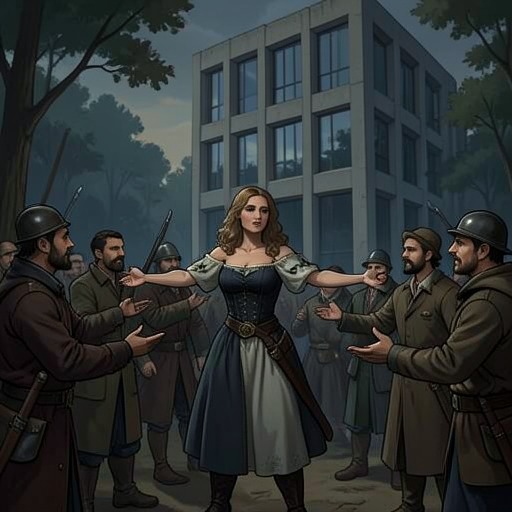
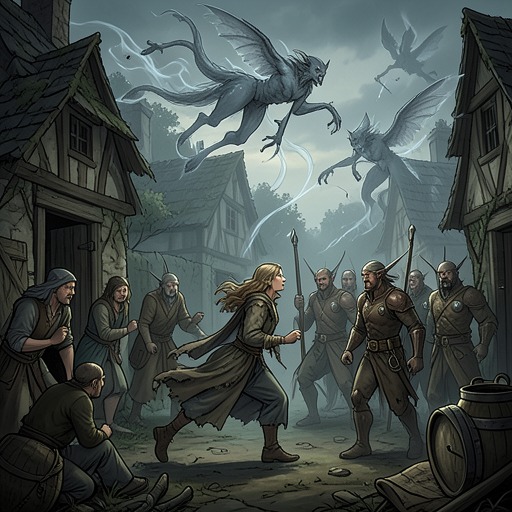
The Banshee assault begins during a moment when Sondra is expected to become the new leader of the clan upon reaching eighteen. The ceremony and its promise of orderly succession are abruptly overturned when screams erupt throughout the village. Saphira Richards immediately covers her ears, while Ashton Smith does the same. Werewolves can block other noises with one noise, but the villagers around them remain vulnerable, and the danger becomes unmistakable when a Banshee is seen standing over Saphira Richards’s grandparents and screaming at them.
The elders are especially endangered because age has weakened their bodies. Blood runs down both sides of their faces from their ears as they attempt to protect themselves, turning the abstract threat of the Banshee cry into visible physical injury. Saphira Richards refuses to remain passive while the creatures destroy the village and harm her people. She casts a charm that temporarily blocks her hearing, giving herself a brief way to move through the attack, and immediately searches for Sondra, whose prospective leadership makes her a particularly important target.
A Banshee has already seized Sondra by the leg and begun dragging her toward the Banshee village, located several miles away across the boundary between the two communities. When Saphira Richards approaches, the attacker lifts Sondra’s body over its shoulder and sprints toward its own territory. The rescue becomes more difficult because Banshees can cross the boundary more easily than Faeries can. A Faery entering Banshee territory would be exposed to shrieks that could quickly defeat them, so Saphira Richards cannot simply follow without consequence. She instead relies on heightened speed and remains in her human form, knowing that her wolf form offers no defense against the Banshees.
Defeat and Aftermath
The confrontation reaches its decisive point when the pursuing Banshee prepares to scream at Saphira Richards. Before the cry can escape, an arrow strikes it directly in the head. The attack comes from Ashton Smith, who is holding a crossbow and is already suffering cuts across his face and arms as well as a limp in his left leg. The Banshee collapses, and dust spirals around its body until the creature seems to vanish completely. Ashton Smith observes that all the Banshees disappeared into clouds of dust, a supernatural ending that leaves even him confused about the nature of their defeat.
The village survives without deaths, but many people are injured. That outcome preserves the succession crisis’s immediate human cost without allowing the attack to erase the community entirely. The Banshees’ disappearance also distinguishes them from an enemy that can simply be imprisoned or governed: they arrive across a hostile boundary, use a species-specific power to overwhelm the village, and leave behind uncertainty as well as physical harm. Their role in the narrative is consequently defined by sudden intrusion, lethal sound, and the unstable border separating one supernatural people from another.
Boundaries, Identity, and Narrative Function
The Banshees’ violence is inseparable from the territorial system that separates them from the Faery community. Their village lies several miles beyond a boundary that is not merely geographic: it distributes vulnerability according to species. Banshees can cross into Faery space more easily than Faeries can enter Banshee territory, because a Faery who crosses the line would be exposed to shrieks capable of defeating them. The boundary therefore operates as an uneven law of movement, granting the Banshees strategic mobility while making pursuit dangerous for their opponents. Saphira Richards’s attempt to recover Sondra reveals how this rule turns rescue into a contest between speed and biological susceptibility. She can run after the attacker, but she cannot safely phase into her wolf form, since that form gives her no defense against the Banshee cry. The Banshees thus function not only as antagonists but also as embodiments of a world organized by species boundaries, inherited hostility, and unequal access to shared space.
Species Conflict and Narrative Function
The Banshees also widen the novel’s conflict beyond individual rivalries and mate bonds into a struggle among supernatural peoples whose identities are treated as consequential, inherited categories. Their hostility toward the Faery community is presented as naturalized, while the later prophecy of a war between Vampires and Werewolves shows that species division is a central organizing principle of the wider world. Against that background, the Banshees’ appearance introduces a different form of interspecies danger: their power is not based on political dominance or physical strength alone, but on a biological vulnerability shared by their enemies. Even the presence of a vampire at the Richards family home, which causes Saphira Richards and Simon List to assume protective stances because the vampire is Simon List’s mate, complicates any simple division between species as permanent enemies. The Banshees remain the starkest example of a hostile species boundary, yet the surrounding relationships suggest that such categories can be challenged even when their dangers are real. Their attack therefore serves both as immediate action and as a pressure test for the story’s larger claims about kinship, belonging, and whether supernatural identity must determine allegiance.