Beloved
A Werewolf Thing: A Rejected Mate Werewolf RomanceBeloved is the vampire name for a destined mate: an intimate bond that crosses the species boundary between vampires and werewolves and converts recognition into obligation. In the novel, the concept is not merely romantic vocabulary. It reorganizes danger, loyalty, and medical judgment, first drawing Amanda toward a werewolf she encounters while being hunted and later compelling her to use vampire blood to save Simon’s life.
Definition and First Recognition
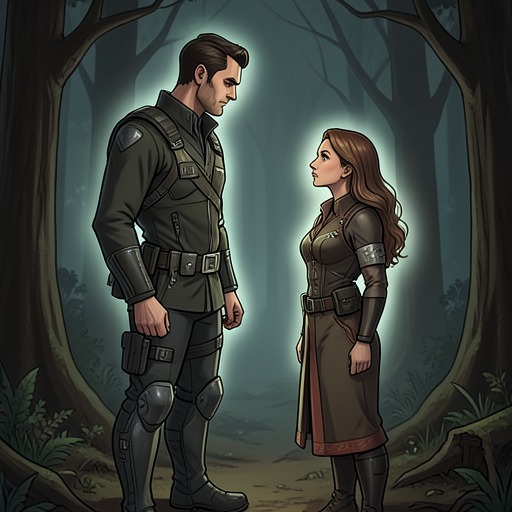
The concept appears during Amanda’s flight through the forest. The moonlight and trees might have seemed beautiful, but she is being chased by werewolves, and she understands that her status as a vampire makes the pursuit unsurprising because werewolves and vampires are natural enemies. Three wolves surround her: a beta, a third-in-command, and a high-ranking pack member. Her attention fixes on the third wolf, and the surrounding world loses focus as recognition overtakes fear.
Amanda identifies him as her beloved before the relationship has been explained through conversation or social permission. The wolf shifts into human form, and the other two follow after receiving a signal from him. His human appearance includes blonde hair and ocean-blue eyes, but the decisive fact is Amanda’s certainty that he is her destined partner. The phrase “My werewolf” captures the strangeness of the discovery: the partner is both unfamiliar and immediately intimate, an enemy by species classification and an object of singular attachment by supernatural bond.
A Bond Against Species Boundaries
Beloved therefore functions as a challenge to the world’s rigid species divisions. The story establishes antagonisms among vampires, werewolves, and other supernatural peoples: werewolves pursue Amanda because she is a vampire; the Banshees are natural foes of the faery people and use lethal screams as their defense; and a prophecy anticipates a war between vampires and werewolves to determine which race will become dominant. Against that framework of collective hostility, the beloved bond creates a private relation that cannot be contained by species allegiance.
The bond does not erase the danger between groups. Instead, it makes the danger personal. Amanda’s beloved is a werewolf encountered in the middle of a chase, so the bond begins in a situation where ordinary group identity would require fear or attack. Later, when a vampire enters with Saphira’s father and Simon, Saphira immediately takes a protective stance after recognizing the girl as a vampire. Simon responds in the same defensive manner, but his protection is directed toward the vampire. The scene reveals that the vampire is Simon’s mate, demonstrating that a destined cross-species attachment can alter behavior even when inherited hostility remains active.
The concept also sits within a wider system of supernatural identity. Saphira and Trevor are both half werewolf and half witch, and their mother had led the witches before her sister took over. Their mixed ancestry shows that the novel repeatedly unsettles supposedly pure categories. Amanda’s beloved bond extends that destabilization into intimate life: species is presented as a social boundary, but destiny repeatedly produces relationships that cross it.
Beloved as Care and Medical Risk
The bond acquires its sharpest practical consequence when Simon is found critically injured. His heartbeat is present but becoming slower by the minute, making immediate intervention necessary. Amanda stops Saphira and Trevor as they are about to enter and focuses on Simon’s body. She identifies the solution as her blood, explaining that because he is her beloved, it will heal him faster.
Amanda’s claim is both emotional and physiological. Her blood can heal Simon, but it may also change him. Trevor warns that Simon could become a vampire, and Austin states the danger directly: Simon could go vampire. The possible cure therefore threatens to replace one crisis with another by altering Simon’s species and, potentially, his place in the conflict between vampires and werewolves.
Amanda nevertheless insists that she must act because Simon may die without her intervention. Her tears and pleading make the beloved bond visible as a force of action rather than a passive label. The relationship directs her toward care at the precise moment when caution would favor withholding her blood. Saphira sees Trevor’s conflicted expression before he finally nods, so Amanda’s decision receives reluctant permission from those who understand both the healing power and the transformative cost.
Relation to Family, Loyalty, and Destiny
The novel places Beloved beside other forms of attachment rather than treating it as the only meaningful bond. Saphira’s twin connection with Trevor allows each sibling to sense the other’s distress, and physical injury to one is felt by the other. That bond is embedded in family and shared bloodline, while the beloved bond is created through supernatural recognition across species. Both forms of attachment can override ordinary concealment: Trevor knows when Saphira is lying, and Amanda recognizes her destined partner despite the threat surrounding them.
Family loyalty also provides a parallel to beloved devotion. During the Banshee attack, Saphira decides that Sondra must be recovered at any cost because Sondra is her cousin and family cannot be left behind or kidnapped. The rescue is coordinated through the pack mind link, with Trevor tackling the Banshee and causing Sondra to fall from the attacker’s shoulder. This episode does not involve Beloved directly, but it clarifies the novel’s larger value system: supernatural relationships become meaningful when they demand protective action under pressure.
The distinction becomes especially important in the later domestic scene involving Saphira, Ashton, and Clayton. When Saphira suggests that a young girl’s future mate may be high-ranking and that she might become a Luna, Ashton rejects the idea of a mate from the doorway. His response contrasts the certainty and force of destined attachment with the resistance, cynicism, or refusal that can surround it. Beloved may establish recognition, but the story’s relationships still unfold through danger, choice, protection, and consequences.
Narrative and Thematic Significance
Beloved gives the book a mechanism for making forbidden intimacy structurally important. Amanda’s encounter does not simply pair two attractive strangers; it places a vampire and a werewolf inside the same emotional system that is also preparing for species war. The prophecy states that the war will occur when the sun is black and stars cross the sky, and that two hybrids of the same origin will lead the winning side. In that setting, cross-species bonds are not private anomalies. They expose the instability of the categories on which political dominance depends.
The concept also converts the body into a site of allegiance. Amanda’s blood is at once medicine, species marker, and possible agent of transformation. Her decision to offer it to Simon shows how the beloved relation can make bodily boundaries negotiable, but not consequence-free. Healing may save a life while changing the person who survives, leaving love entangled with identity and danger.
As a recurring idea, Beloved links recognition to responsibility. Amanda first names the bond while running from wolves; later, another vampire’s mate relationship is identified through Simon’s protective response; and the bond ultimately becomes the reason Amanda risks an irreversible intervention. Across these moments, the novel presents destiny as a disruptive force that crosses enemy lines, exposes the weakness of species absolutism, and demands that intimate loyalty be tested against the survival rules of entire supernatural communities.