Captivity
A Werewolf Thing: A Rejected Mate Werewolf RomanceCaptivity is the condition forced upon Saphira when a rogue abducts her during pregnancy and removes her from the werewolf community. It combines confinement, bodily danger, political leverage, and separation from Ashton: trapped on an island and unable to shift without risking herself, Saphira experiences imprisonment as both a physical enclosure and a deliberate attempt to neutralize the woman expected to lead the werewolves.
Causes and Circumstances
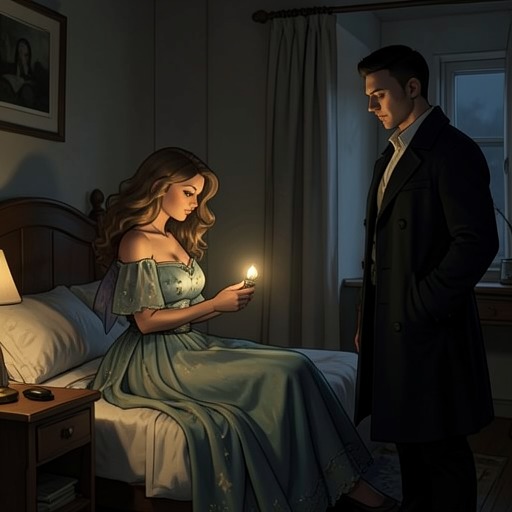
A stranger appears in the doorway while Saphira is expecting Ashton to return from his alpha duties. His scent identifies him as a rogue, and Saphira immediately steps back, growling and trying to shield her enlarged stomach. The rogue notices the pregnancy, yet claims that he does not intend to hurt Saphira or her baby. His reassurance is inseparable from the threat of his advance: Saphira is cornered before she can create enough distance to protect herself.
The rogue frames the abduction as a political calculation rather than the beginning of an openly declared war. He says that he knows Saphira will be the one leading the werewolves and that he prefers the existing order because war would change everything. His words reveal that her pregnancy and anticipated leadership make her strategically important. Captivity therefore begins not as random violence but as an effort to control a future Luna and preserve a particular balance of power through coercion.
The Abduction and Loss of Control
Saphira asks what the rogue wants while attempting to keep away from him, but the exchange gives her no opportunity to resist effectively. He reaches behind his back and produces a cloth. After telling her that she will be fine, he presses it roughly over her nose and mouth. Her senses blur, panic rises, and conscious resistance becomes impossible. The scene’s decisive reversal is the movement from guarded defiance to enforced helplessness: the growl that marks Saphira’s attempt to protect herself is answered by a method that disables her body rather than defeating her in a fair confrontation.
Before losing consciousness, Saphira sends an urgent call to Ashton through the mind link. She falls into the rogue’s arms immediately afterward. The mind link preserves a connection to her mate even as captivity severs her physical access to him, making the call both an alarm and a sign that the abductors have not entirely isolated her. It also places Ashton at the center of the rescue effort without allowing Saphira to control what happens next.
The Island as Prison
When Saphira later opens a door and steps outside, she discovers sand beneath her feet and realizes that she is on an island. The surrounding water makes the geography itself function as a cell. The building has unlocked doors, but that apparent freedom proves misleading: the absence of a visible lock does not provide an actual route of escape. Saphira is confined by distance, water, and the danger of her own condition.
She reaches the water’s edge and recognizes that swimming is the only apparent way back. Shifting and crossing the water might otherwise offer a werewolf a means of escape, but pregnancy makes shifting too risky. Her body, which the rogue had already used as the focus of his political calculation, now becomes the immediate condition limiting her choices. The island thus converts pregnancy into a practical barrier: Saphira remains capable of assessing the situation, yet the safest available action is to return to the building rather than gamble with her life and the baby’s life.
Confrontation and Rescue
The captivity becomes openly violent when footsteps approach Saphira’s door. Several more sets of footsteps run down the hallway, followed by thumps and groans as the door flies open. The rogue who took her enters with his wolf fully dominant, his eyes dark black. Saphira backs into the wall and shields her stomach, still unable to understand what is happening or why the threat has intensified.
Just before the rogue reaches her, he is thrown halfway across the room and lands against the wall. Trevor stands before Saphira, smiling and breathing heavily, and immediately takes her hand. His first concern is getting her out before Ashton suffers a heart attack, so the rescue is presented as urgent extraction rather than a completed victory over the larger rogue threat. Saphira follows Trevor toward the main entrance, while a menacing growl from the room behind them confirms that danger remains close. Captivity ends as an immediate condition of isolation, but the rescue does not erase the violence, fear, or political conflict that produced it.
Narrative Significance
Captivity organizes a classic abduction-and-rescue pattern around a distinctive vulnerability. Saphira is physically capable of fighting and possesses supernatural means of escape, yet pregnancy, confinement, and the island environment prevent those abilities from functioning freely. The episode therefore makes agency situational rather than absolute: Saphira resists by identifying the rogue, demanding his purpose, protecting her stomach, and contacting Ashton, while the surrounding conditions force her to depend on the mind link and on Trevor’s intervention.
The episode also turns imprisonment into a crisis of succession. The rogue explicitly connects Saphira’s capture with the future leadership of the werewolves, so the captive body carries consequences beyond personal safety. Her absence threatens the continuity represented by the coming child and by her expected role beside Ashton. At the same time, Trevor’s arrival restores a family connection at the precise moment when the rogue’s violence threatens to overwhelm her. The rescue’s incomplete ending—escape from the room, but a remaining growl behind them—keeps captivity linked to the wider conflict rather than treating it as an isolated ordeal.