Clayton
A Werewolf Thing: A Rejected Mate Werewolf RomanceClayton appears at the end of the story as the four-year-old son of Saphira Richards and Ashton Smith. Although his direct role is limited to the concluding family scene, his presence carries decisive narrative weight: after the violence, supernatural conflict, threatened relationships, and struggles over rank that shape the wider story, Clayton belongs to a household that can finally say that everything is “okay” and “great.” He is both a child in an ordinary kitchen and a visible sign that the family’s future has continued.
Identity and Family Position
Clayton is identified through his place in Saphira Richards and Ashton Smith’s family. He is young enough to be carried by his father and to run toward his mother, yet old enough to understand that social rank and succession matter. When Crystal asks why she cannot be an alpha, Saphira explains that Clayton is expected to become alpha when he grows up. The exchange establishes that his future is already being imagined through the hierarchy of the werewolf community, even while he remains a small child in a domestic setting.
His position is therefore connected to both inheritance and affection. The family’s expectations attach a public future to Clayton, but the scene presents him first through everyday gestures: entering with Ashton, running to Saphira, kissing her cheek, and asking to be picked up. The contrast keeps his identity from being reduced to a title. He is a prospective alpha, but he is also simply the child who wants his parents’ attention.
Appearance and Resemblance
Clayton is described as a “spitting image” of Ashton, with light brown hair and matching hazel eyes. The physical resemblance makes his paternal connection immediately legible and visually links the child to Ashton’s lineage. Crystal, by contrast, favors Saphira, with light brown hair and green eyes. The siblings are thus distinguished through a deliberate division of family features: Clayton reflects Ashton, while Crystal reflects Saphira.
This resemblance also gives Clayton a symbolic place between inheritance and renewal. Ashton’s appearance is carried forward in the next generation, but the child’s identity is not presented as a repetition of Ashton’s earlier behavior. The evidence shows Clayton in a loving family moment rather than in the rebellion, partying, or substance abuse associated with Ashton’s earlier characterization. His likeness preserves family continuity without proving that he will reproduce his father’s past.
Domestic Actions and Relationships
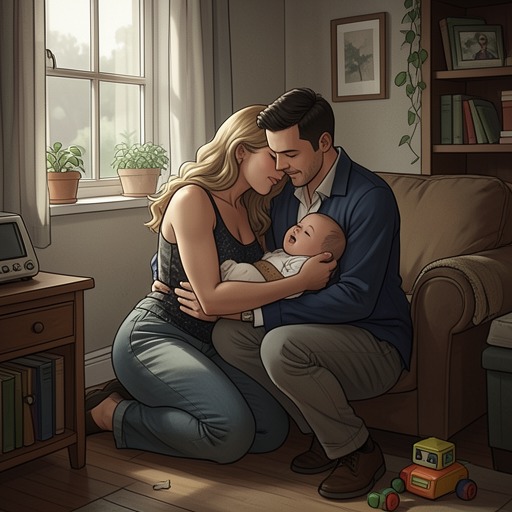
Clayton’s strongest characterization comes through his relationship with Saphira. After Ashton brings the children into the kitchen, Clayton runs toward Saphira and calls for his mother. She bends down and picks him up, transforming the reunion into an intimate act of care. Later, while Ashton holds Crystal, Clayton kisses Saphira on the cheek and tells her that he loves her. Saphira answers by kissing his forehead and telling him that she loves him more, turning their exchange into a playful contest of affection.
Clayton is equally connected to Ashton. Ashton picks him up before bringing him toward Saphira, and later declares his love for all of the children while kissing Crystal and pinching Clayton’s cheek. The gesture is teasing and familial rather than ceremonial. It places Clayton and Crystal together as recipients of Ashton’s affection, while also showing Ashton participating directly in the children’s care instead of appearing only as a figure of authority.
The scene’s emotional structure is collective. Clayton does not stand apart from the family or serve only as an heir; he joins a chain of reciprocal declarations in which Saphira and Ashton affirm love to one another and to both children. His kiss, his words, and his willingness to be carried make him an active participant in that family language. Through him, the household’s restored stability becomes something lived in small physical actions rather than merely announced.
Rank, Gender, and the Future
Clayton’s future as alpha is introduced through Crystal’s question about why she cannot hold the same position. Saphira answers that Clayton will become alpha when he is older and that a boy must be alpha. The conversation exposes the gendered rule governing succession: Clayton’s anticipated authority is not based on a demonstrated achievement in the scene, but on his status as a male child within the community’s inheritance system.
The exchange gives Clayton an importance he does not yet understand fully. Crystal recognizes that he has been assigned a possibility denied to her, while Clayton himself remains focused on family affection rather than power. Saphira softens the disappointment by telling Crystal that her future mate may be high-ranking and that she might become a Luna. Clayton’s position consequently helps reveal how the next generation is being sorted into expected roles before adulthood, even inside a warm family moment.
Narrative Role and Ending
Clayton functions as a marker of aftermath and continuity. The wider narrative contains conflict between supernatural groups, poison, attacks, prophecy, and threats to family members, but the closing scene narrows the scale to cooking, children climbing onto stools, parents lifting them, and kisses exchanged in the kitchen. Clayton’s presence makes the ending concrete. The story’s final assurance that everything is fine is embodied in a child who can run to his mother and hear both parents claim him with love.
His characterization remains deliberately limited and future-oriented. The evidence does not show Clayton making political decisions, leading a pack, or confronting the dangers that shaped his parents’ lives. Instead, it presents the possibility of succession without prematurely turning him into an adult authority figure. Clayton is important because he stands at the threshold of that future: visually tied to Ashton, emotionally secure with Saphira, recognized by both parents, and positioned to inherit a role whose consequences belong to the life still ahead of him.