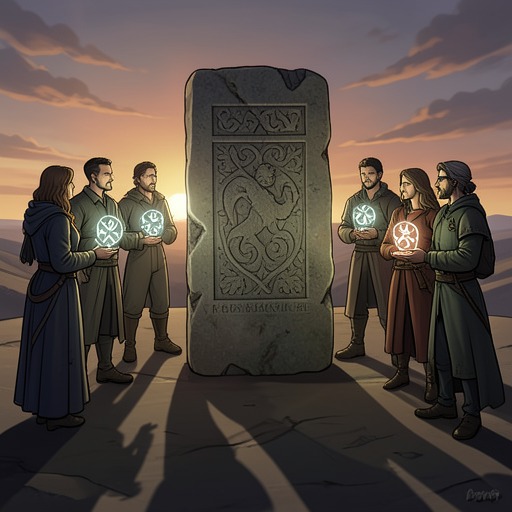
Full Moon Mate-Restoration Ritual
A Werewolf Thing: A Rejected Mate Werewolf RomanceThe Full Moon Mate-Restoration Ritual governs the restoration of a mate bond after one partner has rejected the other. Its decisive significance is that rejection is not necessarily permanent: the relationship can be repaired, but only through a narrowly timed act in which the rejecting mate accepts the rejected partner again and marks them under the full moon. The rule therefore turns romantic reconciliation into a supernatural obligation with a precise deadline, a physical sign, and consequences for the identities of both partners.
Definition and Conditions
The ritual is explicitly described as the moment when a mate accepts the mate previously rejected. It must take place at the closest full moon following the date of rejection, so the opportunity is tied to lunar time rather than left open indefinitely. The rule creates urgency because a desired reconciliation cannot simply be postponed until a convenient occasion; the relevant full moon is the first one after the rejection.
The ritual also requires the rejecting mate to mark the other when the full moon reaches its highest point. This condition gives the restoration a specific physical and temporal structure. Acceptance alone is insufficient. The rejecting partner must perform the mark at the moon's highest point, and that act restores the mate bond. The rule thus joins inner recognition to an outward bodily action witnessed by the supernatural order of the full moon.
Ashton Smith and Saphira Richards
Ashton Smith invokes the ritual after the relationship between him and Saphira Richards has been damaged by his rejection of her. He directly states that he wants to perform the full moon ritual, surprising Saphira because the proposal signals a reversal of the earlier rejection. Her immediate response is acceptance, and she makes clear that she genuinely wants their bond restored.
The timing makes the reconciliation almost immediate but also precarious. Ashton Smith tells Saphira Richards that the next day is the full moon. Since the rule requires the closest full moon after the rejection, the announcement establishes that the pair have only a short interval before the ritual's prescribed moment. His proposal is therefore both an emotional gesture and a commitment to act within the rule's exact timetable.
Saphira Richards later explains the plan to Trevor Richards, identifying the night's event as the ritual through which she and Ashton Smith intend to restore their bond. Trevor Richards initially treats the disclosure as evidence that the couple are together again and responds with happiness for his sister. His reaction shows that the ritual has relational consequences beyond the two participants: its intended completion changes how their reconciliation is understood within the family.
Ritual Action and Social Consequences
The ritual's central action is the mark made by the mate who previously rejected the other. Because Ashton Smith is the rejecting partner in this reconciliation, the rule places the decisive act on him. The restored bond is not represented as a purely verbal apology or a private decision. It must be enacted through his marking of Saphira Richards at the full moon's highest point.
That structure gives the ritual a double function. It repairs the intimate bond between Ashton Smith and Saphira Richards while also reestablishing their standing as a couple within the surrounding werewolf social order. The later announcement that Ashton Smith will become alpha and Saphira Richards will join him as Luna provides a broader institutional context for their restored relationship. Their partnership is not only emotionally renewed; it is connected to the legitimacy of the Alpha–Luna succession.
The rule also makes the body a record of relational change. The mark carries the fact of acceptance in a form that cannot be reduced to an internal feeling. The full moon supplies the sacred time, the highest lunar point supplies the required instant, and the mark supplies the visible or bodily completion of the bond's restoration.
Narrative and Thematic Significance
As a plot mechanism, the Full Moon Mate-Restoration Ritual transforms the romance's movement from rejection to reunion into a formal sequence of separation, attempted return, and renewed union. Ashton Smith's proposal is the turning point: the earlier negative status of the relationship is replaced by the possibility of restoration, but the possibility remains conditional until the prescribed act is completed.
The rule also creates tension between human emotion and supernatural law. Ashton Smith can desire reconciliation, and Saphira Richards can welcome it, yet their wishes do not by themselves restore the bond. The lunar deadline and the requirement of marking impose an external structure on their feelings. Love is presented as capable of repair, but repair must be recognized and enacted through ritual.
Finally, the ritual's repetition of the full moon's appointed time gives the relationship a sacred dimension. Ordinary chronological time is interrupted by a specific lunar occasion at which identity and intimacy can be remade. The rule makes reconciliation a threshold: after rejection, the pair must pass through a carefully defined moment before they can return to the status of bonded mates. Its emotional promise is therefore inseparable from discipline, timing, and embodied acceptance.