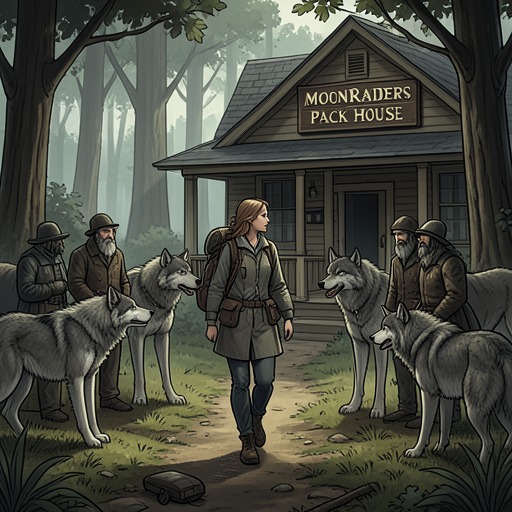
MoonRaiders Pack House
A Werewolf Thing: A Rejected Mate Werewolf RomanceMoonRaiders Pack House is more than a large residence for the MoonRaiders pack: it is the story’s principal domestic, ceremonial, and strategic threshold. Characters enter it carrying unresolved family and romantic conflicts, and events inside repeatedly transform private relationships into publicly recognized identities, while alarms from beyond its walls turn the home into a defensive command center. Its significance lies in this double function. The building promises shelter and belonging, yet it is also where authority is witnessed, challenged, and tested.
Definition and Setting
MoonRaiders Pack House is introduced as the new home of the pack, a place noticeably large enough to impress Saphira. Her comparison with her previous, more “nontraditional” pack establishes the building as a marker of a changed social order rather than merely a change of address. The family approaches it together, with her father calling for the children to follow him toward the front door. That entrance frames the house as a passage into an uncertain communal future: Saphira hopes the move will go well, but the hope is cautious rather than confident.
The house contains several identifiable communal and private areas. Saphira stands at the doorway of the dining hall while everyone gathers for dinner, making the threshold itself a position from which she observes the pack assembling. The pack house also includes a library, where Ashton later finds her reading, and stairs leading upward when she decides to take a shower. These details give the residence an internal geography that accommodates both collective life and withdrawal. Meals, books, movement through the entrance, and solitary pauses all occur within the same structure, allowing the building to hold conflicting emotional registers at once.
Domestic and Familial Space
The pack house serves as a meeting place for Saphira’s unusually interwoven family. Her twin brother Trevor’s bond with her is so immediate that he can sense her sadness and feel her physical pain; the house therefore becomes a setting in which kinship is not abstract but continually present in shared encounters and reactions. Saphira’s parents also move through the house with her, while the family’s mixed background complicates the social identity the residence is meant to consolidate. Saphira and Trevor are both half werewolf and half witch, and their mother once led the witches before her estranged sister assumed that position.
The building’s domestic promise is repeatedly strained by conflict. After Saphira explains what Trevor has done, she is told that she may stay at the house for the night because it is Saturday and she presumably does not want to see him. The offer makes the pack house a temporary refuge from family confrontation, but not a permanent escape from it. Similarly, Saphira can retreat upstairs to shower or sit in the library, yet the house’s shared spaces keep drawing her back toward the relationships and responsibilities she cannot simply leave behind.
The house is also associated with Ashton’s unstable personal life. Ashton is introduced as the rebellious son of an alpha, known for partying, getting high, and constantly changing girlfriends. Against that background, the pack house becomes the setting in which his private behavior is observed against communal expectations. When Saphira and Trevor return with her father, they find the house unexpectedly empty, an absence that heightens uncertainty. Soon afterward, Saphira begins to ask Ashton whether he has been doing something, only to be interrupted by Alpha David’s unmistakably loud voice. The interruption links Ashton’s personal secrecy to the authority structure of the pack house: private disorder is never entirely separate from public judgment.
Ritual, Status, and Public Recognition
MoonRaiders Pack House is repeatedly connected with ceremonies that turn relationships and rank into visible social facts. Ashton expresses a desire to perform the full moon ritual, startling Saphira. The request places the house near the emotional center of the mate-bond plot, because a ritual that might restore or formalize a bond cannot be separated from the communal setting in which the pair must live. The residence thus functions as a threshold between rejection, uncertainty, and possible reintegration.
The same space later participates in the recognition of new leadership. Saphira and the assembled pack make their way onto a makeshift stage, and David announces to the large crowd that there will be a new alpha and Luna. The house, ordinarily a domestic building, is temporarily transformed into a public arena. Its interior can contain dinner and private reading, but it can also hold a crowd large enough for a succession announcement. The contrast shows how the pack defines political legitimacy through collective witnessing: leadership becomes real not only through personal ability but through declaration before the community.
The house’s ritual associations extend beyond wolf identity. Saphira and Trevor are told that they must perform the færy ritual, bringing their witch and mixed-blood inheritance into the same narrative space as MoonRaiders authority. The pack house therefore gathers multiple systems of belonging—family, wolf pack, witch ancestry, and færy obligation—without making them harmoniously interchangeable. It is a place where identities overlap and where that overlap creates duties as well as status.
Crisis, Defense, and the Boundary of Home
The apparent security of MoonRaiders Pack House is repeatedly threatened by events outside it. At one point, sirens stop abruptly, leaving an eerie silence over the house. The silence is not peace; it is the pause before danger becomes immediate. Ashton then orders the pack warriors to ready themselves, explaining that the attackers are close and that the warriors must cut them off in the forest before they reach MoonRaiders territory. The house consequently operates as a warning center and point of mobilization, converting domestic alarm into coordinated defense.
This defensive role gives the building a clear boundary function. The pack house represents the protected inside, while the forest and surrounding territory represent spaces through which hostile forces may approach. Yet the boundary is porous: sirens, announcements, and the movement of warriors bring the external conflict directly into the home’s emotional atmosphere. The residence cannot guarantee safety; it can only organize the pack’s response to the threat.
The wider conflict makes that limitation more severe. The prophecy states that a war between vampires and werewolves will occur on the night when the sun is black and stars cross the sky, with the outcome determining which species becomes dominant. Against such a prophecy, the pack house is both sanctuary and vulnerable political headquarters. Its scale and communal life suggest strength, but the repeated need to prepare warriors reveals that its walls are meaningful only when the pack acts collectively beyond them.
Emotional Thresholds and Narrative Significance
The house’s thresholds mirror the characters’ unstable relationships. Saphira is often positioned at doors, stairways, or the edges of communal rooms: at the dining hall entrance while the pack gathers, moving toward the front door with her family, or heading upstairs when she needs temporary privacy. These recurring movements make the building a spatial record of inclusion and hesitation. She belongs to the community, but her position within it is continually renegotiated.
The library offers a quieter version of the same tension. When Ashton stands in its doorway and asks how Saphira likes being Luna, the question joins personal intimacy to public rank. The doorway places him between entering her private space and remaining outside it, while the title “Luna” recalls the political identity announced before the crowd. A conversation that appears domestic therefore carries the weight of succession, partnership, and the expectations attached to them.
The pack house also becomes a site of confrontation with Ashton’s denial. When Clayton is set down and Ashton rejects the idea of a mate from the doorway, his response resists the relational order that the house otherwise helps formalize. The building’s ceremonial and communal meanings cannot force emotional acceptance. Instead, they make rejection more visible: the same residence that can announce an alpha and Luna also exposes the refusal of a mate bond.
Taken together, these scenes establish MoonRaiders Pack House as a condensed model of the novel’s social world. It is a home, dining hall, library, ritual setting, stage, refuge, alarm center, and launch point for defense. Its rooms permit privacy, but its communal structure repeatedly returns characters to family obligations and public consequences. The house matters because it turns space into social pressure: to enter is to approach belonging, to stand at its thresholds is to reveal uncertainty, and to defend it is to affirm that family and pack identity are worth protecting even when the home itself cannot resolve their conflicts.