Pregnancy
A Werewolf Thing: A Rejected Mate Werewolf RomancePregnancy is a decisive state in Saphira’s later story because it joins intimate love, physical danger, political responsibility, and inheritance. What begins as an alarming bodily revelation becomes a condition that reshapes how Saphira understands her relationship with Ashton, her twin bond with Trevor, the prophecy surrounding their hybrid identities, and her own authority to choose whether she will fight. The pregnancy also survives repeated threats, including poison, violence, abduction, and captivity, and ultimately leads to the birth and childhood of Crystal.
Discovery and Bodily Recognition
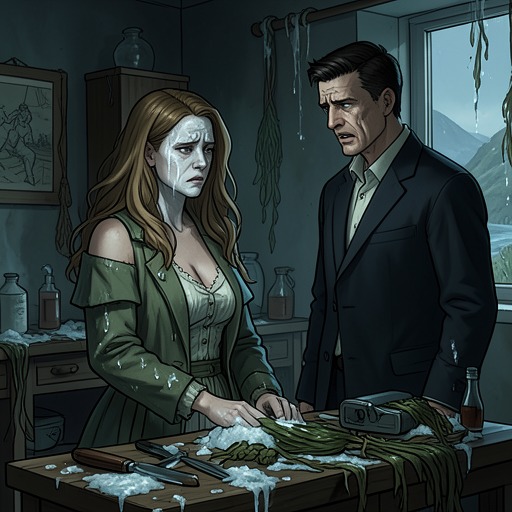
Pregnancy first appears through a sudden physical reversal. Saphira is initially capable of smiling at Ashton as he sleeps, but the smile vanishes when bile rises in her throat. She rushes to the bathroom, vomits, and remains sitting on the floor afterward, turning an ordinary domestic moment into evidence that her body is undergoing a change she does not yet understand.
Amanda provides the first interpretation of that change. Before Saphira can properly greet her, Amanda places a hand on Saphira’s stomach and says that she hears another heartbeat inside her. The discovery is immediately confirmed when Saphira looks at the pregnancy test and sees its tiny purple plus sign. Pregnancy therefore enters the narrative through two forms of knowledge at once: Amanda’s supernatural or heightened bodily perception and the material proof of the test. Saphira’s reaction is shock rather than prepared celebration, showing that motherhood arrives as a destabilizing revelation before it becomes an accepted future.
The state is also tied to Saphira’s bond with Trevor. When she tells him that she is pregnant, she explains that he cannot afford serious injury because harm to him might affect her baby. Her concern reflects the story’s unusual connection between Saphira and Trevor: danger to Trevor is experienced not only as a threat to her twin but also as a possible threat to the child she carries. The pregnancy consequently enlarges the emotional and physical consequences of violence across the family.
Pregnancy and the Prophecy Conflict
Pregnancy becomes politically significant when Amanda explains that a solar eclipse in March may coincide with a meteor shower cast down by a powerful sorcerer, an event that could provoke open conflict between the supernatural councils. Saphira objects that she is pregnant and therefore in no condition to fight or lead a war. Her body becomes the immediate argument against treating her as an available military or prophetic instrument.
Amanda answers that if Saphira and Trevor are the hybrids named in the prophecy, they will have no choice but to fight. This claim places pregnancy inside a conflict between destiny and bodily circumstance. The prophecy demands action from the very person whose pregnancy makes that action more dangerous, while the approaching war gives the pregnancy consequences beyond Saphira’s household. The child is carried through a period in which Saphira’s reproductive condition is treated as both a vulnerability and part of the future represented by the hybrid prophecy.
Trevor later insists that Saphira must not fight because she is pregnant and cannot lead an army. Saphira rejects the restriction. She argues that, as half faery, she can cast a protective charm on herself, but Trevor continues to regard combat as too risky. Their disagreement is not a simple absence of care: both are responding to the danger surrounding the pregnancy, yet they differ over whether protection should limit Saphira’s agency. Saphira finally declares that if she and Trevor are the chosen ones, she will fight whether he approves or not. Pregnancy thus becomes a direct test of her authority, rather than a condition that automatically removes her from the political and military story.
Vulnerability, Protection, and Captivity
The pregnancy repeatedly changes how Saphira moves through danger. After being struck by a poisoned arrow, a doctor tells Ashton that the arrow was coated in poison. Although that revelation concerns an immediate attack, it intensifies the larger threat surrounding Saphira’s body: she is already carrying a child when injury and poison place both her life and the pregnancy at risk. Her physical condition makes each attack carry a doubled consequence.
When Saphira and Ashton share an affectionate moment, Ashton’s hands move from her stomach to her waist, and he kisses her after telling her that he loves her. The pregnancy is present in the physical choreography of their relationship, guiding where he touches her and making care visible without removing intimacy. The scene is interrupted when Trevor arrives in distress, and Saphira’s pain at meeting his eyes recalls the bodily anguish associated with earlier family losses. Pregnancy therefore exists within a network of attachment rather than apart from it: Saphira’s love for Ashton, her connection with Trevor, and her fear of loss all converge in the pregnant body.
Saphira is also seven months pregnant before Ashton knows the sex of the child. She recognizes that withholding this information is unfair, even though he has not asked about it, and plans to tell him after returning home. At the same time, she and Trevor discuss names. These details give the pregnancy a developing domestic future, but that future remains shadowed by death: near a cemetery, Saphira says that the deceased person will never see her daughter. Her hand rests on her stomach as she speaks, joining mourning for the dead to anticipation of the child who has not yet been born.
Near the end of the pregnancy, Saphira is almost full term. She encounters a rogue in a doorway, smells that he is rogue, and steps backward while growling and attempting to shield her stomach. The gesture is instinctive and defensive, making the pregnancy the first part of herself she protects when confronted by an unknown threat. Soon afterward, she discovers that she is on an island and trapped. The only possible route home would require shifting and swimming through the surrounding water, but shifting in her condition is too risky. Pregnancy has now become a literal restriction on escape: it does not merely make captivity more frightening, but removes the physical action that might otherwise restore her freedom.
Approaching Motherhood and Aftermath
Despite danger and uncertainty, Saphira prepares for the child’s arrival. The nursery contains a crib, a large bookshelf filled with storybooks and empty picture frames, stuffed animals, and a light-red dresser. Saphira rubs her baby bump while acknowledging that the due date is only weeks away. She is ready to become a mother, even while admitting that she is not ready for restless nights and dirty diapers. The nursery converts an abstract pregnancy into a planned domestic life, while the empty frames suggest a future that has yet to be filled with family memories.
Her late-term body is increasingly cumbersome; she describes herself as being in the stage of walking like a penguin and resents it. This irritation keeps the pregnancy grounded in lived physical experience rather than presenting motherhood as an uncomplicated ideal. The same body that carries a hoped-for child produces nausea, limited mobility, fear, and practical discomfort. The narrative gives those conditions space alongside romance and prophecy.
When Ashton finds Saphira after her captivity, she moves toward him and throws herself into his arms. He embraces her carefully around her stomach, and she tells him that she missed him. His caution acknowledges the pregnancy as a continuing physical reality, while the embrace restores emotional connection after separation and danger. The child remains part of the reunion without replacing the couple’s relationship.
Years later, Saphira is shown with her six-year-old daughter, Crystal, in the kitchen. Crystal calls her mother as Saphira finishes putting chicken into the oven, and Saphira has taken cooking classes even though preparing the chicken correctly still requires effort. The scene confirms that the pregnancy reached a living future and that Saphira’s identity has expanded into everyday motherhood. Pregnancy’s final significance is therefore not limited to the conflicts it complicates: it produces Crystal, whose presence demonstrates survival beyond the prophecy’s violence and the dangers that once surrounded Saphira’s unborn child.
Narrative Significance
Pregnancy functions as both a private transformation and a contested form of power. Other characters repeatedly define what Saphira should or should not do because she is pregnant: Trevor urges her not to fight, Amanda links her condition to the prophecy, and Saphira herself insists that protection cannot erase her decision to participate. The conflict reveals that care can become restrictive when others speak for the pregnant person, while Saphira’s refusal preserves her agency without denying the genuine risks to the child.
The state also changes the story’s scale. A poisoned arrow, a rogue invasion, an island prison, and the threatened war are no longer dangers directed only at Saphira; each potentially reaches the child she carries. At the same time, the pregnancy gives the future a concrete shape through names, a nursery, a due date, and the later figure of Crystal. It binds prophecy to inheritance, violence to family responsibility, and supernatural conflict to the ordinary work of raising a child. By ending with Crystal at six years old, the narrative presents pregnancy not as a temporary plot device but as the beginning of a durable maternal identity and a continuing family line.