Ravenous pack
A Werewolf Thing: A Rejected Mate Werewolf RomanceThe Ravenous pack is an antagonistic werewolf faction whose assault on Ashton’s pack becomes one of the book’s clearest eruptions of inter-pack violence. Its hostility toward Ashton’s pack predates the attack, but the group’s sudden advance transforms that enmity into an immediate military threat. In the battle, the Ravenous pack is distinguished not only by its aggression but also by its visibly degraded appearance, making it a marked counter-image to the pack it attacks.
Identity and Appearance
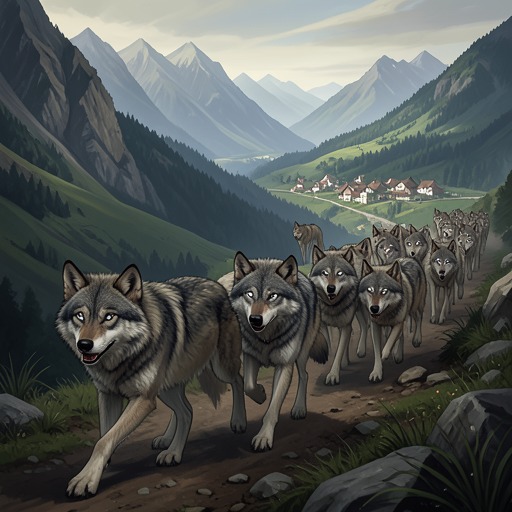
The Ravenous pack is presented as a werewolf group opposed to Ashton’s pack. Its members are recognizable in wolf form because they look dirty and sick, unlike the clean and healthy wolves on the defending side. Their most distinctive feature is their eyes: while the eyes of Ashton’s wolves retain the same color they have in human form, the eyes of the Ravenous pack are a sickly pale white regardless of their human coloration. This difference makes the conflict legible at a glance and gives the pack an almost diseased visual identity.
The contrast is more than a matter of costume or battlefield identification. The narrative repeatedly places the two groups beside one another as opposing kinds of werewolf community: one associated with health and order, the other with contamination, hostility, and bodily decline. The text does not provide a full history of how the Ravenous pack acquired this condition, so its sickly appearance remains an observable mark rather than an explained origin. That unexplained physical difference intensifies the pack’s menace while also reducing its members, in the immediate battle scene, to a threatening collective image.
Conflict with Ashton’s Pack
The Ravenous pack never liked Ashton’s pack, and its attack is therefore framed as the escalation of an established rivalry rather than an accidental encounter. Ashton announces the news that the Ravenous pack has attacked, prompting shock among the pack members and an urgent order for the warriors to prepare. Because the attackers are close, Ashton directs the defenders to intercept them in the forest before they can reach the territory itself. The response turns the pack’s home ground and surrounding forest into a defensive boundary that must be protected through organized action.
The speed of the mobilization emphasizes the structure of Ashton’s pack. Warriors rush outside, and the threat is handled collectively rather than by a single isolated fighter. The Ravenous pack’s importance consequently lies not only in its own violence but in the way it activates the opposing pack’s hierarchy, loyalty, and military readiness. Its attack compels Ashton to act publicly as a leader and forces Saphira and the other defenders into the same immediate crisis.
The Battle and Its Violence
Saphira follows Ashton toward the source of the howling and stops when she reaches the battle. The visual distinction between the two groups allows her to identify the sides even amid the fighting: Ashton’s wolves are clean and healthy, while the Ravenous wolves appear dirty and sick, with pale white eyes that separate them from their opponents. Ashton then charges into the conflict and begins fighting. Before Saphira can join the attack, another wolf leaps onto her and bites down on her neck, demonstrating that the Ravenous pack’s threat is not abstract or distant but directly capable of injuring central members of the defending group.
The consequences extend beyond the initial clash. After the battle, Saphira searches for signs of life and finds a brown werewolf whom she identifies as Simon. The discovery places Simon among the casualties or victims associated with the attack and gives the Ravenous pack’s assault a personal cost within the central relationship network. The battle thus moves from a territorial dispute to a crisis involving recognizable individuals, bodily harm, and the possible loss of an important member of the community.
Wider Species Conflict and Narrative Significance
The Ravenous pack’s attack occurs in a world already organized by antagonism among supernatural species. Banshees are described as natural foes of the other kind, and their screams can kill werewolves if exposure continues; a vampire’s arrival provokes a protective stance from Saphira and an equally defensive reaction from Simon before the revelation that the vampire is Simon’s mate. These surrounding tensions make the Ravenous pack part of a broader system in which species and factions are quickly categorized as allies, enemies, or threats. Its conflict with Ashton’s pack therefore reinforces the book’s tendency to make bodily difference and group identity central to social relations.
The attack also foreshadows the prophecy that a war between vampires and werewolves will occur on the night when the sun is black and stars cross the sky. That prophecy assigns the coming war a struggle over which race will become dominant and states that two hybrids of the same origin will lead the victorious side. The Ravenous pack’s assault is not itself the foretold species-wide war, but it supplies an earlier, concrete image of the violence that such a prophecy threatens to enlarge. Through the Ravenous pack, hostility becomes visible first as a local pack attack, then as part of a much wider crisis involving species supremacy, hybrid identity, and the unstable boundaries between communities.