Rogues
A Werewolf Thing: A Rejected Mate Werewolf RomanceRogues are a faction of rogue werewolves defined by territorial intrusion, secrecy, and opposition to the established order of the werewolf packs. They become decisive when they penetrate guarded territory, abduct the pregnant Saphira Richards, and reveal that they know she is expected to lead the werewolves in the coming conflict. Their conduct makes them more than anonymous predators: they are a coordinated power capable of bypassing defenses, manipulating the war’s conditions, and using Saphira’s body and unborn child as leverage.
Nature and Position
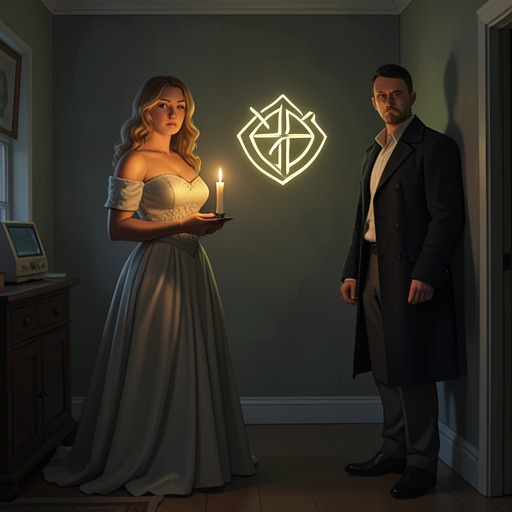
Rogues stand outside the ordinary structures of werewolf society. The narrative identifies them by their scent before their identity is known, marking them as a distinct and immediately threatening presence. When one Rogue appears at Saphira Richards’s home, he has pitch-black eyes and matching hair, and his physical presentation intensifies the scene’s sense of menace. Saphira backs away, growls, and attempts to shield her enlarged stomach, responding not only as a werewolf defending territory but also as a pregnant mother protecting her child.
Their position outside the pack system does not make them politically ignorant. On the contrary, the Rogue who confronts Saphira knows that she is the one who will lead the werewolves. He presents himself as opposed to war because he prefers the existing balance and believes that open conflict would change everything. This claim gives the Rogues an objective more complex than simple destruction: they seek to prevent a transformation of power while using coercion to control the person most closely connected to that transformation.
Infiltration and Abduction
The Rogues’ major operation is an invasion of werewolf territory. They catch the defenders off guard and successfully pass through the main guards, demonstrating both preparation and the limits of the pack’s security. The breach reaches the household of Saphira Richards and Ashton Smith, where a Rogue confronts Saphira while Ashton is absent. The open door and the sudden appearance of an unknown intruder turn domestic space into contested territory.
The intruder verbally denies an intention to harm Saphira or her baby, but his actions contradict the reassurance. He advances while Saphira is cornered, produces a cloth from behind his back, and presses it roughly over her nose and mouth. His final assurance that she will be fine does not lessen the violence of the act; it underscores the Rogues’ ability to disguise coercion as protection. Saphira is rendered helpless and taken, while the child becomes part of the threat’s strategic significance.
The abduction is therefore both physical and political. Saphira is not seized at random. The Rogue explicitly connects her pregnancy with her future leadership and frames the kidnapping as an attempt to prevent war. By targeting her before the conflict begins, the Rogues try to alter the prophecy’s possible outcome without openly fighting either the vampires or the werewolves.
Conflict with the Pack
The invasion exposes how quickly the Rogues can destabilize the werewolf community. Ashton Smith returns after the attack and discovers that Saphira is gone. He does not know which Rogues took her, but he immediately declares that he will find and kill them. His reaction turns the abduction into a personal crisis, while the wider pack leadership recognizes that an uncontrolled response could produce the war the Rogues claim to oppose.
Simon List urges the group to think the situation through because war was precisely what they had been trying to avoid. Ashton Smith rejects that restraint, arguing that the Rogues have taken what belongs to him and that he cannot simply remain inactive. The disagreement establishes two competing responses to the same attack: strategic containment and retaliatory pursuit. The Rogues thus succeed in creating conflict even before the larger vampire-werewolf war has formally begun.
Their breach also intersects with the prophecy revealed by Amanda. The prophecy states that a war between vampires and werewolves will occur on the night when the sun is black and stars cross the sky, and that two hybrids of the same origin will lead the winning side. The Rogues’ knowledge that Saphira will lead the werewolves suggests that they understand the stakes surrounding the predicted conflict. Their intervention is consequently positioned against a supernatural future that may be larger than their own faction.
Threat, Knowledge, and Narrative Significance
Rogues function as a test of the boundaries that supposedly protect werewolf society. Guards, territory, and the home all fail to keep them out. Their movement across those boundaries turns the pack from a secure political community into a vulnerable space in which enemies can appear without warning. The contrast is especially sharp because Saphira Richards is discovered in an intimate domestic setting, protecting her pregnancy, rather than on a battlefield.
The faction also complicates species-based divisions. The broader story separates werewolves, vampires, Faeries, witches, and Banshees into competing groups: Banshees are described as natural foes of the Faeries, while Simon List’s protective stance toward a vampire reveals that a cross-species mate bond can challenge inherited hostility. Against that background, the Rogues represent an internal fracture within werewolf identity itself. They are werewolves, but they do not act as loyal members of the pack; their shared species does not produce shared political allegiance.
Their importance finally rests in the tension between stated motive and chosen method. The Rogue says that he does not want a war because war would change the existing order, yet he initiates an invasion and abducts the pregnant woman believed to lead the werewolves. The narrative leaves the Rogues as an unresolved force whose intervention accelerates the crisis they claim to prevent. Their attack links territorial insecurity, reproductive vulnerability, leadership succession, and the prophecy of species dominance, making them a central mechanism through which private danger becomes collective war.