Saphira and Trevor relationship
A Werewolf Thing: A Rejected Mate Werewolf RomanceSaphira and Trevor relationship is defined by a twin bond that operates as both emotional intimacy and supernatural vulnerability. Saphira describes Trevor as her “other half”: he can detect when she is hiding distress, feels her physical pain when she is hurt, and remains connected to her beyond ordinary blood kinship. The bond is not always welcome to Saphira, who says that she hates it much of the time because it prevents either twin from concealing sadness or injury, but its intrusiveness also makes abandonment difficult. Their relationship becomes one of the story’s clearest structures of family loyalty, survival, and shared risk.
Identity and Operation
The bond first appears through Trevor’s immediate awareness of Saphira’s emotional state. When she tries to conceal the fact that her mate has rejected her, Trevor recognizes the lie and presses her to explain what happened. His knowledge is not presented as ordinary observation alone: Saphira says that whenever one twin is sad, the other knows, and that physical injury crosses the connection as pain felt by both. The relationship therefore collapses the boundary between private experience and shared experience. Saphira may refuse to speak, but she cannot make her suffering entirely solitary.
The bond also gives Trevor and Saphira a form of communication and recognition that exceeds family resemblance. Their connection is described as existing “beyond just blood,” and Trevor invokes it when the group is trying to locate Saphira after her abduction. This language matters because it frames twinship not as a passive biological fact but as an active resource: the twins can use their connection to pursue one another when ordinary searches fail.
Loyalty Under Threat
Trevor’s attachment to Saphira repeatedly becomes action. During the Banshee attack, Saphira insists that Sondra, her cousin, is family and cannot be left behind; the same principle illuminates the twin relationship more intensely. Trevor’s bond with Saphira makes her disappearance a personal emergency rather than a distant military problem. After she is taken, he tries everything in his power to find her, including an unsuccessful map-based effort that cannot penetrate the supernatural protection surrounding her location.
When ordinary methods fail, Trevor proposes a faery search ritual. He explains that faeries can perform such a ritual to search for one of their own, but that it has normally been performed only by full faeries. The ceremony drains energy and power, and if it continues too long it can cause death. Trevor’s willingness to undertake that danger shows the bond’s reciprocal logic: Saphira’s captivity threatens his own life indirectly, while his effort to recover her risks ending it directly. The relationship turns rescue into a form of kinship obligation rather than optional heroism.
Shared Mortality and Rescue
The most extreme condition of the twin bond is that if one twin dies, the other dies as well. This rule gives their relationship a literal life-and-death structure and raises the stakes of every injury, disappearance, and rescue attempt. Saphira does not fully understand the extent of the connection, but she knows this central fact: their lives are inseparable. The bond consequently differs from a merely affectionate sibling relationship. It is a supernatural condition that makes individual survival impossible without the survival of the other.
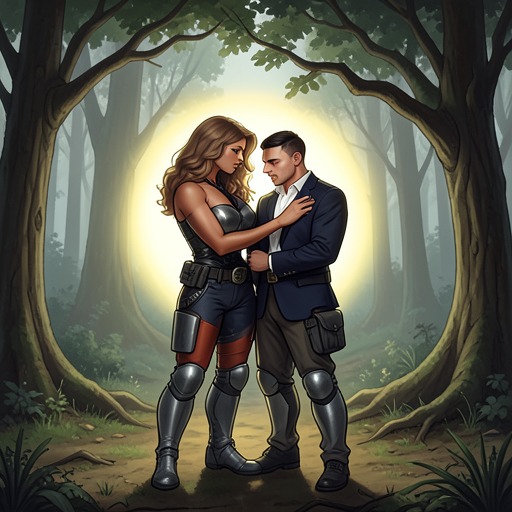
The rescue scenes make that connection visible through physical action. When Saphira is in danger, Trevor suddenly appears, throws the attacker across the room, and pulls her out before the threat can close in again. He is smiling but breathing heavily, indicating the exertion of the intervention, and he tells her to leave before Ashton suffers a heart attack. Once outside, Trevor embraces her, and Saphira returns the hug. The reunion is therefore both tactical and emotional: he has extracted her from immediate danger, then restores the bodily reassurance that their separation had denied them.
Their escape also reveals a further feature of their shared status. Trevor explains that Ashton could not enter the room because only half-breeds could do so. Saphira and Trevor’s ability to move through the protected space is thus tied to their hybrid identity, while Ashton’s exclusion marks the limit of even a mate’s access. The twins’ connection is not merely stronger than ordinary family affection; it is embedded in the supernatural rules governing who can cross particular boundaries.
Care, Conflict, and Protective Pressure
The relationship is protective without being wholly gentle or uncomplicated. Trevor questions Saphira, tracks her whereabouts, undertakes dangerous searching, and intervenes physically when she is threatened. Saphira, for her part, accepts his help while retaining her own will. When Trevor tells her that pregnancy means she cannot lead an army, she rejects the restriction, arguing that her half-faery nature allows her to cast a protective charm on herself. Their closeness therefore produces conflict over protection: Trevor interprets care as a reason to limit her battlefield role, while Saphira insists that bodily danger does not erase her agency.
This disagreement does not dissolve the bond. It shows instead that their intimacy is strong enough to contain argument, fear, and competing judgments about risk. Trevor’s concern is grounded in the life-and-death connection between them, but Saphira refuses to let that connection turn into total control over her choices. The twins remain allied even when they disagree about what survival requires.
Narrative Significance
Saphira and Trevor relationship gives the novel a counterweight to mate bonds and interspecies conflict. Saphira’s bond with Ashton is romantic and politically consequential, but Trevor’s twin bond is older in the immediate texture of the story: it is the connection that detects concealed pain, survives distance, motivates the search, and makes rescue urgent. It also broadens the meaning of family. Family includes cousins who must be recovered from Banshees, but the twins embody the most absolute version of that ethic because neither can live if the other dies.
The relationship also challenges the idea that supernatural power belongs only to formal institutions or dominant species. Trevor’s knowledge of the faery ritual, his hybrid status, and his connection with Saphira allow the twins to navigate protections that exclude others. Their bond is simultaneously a vulnerability, because injury and death are shared, and a source of power, because it creates knowledge, resolve, and access. In this double structure, the story presents kinship as costly rather than decorative: love binds the twins so tightly that it exposes them to one another’s pain, yet that same exposure becomes the force that brings Saphira home.