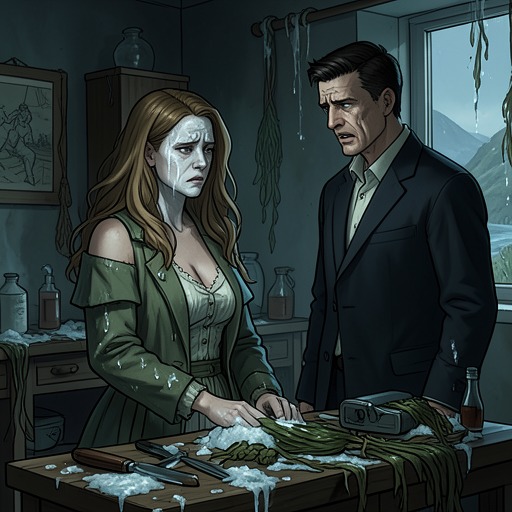
Saphira's Island Escape Attempt
A Werewolf Thing: A Rejected Mate Werewolf RomanceSaphira's Island Escape Attempt is a crucial reversal in Saphira's captivity: the unlocked doors suggest an opportunity for freedom, but the outside world reveals an island prison. Her body, already placed at risk by pregnancy, prevents the only apparent route home and turns escape into a conflict between autonomy and the protection demanded by those around her.
The Captive Setting
Saphira awakens in a storage room, a dark and improvised space illuminated only by a flickering bulb on a short cord. Water drips from the ceiling, emphasizing the room's confinement and stark physical conditions. The setting gives her no clear explanation of who holds her or why, but it establishes that she has been isolated inside an unfamiliar building rather than placed in an ordinary domestic or pack environment.
The first sign of possible escape is the door. Saphira searches for a doorknob, turns it, and finds that the door is unlocked. The discovery unsettles rather than reassures her. A second door also opens without resistance, and the repeated absence of a lock makes the apparent freedom feel suspicious. The unlocked passages create an expectation that she can leave, while the surrounding silence and uncertainty keep the danger unresolved.
Discovery of the Island
Saphira proceeds cautiously, opening the door and stepping outside while holding her breath and looking around. Sand lies beneath her feet, and a soft breeze moves across her face. She walks only a few yards before reaching the water's edge, where the waves lap against her toes. These sensory details transform the building's unexplained openness into a concrete geographical trap: she is on an island.
The discovery changes the meaning of the unlocked doors. They have not released Saphira into a route back to safety; they have allowed her to move within a prison whose true boundary is the surrounding water. Her conclusion is direct: she is trapped. The island functions as both location and mechanism of captivity, replacing visible locks with distance and the sea.
Pregnancy and the Failed Escape
Once Saphira understands the island's geography, she identifies the only possible way home. She would have to shift and swim through the water. That option is not merely difficult. Because she is pregnant, shifting poses too much of a risk, and she cannot treat her supernatural ability as an unrestricted means of escape.
This limitation connects the escape attempt to the wider conflict over Saphira's body and agency. When Trevor tells her that she must not fight because she is pregnant and cannot lead an army, Saphira rejects the conclusion that pregnancy should remove her from action. She insists that, as half færy, she can cast a protective charm and declares that she will fight if she and the others are the chosen figures of the prophecy. In the island scene, however, the danger is immediate and physical: the same pregnancy that becomes an argument about military leadership also prevents her from using the only route off the island.
The failed escape therefore produces no physical liberation, but it clarifies the stakes of Saphira's captivity. She is not simply prevented by a locked room or a guard. She is forced to weigh freedom against the life developing inside her, while the environment leaves no safe alternative. The attempt ends when she returns to the building, closes the door, and walks back down the hall to the room where she had been held.
Consequences and Later Release
The return to the room marks a temporary defeat rather than Saphira's surrender. Her attempt has tested the boundaries of captivity and revealed that the apparent openness of the building is controlled by the island's isolation. It also establishes why escape cannot be achieved by impulsive transformation or swimming: the risk to her pregnancy is decisive.
Saphira is later found by Ashton. When he approaches, she moves toward him and throws herself into his arms, while he embraces her carefully around her stomach. Their reunion reverses the emotional direction of the island sequence. The island had converted open doors into confinement; Ashton's arrival converts physical contact into reassurance and the possibility that circumstances may finally improve. The pregnancy remains visible in the careful way he holds her, linking rescue with continued bodily vulnerability rather than erasing the danger that shaped the failed escape.
Narrative Significance
As an escape plot, the episode follows a pattern of discovery, apparent opportunity, spatial revelation, and forced return. Its central reversal lies in the contrast between unlocked doors and actual freedom: Saphira can leave the room, but she cannot leave the island. The sequence also makes boundaries material. Elsewhere, territory and supernatural borders determine who can pass safely; here, sand and seawater create a boundary that Saphira can perceive but cannot safely cross.
The attempt is significant because it gives Saphira active resistance within captivity while refusing to make action costless. She investigates, opens the doors, maps the space through smell and touch, reaches the shore, and calculates the route home. Yet the decision to avoid shifting shows that her agency now operates under the demands of pregnancy. The scene thus holds two values in tension—freedom and protection—without reducing either to a simple victory. Saphira's later reunion with Ashton confirms that escape is eventually possible through rescue, but the island attempt remains the moment when she learns exactly how thoroughly she has been confined.