Simon and Amanda’s Mate Encounter
A Werewolf Thing: A Rejected Mate Werewolf RomanceSimon and Amanda’s Mate Encounter is a decisive reversal in the novel’s pattern of species conflict: Amanda, a vampire being pursued by werewolves, discovers that the third-ranking werewolf among her pursuers is her destined beloved. The scene does not erase the danger between their peoples, but it places intimate recognition inside that danger, making a cross-species bond the immediate counterforce to the hostility that organizes the surrounding world.
Causes and Background
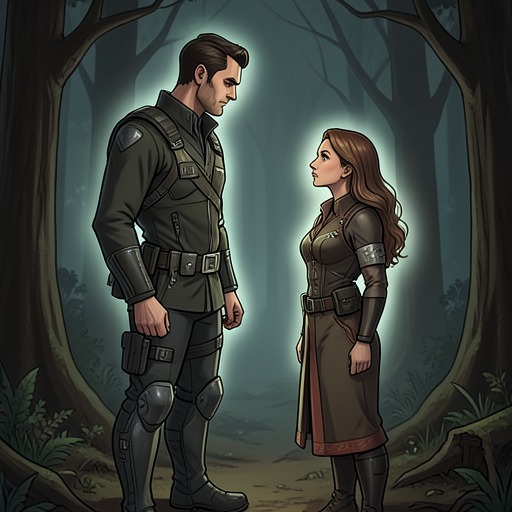
Amanda enters the encounter under immediate threat. At night, the moonlight falls through the trees while werewolves chase her, and she identifies the reason for their hostility plainly: she is a vampire, and werewolves do not generally welcome her kind. The setting therefore establishes the encounter as a flight across a species boundary rather than a peaceful meeting. Amanda is not searching for romance; she is attempting to survive pursuit while protecting the person with her.
That person is Austin, whom Amanda shelters behind her as the wolves close in. Her response is protective rather than submissive: she moves out from behind a tree with Austin concealed behind her and takes a stance between him and the approaching wolves. Her willingness to risk her own life is tied to her fear of losing her only family member, whom she describes as her light and her world. The scene consequently gives the encounter a second stake beyond Amanda’s survival: the preservation of chosen family in a world where species identity makes both outsiders vulnerable.
The Recognition in the Forest
Three werewolves confront Amanda: a beta, a third-in-command pack member, and a high-ranking member of the pack. Amanda meets each of their eyes, but her attention stops on the third. The narrative describes a sudden narrowing of perception in which everything around her seems to blur and the chosen werewolf becomes the only figure she can see. This bodily and visual interruption marks the value shift at the center of the scene: the wolf who represented danger becomes, through recognition, the person Amanda understands as her beloved.
The recognition is immediate and mutual in its narrative force, although the relationship is not yet socially settled. Amanda identifies the third werewolf as her beloved before she knows his name. He then shifts back into human form, and his clothing materializes on his body; the other two wolves follow after receiving a signal from him. The transformation changes the terms of the confrontation without making Amanda trust him automatically. Even after recognizing the bond, she remains cautious and asks who he is. He asks the same question in return, and the exchange preserves the tension between supernatural certainty and personal unfamiliarity.
Simon answers that his name is Simon. He has blonde hair and ocean-blue eyes, details that individualize the figure who had first appeared as one member of a threatening group. Amanda’s thought of him as “my werewolf” captures the contradiction produced by the encounter: the bond feels both foreign and familiar. The phrase connects private belonging to the species division that made the meeting dangerous in the first place.
From Species Hostility to Mate Conflict
The encounter’s central importance lies in its refusal to treat species categories as impermeable. Amanda remains a vampire, and Simon remains a werewolf; neither identity is dissolved by the mate bond. Instead, the relationship makes the existing hostility impossible to regard as a complete account of either character. A vampire can be pursued by werewolves and still be the beloved of one of them. The scene thus converts an abstract conflict between peoples into a personal contradiction that demands recognition.
This contradiction later becomes visible to Saphira when Simon arrives with Amanda. Saphira immediately detects that the girl is a vampire and rises into a protective stance. Simon responds in the same defensive manner, but his protection is directed toward the vampire. His darkened eyes and snarl reveal the intensity of the threat he perceives, and Saphira realizes that the vampire is Simon’s mate. The later scene confirms that the forest encounter was not a passing attraction: it has reorganized Simon’s loyalties and placed Amanda under his protection.
The relationship also gains significance from the broader social structure surrounding it. Saphira is a werewolf with a half-werewolf, half-witch heritage, while her family is drawn into faery leadership rituals and conflicts with Banshees. Simon and Amanda’s bond therefore belongs to a larger pattern in which inherited identities, supernatural institutions, and family obligations repeatedly collide. Their connection is especially disruptive because it crosses the most openly antagonistic boundary in the prophecy later revealed to the characters: a future war between vampires and werewolves, fought to determine which species will become dominant.
Consequences and Narrative Significance
The encounter foreshadows the prophecy’s larger crisis. The prophecy places the vampire–werewolf war on the night when the sun is black and stars cross the sky, and it claims that two hybrids of the same origin will lead the victorious side. Against that backdrop, Simon’s attachment to Amanda is not merely a private romance. It offers a living challenge to the logic of species supremacy, even as the coming war threatens to make such a bond politically and physically dangerous.
The event also contrasts with the relationship patterns elsewhere in the story. Ashton Smith, the rebellious son of an alpha, is associated with partying, drug use, and a succession of girlfriends before he rejects Saphira despite their mate bond. His later desire to perform the full-moon ritual depends on a formal act of acceptance and marking to restore what rejection damaged. Simon and Amanda’s encounter begins differently: it arises in a chase, crosses an established species hostility, and is marked first by recognition and protection rather than by a ritual of restoration.
Finally, the encounter expands the novel’s definition of family and allegiance. Amanda risks herself for Austin because she regards him as her only family member, while Simon’s recognition of Amanda creates another intimate obligation across enemy lines. The book repeatedly treats family as something that must be defended—even when doing so means confronting Banshees, resisting danger, or refusing to leave a relative behind. Simon and Amanda’s bond extends that principle beyond blood and pack membership: affection can create kinship where social categories prescribe enmity.