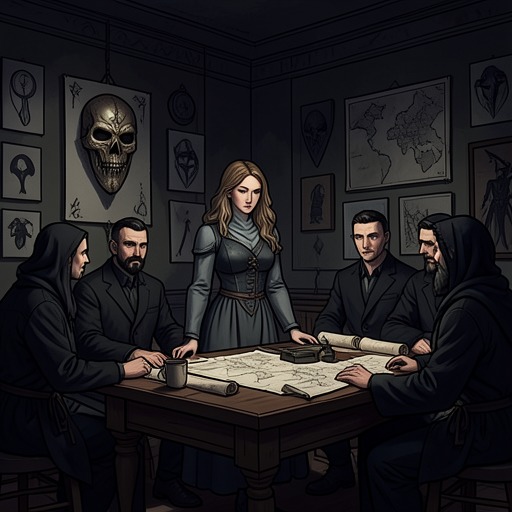
Vampire Council
A Werewolf Thing: A Rejected Mate Werewolf RomanceThe Vampire Council is the central governing institution of vampire society. It is composed of powerful elders who regulate the safety of vampires and humans within territories occupied by vampires, while enforcing the secrecy of vampire existence. The Council therefore stands at the intersection of public order, species protection, and concealment: it protects its own community, manages relations with humans, and preserves the boundary separating supernatural society from the human world.
Nature and Structure
The Council is not presented as an informal gathering but as an organized body of elders. Its members are described as exceptionally powerful and strong, possessing abilities beyond those of ordinary vampires. Their authority derives both from age and from supernatural capacity, making the Council a political institution backed by force rather than merely an advisory assembly.
The Council’s role is explicitly communal. It ensures the safety of vampires in an occupied area and also considers the safety of humans living there. This dual responsibility gives vampire governance a protective appearance, but it also makes the Council the keeper of a coercive social boundary: humans may be protected without being permitted to know that vampires exist.
Powers and Methods
The Council’s most distinctive power is its ability to erase human memories. This capacity is described as useful when the existence of vampires must remain secret, turning secrecy into an active practice rather than a passive absence of information. The Council can therefore repair breaches in its concealment through direct intervention in human minds.
That power also reveals the limits of the Council’s protection. Its concern for human safety operates alongside the right to remove human knowledge and autonomy. The same institution that preserves order can decide what humans are allowed to remember, positioning vampire secrecy as a form of governance over both supernatural and human populations.
Prophecy and Inter-Species Conflict
The Council’s political importance expands when Amanda explains the prophecy of a war between vampires and werewolves. The conflict is associated with a night on which the sun is black and stars cross the sky, and its supposed outcome is the decision of which species will become dominant. The prophecy states that two hybrids of the same origin will lead the winning side, linking the Council’s species-based politics to the identities of Saphira Richards and Trevor Richards, who are both half-werewolf and half-witch.
The predicted celestial signs are not necessarily expected to occur naturally in the immediate future. Amanda explains that a solar eclipse and meteor shower are traditionally associated with the war, while the natural event is said to be a thousand years away. The danger becomes immediate because, in March, a solar eclipse is expected and both councils are discussing the possibility that a powerful sorcerer will deliberately bring down a meteor shower that night. Under those circumstances, the distinction between prophecy and political provocation becomes unstable: a manufactured sign could persuade both species to treat the moment as a reason to fight.
The Vampire Council is thus connected to a larger institutional rivalry with the Werewolf Council. The evidence does not describe a specific Council decree or battlefield action, but it establishes that the vampire governing body participates in discussions about the possible meteor shower and the resulting war. Its administrative authority consequently exists under the pressure of an impending species conflict, in which secrecy, dominance, and prophetic interpretation may all become instruments of power.
Cross-Species Relations and Narrative Significance
The Council’s order is challenged by personal bonds that cross species boundaries. When Saphira Richards encounters Amanda, she recognizes Amanda as a vampire and immediately takes a protective stance. Simon List responds in the same way, but he protects Amanda, revealing that she is his mate. Their bond places intimate loyalty against the instinctive hostility dividing werewolves and vampires.
This tension mirrors the wider structure of the world. The Banshees and werewolves are described as natural foes, while the Vampire Council and Werewolf Council appear as rival institutions preparing for the possibility of dominance. Against these categorical divisions, mate bonds and family obligations create alternative forms of allegiance. Saphira Richards’s determination to rescue her cousin Sondra because family cannot be abandoned offers a parallel model of loyalty: identity is shaped not only by species or political membership, but also by chosen and inherited relationships.
The Council therefore functions as more than background world-building. It gives the supernatural setting a governing architecture, defines the costs of secrecy, and concentrates the ethical contradiction of a society that protects its communities through control over others. Its presence makes the prophecy politically actionable: the coming war is not only a supernatural destiny but a crisis managed, interpreted, and potentially intensified by institutions that classify beings according to species. It also sharpens the story’s challenge to species absolutism, since the most important relationships repeatedly cross the boundaries that the Councils are built to preserve.