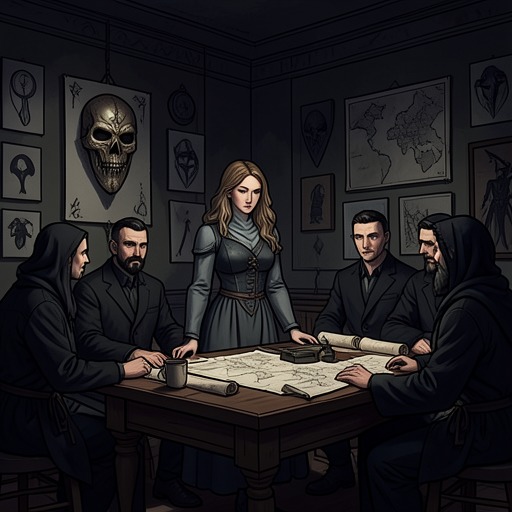
Werewolf Council
A Werewolf Thing: A Rejected Mate Werewolf RomanceThe Werewolf Council is the governing body of the Werewolves as presented in the prophecy storyline, where it appears alongside the Vampire Council as a rival authority. Its importance lies less in any depicted meeting than in the consequences of its political attention: the councils treat the predicted war between Vampires and Werewolves as a question of which race will become dominant, making supernatural identity a matter of collective power rather than only personal allegiance.
Nature and Political Position
The evidence identifies the Werewolf Council as one of two councils monitoring the prophecy and the possibility of war. The prophecy states that a conflict between Vampires and Werewolves will determine which race becomes the dominant species, placing the council within a system organized around species boundaries, rivalry, and collective survival. The text does not provide names of council members, a constitutional structure, or a clear account of how authority is exercised, so its institutional form remains largely offstage.
The council’s political position is nevertheless defined by its relationship to the Vampire Council. The two bodies share information or at least circulate discussion about the coming crisis, and their deliberations give the prophecy public significance. A conflict that might otherwise remain a distant supernatural legend becomes a matter for organized authorities capable of interpreting celestial signs and preparing their populations for war.
Prophecy and the Coming War
The council is connected to a prophecy describing a war on the night when the sun is black and stars cross the sky. That language refers to a solar eclipse and meteor shower, and the predicted conflict is said to decide which of the two species will become dominant. The prophecy further claims that two hybrids of the same origin will lead the winning side, linking the councils’ species-level struggle to the identities and potential military role of the hybrids.
The chronology becomes politically urgent because a natural solar eclipse and meteor shower are expected a thousand years in the future, but another solar eclipse is due in March. According to the discussion attributed to the councils, a powerful sorcerer may use that night to cast down a meteor shower. If the artificial event occurs, the councils are described as willing to treat it as sufficient cause for conflict even though it would not be natural. Their response shows how political belief can convert an omen into an instrument: the celestial sign need not fulfill the prophecy in its original form if leaders are prepared to use it to justify fighting.
Relation to the Hybrid Crisis
The Werewolf Council’s interest in the prophecy creates pressure around Saphira Richards and Trevor Richards. Amanda explains that the two hybrids may be the figures named in the prophecy, which would make them more than unusual individuals; they could become the leaders whose actions determine the outcome of the species war. The council therefore stands behind an expanding chain of consequences in which ancestry, bodily identity, and political destiny become inseparable.
Saphira Richards is pregnant and argues that she is not physically prepared to fight or lead an army. Trevor Richards likewise insists that she must not fight because pregnancy makes military leadership too dangerous. Saphira Richards rejects that restriction, declaring that if she and Trevor Richards are the chosen hybrids, she will fight regardless. The council is not shown directly imposing this expectation, but the prophecy associated with its discussions supplies the external authority that turns a private pregnancy into a question of succession, warfare, and collective obligation.
Institutional Limits and Narrative Significance
The Werewolf Council remains a largely unseen institution. Its presence is conveyed through references to what the councils are discussing rather than through a fully dramatized council chamber, named officials, or explicit decrees. This indirect presentation gives the organization a broad political reach without establishing its precise mechanisms. It functions as a distant force whose deliberations shape the characters’ understanding of danger before the council itself becomes a visible participant.
Its narrative role is to enlarge the scale of the story. The personal relationships, family loyalties, pregnancies, and hybrid identities of Saphira Richards and Trevor Richards are placed against an institutional conflict involving the entire Werewolf and Vampire populations. The council also demonstrates how species categories are politically produced: Werewolves and Vampires are treated as opposing collective races, while hybrids occupy an unstable position that may either threaten those divisions or become the means by which one side prevails. Through the Werewolf Council, prophecy becomes policy, rivalry becomes war planning, and the private choices of a small group acquire consequences for an entire supernatural society.