Werewolf-faerie hybrid status
A Werewolf Thing: A Rejected Mate Werewolf RomanceWerewolf-faerie hybrid status is the central identity shared by Saphira and Trevor, whose bodies and inheritance cross the boundary between werewolf and faery. What begins as a long-silenced family fact becomes the condition that may make them the two hybrids named in a war prophecy, binding private ancestry to public leadership, pregnancy, succession, and the threatened balance among supernatural species.
Definition and Family Origin
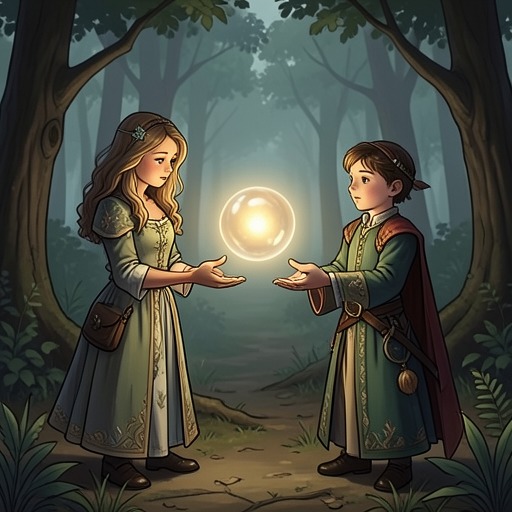
Werewolf-faerie hybrid status means that Saphira and Trevor are each half werewolf and half faery. Saphira reveals this identity only after speaking about their powers for the first time since their mother’s death. The disclosure also establishes the family’s political background: their mother had been the leader of the witches, while her estranged sister assumed that position after her death. Their hybrid nature is therefore connected not only to unusual abilities but also to disrupted authority and an inheritance that the family has avoided discussing.
The revelation is intimate rather than ceremonial. Saphira recognizes that she and Trevor have finally spoken openly about their powers, while Trevor appears to have been waiting for her to do so. Their joking threats to transform one another into a lizard or turn the other’s legs to jelly give the disclosure a sibling’s playful surface, but the exchange marks a deeper change: a concealed origin becomes shared knowledge between the twins. Their hybrid status is not introduced as an abstract classification; it emerges through grief, silence, mutual recognition, and the recovery of a family language.
Political and Ritual Consequences
The status carries a formal obligation within the Færy Clan. Saphira and Trevor are summoned by their grandfather and told that they must perform the Færy ritual. They had been expected to lead their people once they reached eighteen, but their mother’s departure changed the succession plan. The ritual consequently functions as more than a family tradition. It is a mechanism through which their mixed origin may be converted into recognized leadership, making their bodies and ancestry part of a collective political future.
Their identity also places them near the boundaries separating supernatural peoples. Saphira’s heightened reflexes allow her to evade capture when a werewolf from an unfamiliar pack tries to take her into custody for being on its territory. Her faery and werewolf capacities operate together in moments of danger, even though the narrative does not reduce her to a single power set. Elsewhere, the Banshees’ territorial advantage demonstrates how species boundaries govern survival: a faery cannot safely cross into Banshee territory because the Banshees’ shrieks can defeat her kind, while a Banshee can cross boundaries more easily. Hybrid status therefore exists within a world that treats species as politically and physically consequential categories.
The Hybrid Prophecy
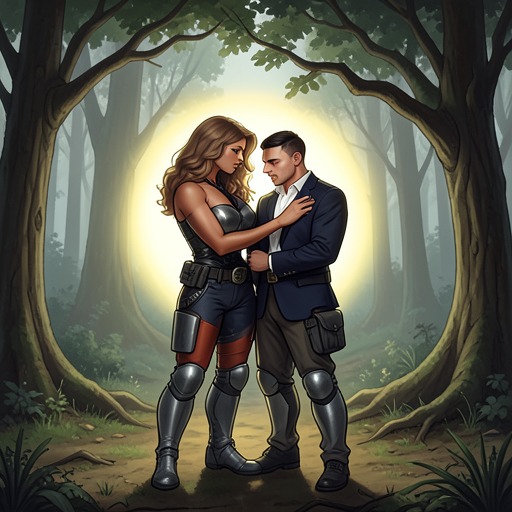
The most far-reaching meaning of the status appears when Amanda explains the prophecy. It foretells a war between vampires and werewolves on a night when the sun is black and stars cross the sky, with the conflict determining which race will become dominant. The prophecy further states that two hybrids of the same origin will lead the winning side. Saphira initially questions whether she and Trevor can qualify, since she associates the word hybrid with a being that is half werewolf and half vampire. Amanda gives the broader definition: a hybrid is a being of two origins, and Saphira and Trevor meet that description as half werewolf and half faery.
The prophecy’s astronomical signs are tied to a possible political act rather than necessarily to nature alone. Amanda says that a solar eclipse and meteor shower are expected in March, and that councils on both sides believe a powerful sorcerer may choose that night to cast down the meteors. Whether natural or manufactured, the event would be enough to provoke a fight. The twins’ mixed lineage thus becomes legible as destiny only through a convergence of bloodline, supernatural interpretation, council politics, and an approaching celestial crisis.
Pregnancy, Agency, and Leadership
Saphira’s pregnancy transforms the practical stakes of her hybrid identity. When she tells Trevor that she is pregnant, she explains that neither of them can afford serious injury because harm to him might affect her baby. Later, Trevor argues that she must not fight because pregnancy prevents her from leading an army. His concern frames protection as a restriction: the same body that may be required by prophecy to command is also treated as too vulnerable to enter the conflict.
Saphira rejects that conclusion. She proposes using her faery heritage to cast a protective charm, but Trevor still considers combat too risky. She insists that if they are the chosen hybrids, she will fight whether he approves or not. Her response preserves the prophetic burden while reclaiming the decision as her own. Hybrid status does not erase bodily vulnerability, but neither does pregnancy erase her political agency. The argument exposes the tension between being protected as a pregnant person and being recognized as a prospective leader.
Identity, Family, and Narrative Significance
The hybrid designation joins several forms of belonging that the surrounding world tends to separate: werewolf blood, faery origin, family succession, and the possibility of leadership over a war involving vampires and werewolves. Saphira’s encounters with species-based danger make those divisions concrete, while the prophecy turns mixed identity into a possible source of power rather than merely a violation of categories. At the same time, the prophecy risks converting the twins into instruments of a larger racial struggle, asking them to bear consequences determined by councils and supernatural factions.
The status also continues into family life rather than ending with the prophecy. Years later, Saphira is shown as the mother of six-year-old Crystal, placing the hybrid lineage within an ordinary domestic scene in which she cooks chicken and answers her daughter affectionately. That later image contrasts with the earlier storage room, territorial pursuit, prophetic war, and arguments over whether a pregnant woman can fight. The hybrid identity remains historically decisive, but it is also carried into parenthood and everyday kinship, where its significance is no longer only military or ceremonial.
Ultimately, Werewolf-faerie hybrid status is both an origin and a threshold. It explains why Saphira and Trevor can be claimed by the Færy Clan’s succession, why Amanda identifies them as possible prophetic leaders, and why their private choices acquire consequences for several supernatural peoples. The narrative presents hybridity as a condition of danger and possibility at once: it makes the twins vulnerable to classification, obligation, and war, yet gives them a position from which inherited boundaries can be crossed and reimagined.